

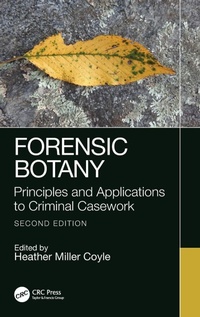
Forensic Botany
Principles and Applications to Criminal Casework
2nd Edition
Published on 26. August 2024
Book
Hardback
308 pages
978-1-4398-6674-0 (ISBN)
Description
Forensic Botany: Principles and Applications to Criminal Casework, Second Edition updates what, at the time, was the very first book published on the subject. This latest edition offers a concise introduction to plant identification, biology, genetics, and how to utilize and apply botanical evidence in criminal cases.
In recent years, forensic botany and the use of various plant and plant-derived evidence have been increasingly utilized in criminal investigations and court cases. Likewise, forensic palynology and other such terms have entered the vernacular as botanical sciences have widened the applications in which such evidence can help solve cases. This includes the use of current and emergent genetic markers and DNA technology, toxicology, diatoms, and pollen. The numerous advances since the last edition was published necessitated added coverage of the technology and testing capabilities that have achieved new levels as the field has developed.
The chapters are written by some of the top experts in the field. Every chapter in the Second Edition is fully updated, with several new chapters focusing on Random Amplified Polymorphic DNA (RAPD), Restriction Fragment Length Polymorphism (RFLP), and Amplified Fragment Length Polymorphism (AFLP), plant-derived toxins and forensic toxicology, identifying ancient plants used in burial practices for dating sites, digested plants as evidence, and more.
Forensic Botany, Second Edition provides scientists working with DNA, trace evidence, and botanical evidence-as well as investigators and legal professionals-with a thorough understanding of the latest advances and current capabilities in utilizing such evidence in investigating and adjudicating criminal cases.
In recent years, forensic botany and the use of various plant and plant-derived evidence have been increasingly utilized in criminal investigations and court cases. Likewise, forensic palynology and other such terms have entered the vernacular as botanical sciences have widened the applications in which such evidence can help solve cases. This includes the use of current and emergent genetic markers and DNA technology, toxicology, diatoms, and pollen. The numerous advances since the last edition was published necessitated added coverage of the technology and testing capabilities that have achieved new levels as the field has developed.
The chapters are written by some of the top experts in the field. Every chapter in the Second Edition is fully updated, with several new chapters focusing on Random Amplified Polymorphic DNA (RAPD), Restriction Fragment Length Polymorphism (RFLP), and Amplified Fragment Length Polymorphism (AFLP), plant-derived toxins and forensic toxicology, identifying ancient plants used in burial practices for dating sites, digested plants as evidence, and more.
Forensic Botany, Second Edition provides scientists working with DNA, trace evidence, and botanical evidence-as well as investigators and legal professionals-with a thorough understanding of the latest advances and current capabilities in utilizing such evidence in investigating and adjudicating criminal cases.
More details
Edition
2nd edition
Language
English
Place of publication
Bosa Roca
United States
Publishing group
Taylor & Francis Inc
Target group
Professional and scholarly
Academic and Professional Practice & Development
Illustrations
48 farbige Abbildungen, 10 s/w Photographien bzw. Rasterbilder, 41 Farbfotos bzw. farbige Rasterbilder, 27 s/w Zeichnungen, 7 farbige Zeichnungen, 20 s/w Tabellen, 37 s/w Abbildungen
20 Tables, black and white; 7 Line drawings, color; 27 Line drawings, black and white; 41 Halftones, color; 10 Halftones, black and white; 48 Illustrations, color; 37 Illustrations, black and white
Dimensions
Height: 240 mm
Width: 161 mm
Thickness: 22 mm
Weight
661 gr
ISBN-13
978-1-4398-6674-0 (9781439866740)
Copyright in bibliographic data and cover images is held by Nielsen Book Services Limited or by the publishers or by their respective licensors: all rights reserved.
Schweitzer Classification
Other editions
Additional editions
E-Book
08/2024
2nd Edition
CRC Press
€85.99
Available for download
E-Book
08/2024
2nd Edition
CRC Press
€85.99
Available for download
Previous edition
Book
09/2004
1st Edition
CRC Press
€198.08
Article exhausted; check for reprint
Person
Heather Miller Coyle is Associate Professor of Forensic Science at University of New Haven.
Content
1. Introduction to Forensic Botany. 2. Basic Plant Biology. 3. Plant Cell Structure and Function. 4. Modes of Plant Reproduction. 5. Plant Diversity. 6. The Use of Biological and Botanical Evidence in Criminal Investigations. 7. Uses of Plant Anatomy, Taxonomy, and Ecology in Forensic Investigations. 8. Forensic Botany Cases. 9. Uses of Plants in Burial Practices. 10. Forensic Palynology. 11. Use of Diatoms and Pollen for Seasonal Calendar. 12. Plant Poisons and Toxicology. 13. Illegal Trafficking of Wood. 14. DNA Structure and Function. 15. An Overview of Historical Developments in Forensic DNA Analysis. 16. Classical and Future DNA Typing Technologies for Plants. 17. Plant Identification by DNA. 18. Wooden Stick Matches as Forensic Evidence. 19. Legal Considerations for Acceptance of New Forensic Methods in Court.