

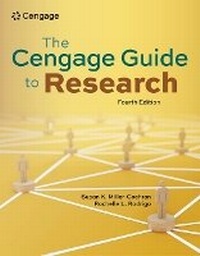
Cengage Guide to Research
4th Edition
Will be published approx. on 1. January 2026
Book
Paperback/Softback
448 pages
979-8-214-14419-1 (ISBN)
Description
Develop the research skills you need for success in academic, career and everyday situations with Miller-Cochran/Rodrigo's "Cengage Guide to Research" 4th Edition. Recognizing that technology, including generative AI, is a part of your daily life, the authors show you how to apply the research skills you use every day (when you're buying a car or choosing a cell phone plan, for example) to academic and professional settings. Annotated student samples, research scenarios and Techno Tips show you how and why researching and key research technologies are important to success. MindTap works alongside this guide by offering interactive digital tools and resources that help you improve your research and writing skills.
More details
Edition
4th edition
Language
English
Place of publication
Belmont, CA
United States
Publishing group
Cengage Learning, Inc
Target group
College/higher education
Dimensions
Height: 230 mm
Width: 203 mm
Thickness: 17 mm
Weight
744 gr
ISBN-13
979-8-214-14419-1 (9798214144191)
Copyright in bibliographic data and cover images is held by Nielsen Book Services Limited or by the publishers or by their respective licensors: all rights reserved.
Schweitzer Classification
Persons
Susan K. Miller-Cochran, now Executive Director of General Education at The University of Arizona, helped shape the writing programs at The University of Arizona from 2015-2020 and North Carolina State University from 2007-2015. Prior to that, she was an English/ESL faculty member at Mesa Community College in Arizona. Dr. Miller-Cochran served as president of the Council of Writing Program Administrators (2015-2017). Her work focuses on the intersections of technology, second-language writing and writing program administration. A widely published and popular presenter, Dr. Miller-Cochran is also a co-author with Rochelle L. Rodrigo on the "Cengage Guide to Research" (Cengage Learning). She received both her Master of Teaching English as a Second Language (MTESL) and her Ph.D. in English, with a concentration in Rhetoric/Composition and Linguistics, from Arizona State University. In addition to being the 2024 NCTE President, Rodrigo is the Senior Director of the Writing Program; Associate Professor in the Rhetoric, Composition and the Teaching of English (RCTE) and Associate Writing Specialist (Continuing Status) in the Department of English at the University of Arizona. She researches how newer technologies better facilitate communicative interactions, specifically teaching and learning. Her scholarly work has appeared in Computers and Composition, C&C Online, Technical Communication Quarterly, Teaching English in the Two-Year College, EDUCAUSE Quarterly, Journal of Interactive Technology & Pedagogy, Enculturation? Journal for Research and Practice in College Teaching, as well as various edited collections. In 2018, she became an Adobe Education Leader; in 2014, she was awarded Old Dominion University's annual Teaching with Technology Award; in 2012, the Digital Humanities High Powered Computing Fellowship and in 2010, she became a Google Certified Teacher/Innovator.
Content
Part I: PREPARING FOR RESEARCH.
1. Research and the Rhetorical Situation.
2. Writing Processes.
3. Identifying a Topic.
DIY: Writing a Research Proposal.
Part II: CONDUCTING RESEARCH.
4. Finding Resources through Secondary Research.
5. Conducting Primary Research.
6. Rhetorically Reading, Tracking, and Evaluating Resources.
7. Understanding Plagiarism and Integrating Resources.
DIY: Writing a Review of Research.
Part III: REPORTING ON RESEARCH.
8. Developing an Argument.
9. Selecting and Integrating Evidence.
10. Sharing the Results.
DIY: Presenting Your Research Results.
Part IV: FORMATTING YOUR RESEARCH.
11. Understanding Citation Styles Rhetorically.
12. MLA Guidelines.
13. APA Guidelines.
14. CMS Guidelines.
15. CSE Guidelines.
DIY: Writing a Rhetorical Analysis of Citations.
1. Research and the Rhetorical Situation.
2. Writing Processes.
3. Identifying a Topic.
DIY: Writing a Research Proposal.
Part II: CONDUCTING RESEARCH.
4. Finding Resources through Secondary Research.
5. Conducting Primary Research.
6. Rhetorically Reading, Tracking, and Evaluating Resources.
7. Understanding Plagiarism and Integrating Resources.
DIY: Writing a Review of Research.
Part III: REPORTING ON RESEARCH.
8. Developing an Argument.
9. Selecting and Integrating Evidence.
10. Sharing the Results.
DIY: Presenting Your Research Results.
Part IV: FORMATTING YOUR RESEARCH.
11. Understanding Citation Styles Rhetorically.
12. MLA Guidelines.
13. APA Guidelines.
14. CMS Guidelines.
15. CSE Guidelines.
DIY: Writing a Rhetorical Analysis of Citations.