

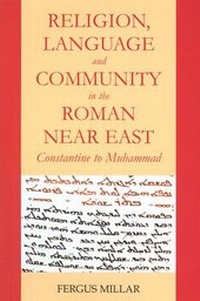
Religion, Language and Community in the Roman Near East 2010
Constantine to Muhammad
Published on 19. December 2013
Book
Hardback
150 pages
978-0-19-726557-4 (ISBN)
Description
This book explores the way in which different ethnic, religious and linguistic communities co-existed and conflicted in the Roman Near East in the three centuries between the conversion of the Emperor Constantine to Christianity in 312 and the beginning of Muhammad's preaching in about 610. In the fourth century a major role was played by Greek-speaking pagans, most notably the great orator, Libanius, from Antioch in Syria. After about 400, however, the public observance of pagan rituals died away under the pressure of Christianity. But the Greek language, as used in the Church, remained dominant.
Pagan Aramaic is curiously invisible in this period, but the dialect of Aramaic used by Jews in Palestine is found in very extensive use, along with Hebrew, in a mass of religious literature, including the Palestinian Talmud, Aramaic versions of books of the Bible, and in inscriptions from synagogues. Most of the synagogue inscriptions come from their often quite elaborate mosaic floors, some of which contain visual representations of scenes from the Bible. Jews used Greek also, even in the inscriptions from synagogues, and so too did Samaritans, who were a powerful force in Late Antique Palestine, mounting two major revolts against the Empire.
Outside Palestine, the most notable development in the culture of the region was the emergence of Syriac (a particular dialect and script of Aramaic) as a language of Christian culture and belief. 'Syrians' however were not a distinct ethnic group. The group which was most distinct from the others was made up of the unsettled and warlike peoples on the fringes of the Empire whom almost invariably, call 'Arabs', but who in Late Antiquity were far more often referred to as 'Saracens'. By the end of the period, many of them had converted to Christianity. The major puzzle which the book poses is what is the relation between this process of conversion and the rise of Islam.
Pagan Aramaic is curiously invisible in this period, but the dialect of Aramaic used by Jews in Palestine is found in very extensive use, along with Hebrew, in a mass of religious literature, including the Palestinian Talmud, Aramaic versions of books of the Bible, and in inscriptions from synagogues. Most of the synagogue inscriptions come from their often quite elaborate mosaic floors, some of which contain visual representations of scenes from the Bible. Jews used Greek also, even in the inscriptions from synagogues, and so too did Samaritans, who were a powerful force in Late Antique Palestine, mounting two major revolts against the Empire.
Outside Palestine, the most notable development in the culture of the region was the emergence of Syriac (a particular dialect and script of Aramaic) as a language of Christian culture and belief. 'Syrians' however were not a distinct ethnic group. The group which was most distinct from the others was made up of the unsettled and warlike peoples on the fringes of the Empire whom almost invariably, call 'Arabs', but who in Late Antiquity were far more often referred to as 'Saracens'. By the end of the period, many of them had converted to Christianity. The major puzzle which the book poses is what is the relation between this process of conversion and the rise of Islam.
Reviews / Votes
a consistent display of dazzling erudition. One can only wish to have been present when the lectures were delivered. * Hagith Sivan, Journal of Jewish Studies *More details
Series
Language
English
Place of publication
Oxford
United Kingdom
Target group
College/higher education
Dimensions
Height: 240 mm
Width: 164 mm
Thickness: 23 mm
Weight
468 gr
ISBN-13
978-0-19-726557-4 (9780197265574)
Copyright in bibliographic data and cover images is held by Nielsen Book Services Limited or by the publishers or by their respective licensors: all rights reserved.
Schweitzer Classification
Person
Fellow of All Souls College, Oxford, 1958-64
Fellow and Tutor in Ancient History, The Queen's College, Oxford, 1964-76
Professor of Ancient History, University College London, 1976-84
Camden Professor of Ancient History, University of Oxford, 1984-2002
Leverhulme Emeritus Fellow, 2002-4
Sather Professor of Classical Literature, University of California, Berkeley, 2002-3
Fellow of the British Academy
Fellow and Tutor in Ancient History, The Queen's College, Oxford, 1964-76
Professor of Ancient History, University College London, 1976-84
Camden Professor of Ancient History, University of Oxford, 1984-2002
Leverhulme Emeritus Fellow, 2002-4
Sather Professor of Classical Literature, University of California, Berkeley, 2002-3
Fellow of the British Academy
Content
PROLOGUE: EXCAVATING THE BIBLE
I. A GREEK CHRISTIAN WORLD?
1: Introduction: Christians and Jews in Gerasa
2: The Late Roman Near East: Time and Space
3: . Aramaic-speaking Pagans in the Christian Period?
4: A Greek World, Pagan and Christian
5: Greek Literary Culture in the Near East
6: Greek Christianity in its Local Context: Documentary Evidence
II. JEWS AND SAMARITANS IN A GREEK CHRISTIAN WORLD
1: Introduction: Greek in Palestine
2: Religious and Ethnic Communities in Palestine: Co-existence and Conflict
3: Samaritan Religion and Culture
4: Jews and Judaism in Palestine
5: The Jewish Diaspora: (a) The Mediterranean Coast and the Orontes Valley (b) From Arabia to Mesopotamia
III. SYRIANS AND SARACENS: SURYOYE AND TAYYOYE
1: Introduction: Sixth-century Divisions
2: The Background: the Third and Fourth Centuries
3: Syriac and Greek, 373-485
4: Syriac, 373-485: Inscriptions and Manuscripts
5: Syriac Writing before 485
6: The Flowering of Syriac from 485
7: Saracens or Tayyoye
EPILOGUE: CONNECTING TO MUHAMMAD?
I. A GREEK CHRISTIAN WORLD?
1: Introduction: Christians and Jews in Gerasa
2: The Late Roman Near East: Time and Space
3: . Aramaic-speaking Pagans in the Christian Period?
4: A Greek World, Pagan and Christian
5: Greek Literary Culture in the Near East
6: Greek Christianity in its Local Context: Documentary Evidence
II. JEWS AND SAMARITANS IN A GREEK CHRISTIAN WORLD
1: Introduction: Greek in Palestine
2: Religious and Ethnic Communities in Palestine: Co-existence and Conflict
3: Samaritan Religion and Culture
4: Jews and Judaism in Palestine
5: The Jewish Diaspora: (a) The Mediterranean Coast and the Orontes Valley (b) From Arabia to Mesopotamia
III. SYRIANS AND SARACENS: SURYOYE AND TAYYOYE
1: Introduction: Sixth-century Divisions
2: The Background: the Third and Fourth Centuries
3: Syriac and Greek, 373-485
4: Syriac, 373-485: Inscriptions and Manuscripts
5: Syriac Writing before 485
6: The Flowering of Syriac from 485
7: Saracens or Tayyoye
EPILOGUE: CONNECTING TO MUHAMMAD?