

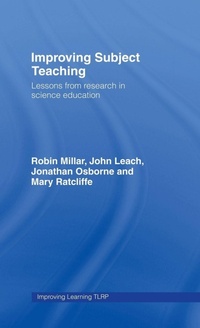
Improving Subject Teaching
Lessons from Research in Science Education
1st Edition
Published on 14. September 2006
Book
Hardback
210 pages
978-0-415-36209-2 (ISBN)
Description
In many countries, questions are being raised about the quality and value of educational research. This book explores the relationship between research and practice in education. It looks at the extent to which current practice could be said to be informed by knowledge or ideas generated by research and at the extent to which the use of current practices or the adoption of new ones are, or could be, supported by research evidence. Science education is used as a case study but the issues considered apply to the teaching and learning of any curriculum subject.
The book draws on the findings of four inter-related research studies and considers:
how research might be used to establish greater consensus about curriculum;
how research can inform the design of assessment tools and teaching interventions;
teachers' and other science educators' perceptions of the influence of research on their teaching practices and their students' learning;
the extent to which evidence can show that an educational practice 'works'.
The book draws on the findings of four inter-related research studies and considers:
how research might be used to establish greater consensus about curriculum;
how research can inform the design of assessment tools and teaching interventions;
teachers' and other science educators' perceptions of the influence of research on their teaching practices and their students' learning;
the extent to which evidence can show that an educational practice 'works'.
Reviews / Votes
'The book makes the point that new and old teaching interventions cannot be directly compared as they do not have the same objectives-and it argues against randomised clinical trials as being the best approach in the educational sector.'- Diana Battersby, Associate Tutor, Edge Hill University, Liverpool
More details
Series
Language
English
Place of publication
London
United Kingdom
Publishing group
Taylor & Francis Ltd
Target group
College/higher education
Illustrations
15 s/w Zeichnungen, 10 s/w Tabellen
10 Tables, black and white; 15 Line drawings, black and white
Dimensions
Height: 222 mm
Width: 145 mm
Thickness: 16 mm
Weight
421 gr
ISBN-13
978-0-415-36209-2 (9780415362092)
Copyright in bibliographic data and cover images is held by Nielsen Book Services Limited or by the publishers or by their respective licensors: all rights reserved.
Schweitzer Classification
Other editions
Additional editions
Robin Millar | John Leach | Jonathan Osborne
Improving Subject Teaching
Lessons from Research in Science Education
E-Book
09/2006
Routledge
€44.49
Available for download
Robin Millar | John Leach | Jonathan Osborne
Improving Subject Teaching
Lessons from Research in Science Education
E-Book
09/2006
Routledge
€44.99
Available for download
Robin Millar | John Leach | Jonathan Osborne
Improving Subject Teaching
Lessons from Research in Science Education
Book
09/2006
1st Edition
Routledge
€50.60
Shipment within 15-20 days
Persons
Robin Millar is Professor of Science Education, University of York, UK. John Leach is Professor of Science Education, University of Leeds, UK. Jonathan Osborne is Professor of Science Education, King's College London, UK. Mary Ratcliffe is Professor of Science Education, University of Southampton, UK.
Content
Part 1: What is the Issue? 1. Research and Practice in Science Education Part 2: What Does Research Tell Us? 2. Using Research to Clarify Curriculum Objectives 3. Issues in Designing Evidence-Informed Teaching 4. Drawing on Research to Focus Teaching and Monitor Progress 5. Issues in Implementing and Evaluating Evidence-Informed Teaching 6. Teaching 'Ideas-About-Science' 7. Outcome Measures - A Necessary Precondition for Evidence-Based Practice Part 3: Research into Practice 8. Practitioners' Views of Research and its Impact on Practice 9. Evidence-Based Science Education: Is it Possible, Desirable, Essential?