

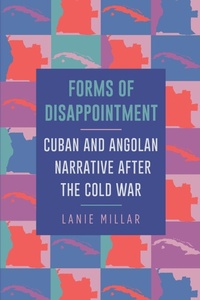
Forms of Disappointment
Cuban and Angolan Narrative after the Cold War
Published on 2. July 2020
Book
Paperback/Softback
262 pages
978-1-4384-7590-5 (ISBN)
Description
Analyzes parallel developments in post-Cold War literature and film from Cuba and Angola to trace a shared history of revolutionary enthusiasm, disappointment, and solidarity.
In Forms of Disappointment, Lanie Millar traces the legacies of anti-imperial solidarity in Cuban and Angolan novels and films after 1989. Cuba's intervention in Angola's post-independence civil war from 1976 to 1991 was its longest and most engaged internationalist project and left a profound mark on the culture of both nations. After the fall of the Berlin Wall, Millar argues, Cuban and Angolan writers and filmmakers responded to this collective history and adapted to new postsocialist realities in analogous ways, developing what she characterizes as works of disappointment. Revamping and riffing on earlier texts and forms of revolutionary enthusiasm, works of disappointment lay bare the aesthetic and political fragmentation of the public sphere while continuing to register the promise of leftist political projects. Pushing past the binaries that tend to dominate histories of the Cold War and its aftermath, Millar gives priority to the perspectives of artists in the Global South, illuminating networks of anticolonial and racial solidarity and showing how their works not only reflect shared feelings of disappointment but also call for ethical gestures of empathy and reconciliation.
In Forms of Disappointment, Lanie Millar traces the legacies of anti-imperial solidarity in Cuban and Angolan novels and films after 1989. Cuba's intervention in Angola's post-independence civil war from 1976 to 1991 was its longest and most engaged internationalist project and left a profound mark on the culture of both nations. After the fall of the Berlin Wall, Millar argues, Cuban and Angolan writers and filmmakers responded to this collective history and adapted to new postsocialist realities in analogous ways, developing what she characterizes as works of disappointment. Revamping and riffing on earlier texts and forms of revolutionary enthusiasm, works of disappointment lay bare the aesthetic and political fragmentation of the public sphere while continuing to register the promise of leftist political projects. Pushing past the binaries that tend to dominate histories of the Cold War and its aftermath, Millar gives priority to the perspectives of artists in the Global South, illuminating networks of anticolonial and racial solidarity and showing how their works not only reflect shared feelings of disappointment but also call for ethical gestures of empathy and reconciliation.
Reviews / Votes
"Forms of Disappointment offers an insightful and unique comparative analysis of a body of works produced in the post-Cold War period. By focusing on the Global South, instead of the customary north-south relationship favored by Cuba experts, the book contributes significantly to the fields of Cuban, African, and Latin American Studies; and more broadly to 'affect theory' and postcolonial studies. It is remarkably well written with elegant and clear prose." - Marta Hernandez Salvan, author of Minima Cuba: Heretical Poetics and Power in Post-Soviet CubaMore details
Series
Language
English
Place of publication
Albany, NY
United States
Target group
Professional and scholarly
US School Grade: College Graduate Student and over
Product notice
Paperback (trade)
Illustrations
2 Illustrations, black and white
Dimensions
Height: 229 mm
Width: 152 mm
Thickness: 16 mm
Weight
430 gr
ISBN-13
978-1-4384-7590-5 (9781438475905)
Copyright in bibliographic data and cover images is held by Nielsen Book Services Limited or by the publishers or by their respective licensors: all rights reserved.
Schweitzer Classification
Other editions
Additional editions
E-Book
09/2019
1st Edition
De Gruyter
from
€84.99
Available for download
Person
Lanie Millar is Assistant Professor of Spanish and Portuguese at the University of Oregon.
Content
List of Illustrations
Acknowledgments
Introduction
Part I. Allegory and Aesthetics in the Post-Revolution
1. Silence and the People in Boaventura Cardoso's Maio, Mes de Maria and Mae, Materno Mar
2. Postwar Cinematic Politics and the Structures of Disappointment
Part II. The Mobility of Form
3. The War Abroad and the War at Home: Eliseo Alberto's Caracol Beach
4. Revolution from the South in J. E. Agualusa's O Ano em que Zumbi Tomou o Rio
Part III. Genre, Style, and Empire
5. Deferred Time and Belated Histories in Leonardo Padura's El hombre que amaba a los perros
6. Post-Revolutionary Pastiche in Pepetela's Jaime Bunda Novels
Epilogue
Notes
Works Cited
Index
Acknowledgments
Introduction
Part I. Allegory and Aesthetics in the Post-Revolution
1. Silence and the People in Boaventura Cardoso's Maio, Mes de Maria and Mae, Materno Mar
2. Postwar Cinematic Politics and the Structures of Disappointment
Part II. The Mobility of Form
3. The War Abroad and the War at Home: Eliseo Alberto's Caracol Beach
4. Revolution from the South in J. E. Agualusa's O Ano em que Zumbi Tomou o Rio
Part III. Genre, Style, and Empire
5. Deferred Time and Belated Histories in Leonardo Padura's El hombre que amaba a los perros
6. Post-Revolutionary Pastiche in Pepetela's Jaime Bunda Novels
Epilogue
Notes
Works Cited
Index