

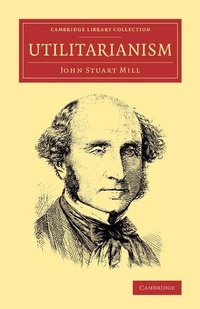
Utilitarianism
Published on 21. August 2014
Book
Paperback/Softback
108 pages
978-1-108-07793-4 (ISBN)
Description
Reissued here in its corrected second edition of 1864, this essay by John Stuart Mill (1806-73) argues for a utilitarian theory of morality. Originally printed as a series of three articles in Fraser's Magazine in 1861, the work sought to refine the 'greatest happiness' principle that had been championed by Jeremy Bentham (1748-1832), defending it from common criticisms, and offering a justification of its validity. Following Bentham, Mill holds that actions can be judged as right or wrong depending on whether they promote happiness or 'the reverse of happiness'. Although attracted by Bentham's consequentialist framework based on empirical evidence rather than intuition, Mill separates happiness into 'higher' and 'lower' pleasures, arguing for a weighted system of measurement when making and judging decisions. Dissected and debated since its first appearance, the essay is Mill's key discussion on the topic and remains a fundamental text in the study of ethics.
More details
Series
Language
English
Place of publication
Cambridge
United Kingdom
Target group
Professional and scholarly
Product notice
Paperback (trade)
Illustrations
Worked examples or Exercises
Dimensions
Height: 216 mm
Width: 140 mm
Thickness: 7 mm
Weight
148 gr
ISBN-13
978-1-108-07793-4 (9781108077934)
Copyright in bibliographic data and cover images is held by Nielsen Book Services Limited or by the publishers or by their respective licensors: all rights reserved.
Schweitzer Classification
Person
John Stuart Mill was an English philosopher, political economist, Member of Parliament (MP), and civil servant who lived from 20 May 1806 to 7 May 1873. He was one of the most significant intellectuals in the development of classical liberalism. The utilitarian movement was started by John Stuart Mill. Being a particularly bright youngster, he was able to read six Plato dialogues and Aesop's Fables by the age of eight. Jeremy Bentham and Francis Place provided guidance and support as John Stuart's father schooled him. At the age of eight, Mill started studying Latin, algebra, and Euclid classes. He liked to read Robinson Crusoe and Don Quixote in his free time. Along with his father, he studied David Ricardo and Adam Smith. He was deeply affected by the vibrant and welcoming culture of France. Mill was inspired to reject Bentham's theory of human nature by his correspondence with Auguste Comte. After 21 years of close friendship with Harriet Taylor, Mill wed her on April 21, 1851. After barely seven years of marriage and after experiencing acute lung congestion, she died in 1858. Thirteen days before his 67th birthday in 1873, Mill passed away from erysipelas in Avignon, France; he was buried next to his wife.
Content
1. General remarks; 2. What utilitarianism is; 3. Of the ultimate sanction of the principle of utility; 4. Of that sort of proof the principle of utility is susceptible; 5. Of the connexion between justice and utility.