

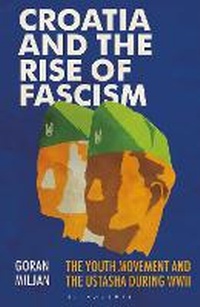
Croatia and the Rise of Fascism
The Youth Movement and the Ustasha During WWII
Published on 28. November 2019
Book
Paperback/Softback
288 pages
978-0-7556-0001-4 (ISBN)
Description
During World War II, Croatia became a fascist state under the control of the Ustasha Movement - allied with Nazi Germany and Fascist Italy. Here, Goran Miljan examines and analyzes for the first time the ideology, practices, and international connections of the Ustasha Youth organization.
The Ustasha Youth was an all-embracing fascist youth organization, established in July 1941 by the `Independent State of Croatia' with the goal of reeducating young people in the model of an ideal `new' Croat. This youth organization attempted to set in motion an all-embracing, totalitarian national revolution which in reality consisted of specific interconnected, mutually dependent practices: prosecution, oppression, mass murder, and the Holocaust - all of which were officially legalized within a month of the regime's accession to power. To this end education, sport, manual work and camping took place in specially established Ustasha Youth Schools. In order to justify their radical policies of youth reeducation, the Ustasha Youth, besides emphasizing national character and the importance of cultural and national purity, also engaged in transnational activities and exchanges, especially with the Hlinkova mladez [Hlinka Youth] of the Slovak Republic. Both youth organizations were closely modelled after the youth organizations in Nazi Germany and Fascist Italy.
This is a little studied part of the history of World War II and of Fascism, and will be essential reading for scholars of Central Europe and the Holocaust.
The Ustasha Youth was an all-embracing fascist youth organization, established in July 1941 by the `Independent State of Croatia' with the goal of reeducating young people in the model of an ideal `new' Croat. This youth organization attempted to set in motion an all-embracing, totalitarian national revolution which in reality consisted of specific interconnected, mutually dependent practices: prosecution, oppression, mass murder, and the Holocaust - all of which were officially legalized within a month of the regime's accession to power. To this end education, sport, manual work and camping took place in specially established Ustasha Youth Schools. In order to justify their radical policies of youth reeducation, the Ustasha Youth, besides emphasizing national character and the importance of cultural and national purity, also engaged in transnational activities and exchanges, especially with the Hlinkova mladez [Hlinka Youth] of the Slovak Republic. Both youth organizations were closely modelled after the youth organizations in Nazi Germany and Fascist Italy.
This is a little studied part of the history of World War II and of Fascism, and will be essential reading for scholars of Central Europe and the Holocaust.
Reviews / Votes
Excellent notes and bibliography. Summing Up: Highly recommended. Graduate students, researchers, and professionals. -- N. Greene, Wesleyan University * CHOICE * [An] archivally rich study of the Ustasa youth sections. * Europe-Asia Studies *More details
Series
Language
English
Place of publication
London
United Kingdom
Target group
College/higher education
Illustrations
15 bw illus
Dimensions
Height: 216 mm
Width: 153 mm
Weight
340 gr
ISBN-13
978-0-7556-0001-4 (9780755600014)
Copyright in bibliographic data and cover images is held by Nielsen Book Services Limited or by the publishers or by their respective licensors: all rights reserved.
Schweitzer Classification
Other editions
Additional editions
E-Book
05/2018
1st Edition
I.B. Tauris
€38.49
Available for download
E-Book
05/2018
1st Edition
I.B. Tauris
€38.49
Available for download
Person
Goran Miljan is a comparative historian and a researcher at the Hugo Valentin Centre, Uppsala University, Sweden. His research interest is in comparative history of fascism, Holocaust, and social memory in Central and South Eastern Europe. He is the author of Croatia and the Rise of Fascism: The Youth Movement and the Ustasha During WWII (I.B. Tauris, 2018) and Revolucionari i ubojice: Iz povijesti hrvatske nacionalisticke emigracije [Revolutionaries and Murderers: From the History of the Croatian Political Emigration] (with Ivica Sute). Miljan is currently heading a major research project on the aryanisation of Jewish property in Romania and the Independent State of Croatia during World War II.