

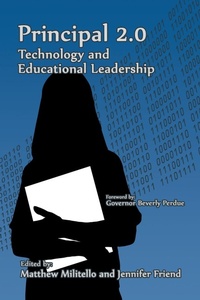
Principal 2.0
Technology and Educational Leadership
Published on 27. March 2013
Book
Paperback/Softback
300 pages
978-1-62396-301-9 (ISBN)
Description
This volume of essays provides insights into educational technology from a diverse set of vantage points. Each chapter provides school leaders with both conceptual insights and practical guides. Moreover, the authors of these insights and guides are eclectic including: current K-12 school educators and students, professors and graduate students of educational technology and educational leadership, and technology industry leaders. Our goal was to provide a thoughtful and thought-provoking set of essays that propels your own work in the world of educational technology forward.
The audience for this book includes teachers, school and district leaders, educational technologists, educational policymakers, and higher education faculty. Chapters demonstrate a number of specific uses of advanced technologies in schools, in educational leadership, and in leadership preparatory programs. Chapters are accompanied by screen-captured images and links to multimedia examples that are accessible to readers via the Internet, including digital artifacts of leadership and learning that will guide readers to implementation in diverse educational settings.
The audience for this book includes teachers, school and district leaders, educational technologists, educational policymakers, and higher education faculty. Chapters demonstrate a number of specific uses of advanced technologies in schools, in educational leadership, and in leadership preparatory programs. Chapters are accompanied by screen-captured images and links to multimedia examples that are accessible to readers via the Internet, including digital artifacts of leadership and learning that will guide readers to implementation in diverse educational settings.
More details
Language
English
Place of publication
Charlotte
United States
Publishing group
Emerald Publishing Inc
Target group
Professional and scholarly
Dimensions
Height: 234 mm
Width: 156 mm
Thickness: 16 mm
Weight
459 gr
ISBN-13
978-1-62396-301-9 (9781623963019)
Copyright in bibliographic data and cover images is held by Nielsen Book Services Limited or by the publishers or by their respective licensors: all rights reserved.
Schweitzer Classification
Other editions
Additional editions
E-Book
01/2013
1st Edition
Information Age Publishing
from
€62.33
Available for download
Persons
Matthew Militello, North Carolina State University, USA
Jennifer Friend, University of Missouri - Kansas City, USA
Jennifer Friend, University of Missouri - Kansas City, USA
Content
Foreword: Ready Set Go! with Educational Technology, Governor Beverly Perdue.
Acknowledgments.
Introduction: Making the Case for Principal 2.0, Jennifer Friend and Matthew Militello.
Part I. Perspectives on Technology and Schooling.
Chapter 1. Augmenting Educational Realities, John Militello.
Chapter 2. The Role of For-Profit Firms in the Educational Ecosystem, Michael J. Schmedlen.
Chapter 3. Generation X Meets Generation Y: Reflections on Technology and Schooling, Jennifer Friend and Alexander David Friend.
Chapter 4. Zen and the Art of Technology in Schools: Multigenerational Perspectives, Matthew Militello, Ronald Militello, Dominic Militello, Luke Militello, and Gabriel Militello.
Part II. Technology Educators Can Use Today.
Chapter 6. Digital Storytelling for Critical Reflection: An Educational Leadership Story, Francisco Guajardo, Miguel A. Guajardo, John A. Oliver, Monica M. Valadez, and Mark Cantu.
Chapter 7. Engaging Youth Voice: Collaborative Reflection to Inform School Relationships, Processes, and Practices, Christopher Janson, Sejal Parikh, Jacqueline Jones, Terrinikka Ransome, and Levertice Moses.
Chapter 8. There's an App for That: 50 Ways to Use Your iPad, April Adams and Jennifer Friend.
Chapter 9. Student-Owned Mobile Technology Use in the Classroom: An Innovation Whose Time Has Come, Tricia J. Stewart and Shawndra T. Johnson.
Chapter 10. Affective Learning Through Social Media Engagement, David Ta-Pryor and Jonathan T. Ta-Pryor.
Chapter 11. The Central Texas Community Learning Exchange Digi-Book: Fostering School and Community Engagement Through the Creation of a Digital Book, Lee Francis, IV, Monica M. Valadez, John A. Oliver, and Miguel A. Guajardo.
Chapter 12. Leaders Online: Enhancing Communication with Facebook and Twitter, John B. Nash and Dan Cox.
Part III. Sociopolitical Context for Technology in Education.
Chapter 13. Balancing Effective Technology Leadership with Legal Compliance: Legal Considerations for Principal 2.0, Justin Bathon and Kevin P. Brady.
Chapter 14. Connected Principals: In Pursuit of Social Capital via Social Media, Candice Barkley and Jonathan D. Becker.
Chapter 15. School Leaders' Perceptions of the Technology Standards, Matthew Militello and Alpay Ersozlu.
Chapter 16. Supporting Effective Technology Integration and Implementation, Scott McLeod and Jayson W. Richardson.
About the Contributors.
Acknowledgments.
Introduction: Making the Case for Principal 2.0, Jennifer Friend and Matthew Militello.
Part I. Perspectives on Technology and Schooling.
Chapter 1. Augmenting Educational Realities, John Militello.
Chapter 2. The Role of For-Profit Firms in the Educational Ecosystem, Michael J. Schmedlen.
Chapter 3. Generation X Meets Generation Y: Reflections on Technology and Schooling, Jennifer Friend and Alexander David Friend.
Chapter 4. Zen and the Art of Technology in Schools: Multigenerational Perspectives, Matthew Militello, Ronald Militello, Dominic Militello, Luke Militello, and Gabriel Militello.
Part II. Technology Educators Can Use Today.
Chapter 6. Digital Storytelling for Critical Reflection: An Educational Leadership Story, Francisco Guajardo, Miguel A. Guajardo, John A. Oliver, Monica M. Valadez, and Mark Cantu.
Chapter 7. Engaging Youth Voice: Collaborative Reflection to Inform School Relationships, Processes, and Practices, Christopher Janson, Sejal Parikh, Jacqueline Jones, Terrinikka Ransome, and Levertice Moses.
Chapter 8. There's an App for That: 50 Ways to Use Your iPad, April Adams and Jennifer Friend.
Chapter 9. Student-Owned Mobile Technology Use in the Classroom: An Innovation Whose Time Has Come, Tricia J. Stewart and Shawndra T. Johnson.
Chapter 10. Affective Learning Through Social Media Engagement, David Ta-Pryor and Jonathan T. Ta-Pryor.
Chapter 11. The Central Texas Community Learning Exchange Digi-Book: Fostering School and Community Engagement Through the Creation of a Digital Book, Lee Francis, IV, Monica M. Valadez, John A. Oliver, and Miguel A. Guajardo.
Chapter 12. Leaders Online: Enhancing Communication with Facebook and Twitter, John B. Nash and Dan Cox.
Part III. Sociopolitical Context for Technology in Education.
Chapter 13. Balancing Effective Technology Leadership with Legal Compliance: Legal Considerations for Principal 2.0, Justin Bathon and Kevin P. Brady.
Chapter 14. Connected Principals: In Pursuit of Social Capital via Social Media, Candice Barkley and Jonathan D. Becker.
Chapter 15. School Leaders' Perceptions of the Technology Standards, Matthew Militello and Alpay Ersozlu.
Chapter 16. Supporting Effective Technology Integration and Implementation, Scott McLeod and Jayson W. Richardson.
About the Contributors.