

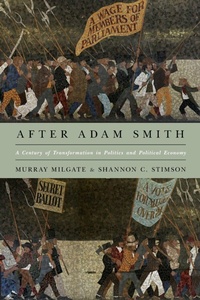
After Adam Smith
A Century of Transformation in Politics and Political Economy
Published on 16. October 2011
Book
Paperback/Softback
320 pages
978-0-691-15234-9 (ISBN)
Description
Few issues are more central to our present predicaments than the relationship between economics and politics. In the century after Adam Smith's Wealth of Nations the British economy was transformed. After Adam Smith looks at how politics and political economy were articulated and altered. It considers how grand ideas about the connections between individual liberty, free markets, and social and economic justice sometimes attributed to Smith are as much the product of gradual modifications and changes wrought by later writers. Thomas Robert Malthus, David Ricardo, James Mill, John Stuart Mill, and other liberals, radicals, and reformers had a hand in conceptual transformations that culminated in the advent of neoclassical economics.
The population problem, the declining importance of agriculture, the consequences of industrialization, the structural characteristics of civil society, the role of the state in economic affairs, and the possible limits to progress were questions that underwent significant readjustments as the thinkers who confronted them in different times and circumstances reworked the framework of ideas advanced by Smith--transforming the dialogue between politics and political economy. By the end of the nineteenth century an industrialized and globalized market economy had firmly established itself. By exploring how questions Smith had originally grappled with were recast as the economy and the principles of political economy altered during the nineteenth century, this book demonstrates that we are as much the heirs of later images of Smith as we are of Smith himself. Many writers helped shape different ways of thinking about economics and politics after Adam Smith. By ignoring their interventions we risk misreading our past--and also misusing it--when thinking about the choices at the interface of economics and politics that confront us today.
The population problem, the declining importance of agriculture, the consequences of industrialization, the structural characteristics of civil society, the role of the state in economic affairs, and the possible limits to progress were questions that underwent significant readjustments as the thinkers who confronted them in different times and circumstances reworked the framework of ideas advanced by Smith--transforming the dialogue between politics and political economy. By the end of the nineteenth century an industrialized and globalized market economy had firmly established itself. By exploring how questions Smith had originally grappled with were recast as the economy and the principles of political economy altered during the nineteenth century, this book demonstrates that we are as much the heirs of later images of Smith as we are of Smith himself. Many writers helped shape different ways of thinking about economics and politics after Adam Smith. By ignoring their interventions we risk misreading our past--and also misusing it--when thinking about the choices at the interface of economics and politics that confront us today.
Reviews / Votes
Winner of the 2011 David and Elaine Spitz Prize, International Conference for the Study of Political Thought "This is an important, sound analysis of the interrelation between political and economic theory in the century after Adam Smith... This book exemplifies the best contemporary work on the nexus of political and economic theory."--Choice "Milgate and Stimson produce a very careful and detailed analysis of early economists' ideas on issues shaping the modern concept of the political order, in the process displaying a rich array of competing ideas... [T]his book provides a striking perspective on classical political economy. The reader will benefit from some prior familiarity with Smith, Malthus, Ricardo and J. S. Mill, along with the Utilitarians."--Donald Frey, EH.net (Economic History Association) "In the last decade, scholars have moved away from the interpretation of Smith as a simple economic determinist who espoused lasissez-faire economics, and Milgate and Simpson have advanced their undertaking immensely with this book."--Donald Stabile, Australian Economic History Review "Milgate and Stimson have undertaken ... enormous scholarship in writing their book. Scholars and students of the history of economic ideas, as well as of the history of political economy and political thought in nineteenth-century Europe can benefit enormously from this book."--Farhad Rassekh, History of Economic IdeasMore details
Language
English
Place of publication
New Jersey
United States
Target group
College/higher education
Professional and scholarly
Product notice
Paperback (trade)
Dimensions
Height: 234 mm
Width: 156 mm
Thickness: 19 mm
Weight
547 gr
ISBN-13
978-0-691-15234-9 (9780691152349)
Copyright in bibliographic data and cover images is held by Nielsen Book Services Limited or by the publishers or by their respective licensors: all rights reserved.
Schweitzer Classification
Other editions
Additional editions
Murray Milgate | Shannon C. Stimson
After Adam Smith
A Century of Transformation in Politics and Political Economy
E-Book
06/2015
1st Edition
Princeton University Press
from
€126.95
Available for download
Murray Milgate | Shannon C. Stimson
After Adam Smith
A Century of Transformation in Politics and Political Economy
Book
08/2009
Princeton University Press
€52.00
Article exhausted; check different version
Persons
Murray Milgate is fellow at Queens' College, University of Cambridge. Shannon C. Stimson is professor of political science and the history of political thought at the University of California, Berkeley.
Content
Preface vii CHAPTER ONE: Introduction 1 CHAPTER TWO: Adam Smith's Political Odyssey 10 CHAPTER THREE: The Rise and Fall of Civil Society 33 CHAPTER FOUR: Economic Life and Political Life 60 CHAPTER FIVE: The Economic Machine and the Invisible Hand 77 CHAPTER SIX: The Figure of Smith 97 CHAPTER SEVEN: Population and Political Economy 121 CHAPTER EIGHT: Utility, Property, and Political Participation 139 CHAPTER NINE: Economic Opinion on Parliamentary Reform 160 CHAPTER TEN: Utopias and Stationary States 186 CHAPTER ELEVEN: Labour Defended 217 CHAPTER TWELVE: Individual Liberty and the Liberty of Trade 237 CHAPTER THIRTEEN: Two Critiques of Classical Political Economy 258 References 269 Index 299