

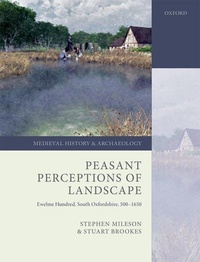
Peasant Perceptions of Landscape
Ewelme Hundred, South Oxfordshire, 500-1650
Published on 4. November 2021
Book
Hardback
384 pages
978-0-19-289489-2 (ISBN)
Description
Peasant Perceptions of Landscape marks a change in the discipline of landscape history, as well as making a major contribution to the history of everyday life. Until now, there has been no sustained analysis of how ordinary medieval and early modern people experienced and perceived their material environment and constructed their identities in relation to the places where they lived. This volume provides exactly such an analysis by examining peasant perceptions in one geographical area over the long period from AD 500 to 1650.
The study takes as its focus Ewelme hundred, a well-documented and archaeologically-rich area of lowland vale and hilly Chiltern wood-pasture comprising fourteen ancient parishes. The analysis draws on a range of sources including legal depositions and thousands of field-names and bynames preserved in largely unpublished deeds and manorial documents. Archaeology makes a major contribution, particularly for understanding the period before 900, but more generally in reconstructing the fabric of villages and the framework for inhabitants' spatial practices and experiences. In its focus on the way inhabitants interacted with the landscape in which they worked, prayed, and socialised, Peasant Perceptions of Landscape supplies a new history of the lives and attitudes of the bulk of the rural population who so seldom make their mark in traditional landscape analysis or documentary history.
The study takes as its focus Ewelme hundred, a well-documented and archaeologically-rich area of lowland vale and hilly Chiltern wood-pasture comprising fourteen ancient parishes. The analysis draws on a range of sources including legal depositions and thousands of field-names and bynames preserved in largely unpublished deeds and manorial documents. Archaeology makes a major contribution, particularly for understanding the period before 900, but more generally in reconstructing the fabric of villages and the framework for inhabitants' spatial practices and experiences. In its focus on the way inhabitants interacted with the landscape in which they worked, prayed, and socialised, Peasant Perceptions of Landscape supplies a new history of the lives and attitudes of the bulk of the rural population who so seldom make their mark in traditional landscape analysis or documentary history.
Reviews / Votes
New ways of seeing the medieval countryside are offered through a rewarding account of 20 villages in S. Oxfordshire with a focus that offers an alternative to the usual narratives of colonisation, village formation, social subjection and agricultural development. * Christopher Dyer, Emeritus Professor of Regional and Local History, University of Leicester, Medieval Archaeology * The book is well written, scholarly yet accessible, and draws on a wide-ranging academic literature from archaeology to history, and from the Dark Ages to the dawn of modernity. Mileson and Brookes have produced an admirable book...the authors' passionate interest in their subject matter, and their informed and judicious judgements, are the outstanding features. * Mark Bailey, Professor of Later Medieval History at the University of East Anglia and Chair of the Manorial Documents Advisory Panel on behalf of The National Archives., The Local Historian * The authors express the hope that the book will 'stand as a model for future research in different regions and landscapes'. They have succeeded admirably in this aim, combining painstaking research with inventive means of exploring the landscape forged by, and in turn influencing, the peasants of Ewelme hundred. * David Stone, Medieval Settlement Research 38 * Stephen Mileson and Stuart Brookes in this valuable volume seek to understand how peasant perceptions changed over the medieval and early modern periods. * Leonie V. Hicks, Speculum 99/1 * Mileson and his co-author Stuart Brookes duly delivered on this in their remarkably ambitious Peasant perceptions of landscape, a study of Ewelme hundred in Oxfordshire over more than a millennium. * Jeremy Burchardt, Historical Journal *More details
Series
Language
English
Place of publication
Oxford
United Kingdom
Target group
Professional and scholarly
Product notice
sewn/stitched
Cloth over boards
Illustrations
numerous black and white and colour figures/illustrations
Dimensions
Height: 256 mm
Width: 197 mm
Thickness: 25 mm
Weight
1034 gr
ISBN-13
978-0-19-289489-2 (9780192894892)
Copyright in bibliographic data and cover images is held by Nielsen Book Services Limited or by the publishers or by their respective licensors: all rights reserved.
Schweitzer Classification
Other editions
Additional editions
Stephen Mileson | Stuart Brookes
Peasant Perceptions of Landscape
Ewelme Hundred, South Oxfordshire, 500-1650
E-Book
11/2021
1st Edition
OUP eBook
€70.99
Available for download
Stephen Mileson | Stuart Brookes
Peasant Perceptions of Landscape
Ewelme Hundred, South Oxfordshire, 500-1650
E-Book
11/2021
1st Edition
OUP eBook
€70.99
Available for download
Persons
Stephen Mileson is a landscape historian who works for the Victoria County History of Oxfordshire. He teaches at Oxford University, and he has published widely on medieval landscapes and social history. His publications include an article in Past and Present on 'Openness and Closure in the Later Medieval Village'. Stephen is editor of the journal Oxoniensia.
Stuart Brookes is a Senior Research Associate at UCL and author of seven monographs and edited volumes, including (with John Baker) Beyond the Burghal Hidage, winner of the 2013 Verbruggen Prize in Military History. Stuart is editor of The Antiquaries Journal and Wiltshire Archaeological and Natural History Magazine.
Stuart Brookes is a Senior Research Associate at UCL and author of seven monographs and edited volumes, including (with John Baker) Beyond the Burghal Hidage, winner of the 2013 Verbruggen Prize in Military History. Stuart is editor of The Antiquaries Journal and Wiltshire Archaeological and Natural History Magazine.
Content
1: Introduction
2: Geography and Sources
3: The Early to Middle Anglo-Saxon Period, 500-800
4: The Late Anglo-Saxon Period, 800-1100
5: The High Middle Ages, 1100-1350
6: The Late Middle Ages, 1350-1530
7: The Early Modern Period, 1530-1650
8: Conclusion
Bibliography
2: Geography and Sources
3: The Early to Middle Anglo-Saxon Period, 500-800
4: The Late Anglo-Saxon Period, 800-1100
5: The High Middle Ages, 1100-1350
6: The Late Middle Ages, 1350-1530
7: The Early Modern Period, 1530-1650
8: Conclusion
Bibliography