

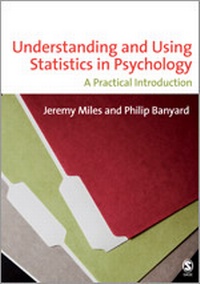
Understanding and Using Statistics in Psychology
A Practical Introduction
1st Edition
Published on 12. April 2007
Book
Hardback
368 pages
978-0-7619-4396-9 (ISBN)
Description
`There are few people who can write about research methods in a lively and engaging way, but Miles and Banyard are amongst them. As well as being an exceptionally clear introduction to research methods, it is full of amusing asides and anecdotes that make you want to read more. A hugely enjoyable book' - Dr Andy Field, University of Sussex
Understanding and Using Statistics in Psychology takes the fear out of psychological statistics to help students understand why statistics are carried out, how to choose the best test and how to carry out the tests and understand them.
Taking a non-technical approach, it encourages the reader to understand why a particular test is being used and what the results mean in the context of a psychological study, focusing on meaning and understanding rather than mindless numerical calculation.
Key features include:
- A light and accessible style
- Descriptions of the most commonly used statistical tests and the principles that underlie them
- Real world examples to aid the understanding of why statistics are valuable
- Boxes on common errors, tips and quotes
- Test yourself questions
The perfect introductory resource, Understanding and Using Statistics in Psychology will guide any student new to statistics effortlessly through the process of test selection and analysis.
Understanding and Using Statistics in Psychology takes the fear out of psychological statistics to help students understand why statistics are carried out, how to choose the best test and how to carry out the tests and understand them.
Taking a non-technical approach, it encourages the reader to understand why a particular test is being used and what the results mean in the context of a psychological study, focusing on meaning and understanding rather than mindless numerical calculation.
Key features include:
- A light and accessible style
- Descriptions of the most commonly used statistical tests and the principles that underlie them
- Real world examples to aid the understanding of why statistics are valuable
- Boxes on common errors, tips and quotes
- Test yourself questions
The perfect introductory resource, Understanding and Using Statistics in Psychology will guide any student new to statistics effortlessly through the process of test selection and analysis.
Reviews / Votes
'The book comprehensively covers all the main areas of statistical research one would expect at an undergraduate level...the subtitle for this book is How I Came To Know and Love the Standard Error. Now, whilst my feelings towards the standard error have not been considerably altered, at the very least I have been entertained and amused but above all informed by this readable book.'Deaglan Page
Psychology: Learning & Teaching
More details
Language
English
Place of publication
Thousand Oaks
United States
Target group
College/higher education
Dimensions
Height: 232 mm
Width: 186 mm
Weight
816 gr
ISBN-13
978-0-7619-4396-9 (9780761943969)
Copyright in bibliographic data and cover images is held by Nielsen Book Services Limited or by the publishers or by their respective licensors: all rights reserved.
Schweitzer Classification
Other editions
Additional editions
Jeremy Miles | Philip Banyard
Understanding and Using Statistics in Psychology
A Practical Introduction
Book
03/2007
1st Edition
SAGE Publications Inc
€113.10
Shipment within 15-20 days
Jeremy Miles | Philip Banyard
Understanding and Using Statistics in Psychology
A Practical Introduction
E-Book
03/2007
1st Edition
SAGE Publications Ltd
€80.59
Available for download
Jeremy Miles | Philip Banyard
Understanding and Using Statistics in Psychology
A Practical Introduction
E-Book
03/2007
1st Edition
SAGE Publications Ltd
from
€80.59
Available for download
Persons
Dr Phil Banyard is Emeritus Professor of Psychology at Nottingham Trent University (NTU). In his thirty years at NTU Phil Banyard taught on a range of courses but focused on introductory modules and critical thinking. His research was concerned with the impact of digital technologies on teaching and learning, especially in schools. He was a chief examiner of A Level Psychology for many years and has written more than twenty texts. Among these is an introductory text with SAGE (now in its fourth edition) that brought in over 50 members of the department at NTU. His cultural interests are largely defined by smallpeople in the family and he is currently enjoying Captain Underpants series three which he regards as riotously creative.
Content
Introduction
How To Get Started with Statistics
Descriptive Statistics
Samples, Populations and the Normal Distribution
Making Inferences
Confidence Limits and Statistical Significance
Analyzing Data from Repeated Measures Experiments
Analyzing Data from Independent Groups
Continuous Ordinal Measures
Analyzing Data from Independent Groups
Categorical Measures
Relationships between Variables
Correlation and Regression
Introducing Analysis of Variance
Analysing Questionnaires and Measurement Instruments
Thinking Some More about Statistics
Report Writing
How To Get Started with Statistics
Descriptive Statistics
Samples, Populations and the Normal Distribution
Making Inferences
Confidence Limits and Statistical Significance
Analyzing Data from Repeated Measures Experiments
Analyzing Data from Independent Groups
Continuous Ordinal Measures
Analyzing Data from Independent Groups
Categorical Measures
Relationships between Variables
Correlation and Regression
Introducing Analysis of Variance
Analysing Questionnaires and Measurement Instruments
Thinking Some More about Statistics
Report Writing