

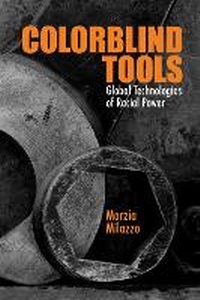
Colorblind Tools
Global Technologies of Racial Power
Published on 30. October 2022
Book
Hardback
416 pages
978-0-8101-4527-6 (ISBN)
Description
A study of anti-Blackness and white supremacy across four continents demonstrates that colorblindness is neither new nor a subtype of racist ideology, but a constitutive technology of racism
In Colorblind Tools, Marzia Milazzo offers a transnational account of anti-Blackness and white supremacy that pushes against the dominant emphasis on historical change pervading current racial theory. This emphasis on change, she contends, misses critical lessons from the past.
Bringing together a capacious archive of texts on race produced in Brazil, Cuba, Mexico, Panama, the United States, and South Africa from multiple disciplines and genres, Milazzo uncovers transnational continuities in structural racism and white supremacist discourse from the inception of colonial modernity to the present. In the process, she traces the global workings of what she calls colorblind tools: technologies and strategies that at once camouflage and reproduce white domination. Whether examining Rijno van der Riet's defense of slavery in the Cape Colony, discourses of racial mixture in Latin American eugenics and their reverberations in contemporary scholarship, the pitfalls of white "antiracism," or Chicana indigenist aesthetics, Milazzo illustrates how white people collectively disavow racism to maintain power across national boundaries, and how anti-Black and colonial logics can be reproduced even in some decolonial literatures. Milazzo's groundbreaking study proves that colorblindness is not new, nor is it a subtype of racist ideology or a hallmark of our era. It is a constitutive technology of racism-a tool the master cannot do without.
In Colorblind Tools, Marzia Milazzo offers a transnational account of anti-Blackness and white supremacy that pushes against the dominant emphasis on historical change pervading current racial theory. This emphasis on change, she contends, misses critical lessons from the past.
Bringing together a capacious archive of texts on race produced in Brazil, Cuba, Mexico, Panama, the United States, and South Africa from multiple disciplines and genres, Milazzo uncovers transnational continuities in structural racism and white supremacist discourse from the inception of colonial modernity to the present. In the process, she traces the global workings of what she calls colorblind tools: technologies and strategies that at once camouflage and reproduce white domination. Whether examining Rijno van der Riet's defense of slavery in the Cape Colony, discourses of racial mixture in Latin American eugenics and their reverberations in contemporary scholarship, the pitfalls of white "antiracism," or Chicana indigenist aesthetics, Milazzo illustrates how white people collectively disavow racism to maintain power across national boundaries, and how anti-Black and colonial logics can be reproduced even in some decolonial literatures. Milazzo's groundbreaking study proves that colorblindness is not new, nor is it a subtype of racist ideology or a hallmark of our era. It is a constitutive technology of racism-a tool the master cannot do without.
More details
Series
Language
English
Place of publication
Evanston
United States
Target group
Professional and scholarly
Dimensions
Height: 229 mm
Width: 152 mm
Weight
287 gr
ISBN-13
978-0-8101-4527-6 (9780810145276)
Copyright in bibliographic data and cover images is held by Nielsen Book Services Limited or by the publishers or by their respective licensors: all rights reserved.
Schweitzer Classification
Other editions
Additional editions
E-Book
10/2022
1st Edition
Northwestern University Press
€102.99
Available for download
Person
Marzia Milazzo is an associate professor of English at the University of Johannesburg.
Content
Introduction:The Master'sColorblind Tools
PART I: THE MAKING OF WHITE NATIONS
Chapter 1:Colorblindness and Nation Building
Chapter 2: Mestizaje and Racial Genocide
PART II: THE ONGOING RACE TO SILENCE RACE
Chapter 3: The White Mobilization Against Desegregation and Redistribution
Chapter 4:The Perils of White "Antiracism"
PART III: DECOLONIAL IMAGINARIES AND COLORBLIND LOGICS
Chapter 5: Espousing Liberal Individualism in Cubena's Works
Chapter 6: Encountering the Other in Chicana Literature
Epilogue: An Undying Colonialism
Acknowledgments
Notes
Bibliography
Index
PART I: THE MAKING OF WHITE NATIONS
Chapter 1:Colorblindness and Nation Building
Chapter 2: Mestizaje and Racial Genocide
PART II: THE ONGOING RACE TO SILENCE RACE
Chapter 3: The White Mobilization Against Desegregation and Redistribution
Chapter 4:The Perils of White "Antiracism"
PART III: DECOLONIAL IMAGINARIES AND COLORBLIND LOGICS
Chapter 5: Espousing Liberal Individualism in Cubena's Works
Chapter 6: Encountering the Other in Chicana Literature
Epilogue: An Undying Colonialism
Acknowledgments
Notes
Bibliography
Index