

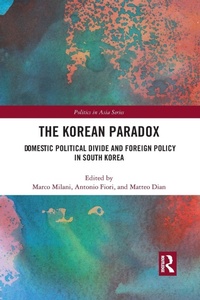
The Korean Paradox
Domestic Political Divide and Foreign Policy in South Korea
1st Edition
Published on 30. June 2021
Book
Paperback/Softback
208 pages
978-1-032-09229-4 (ISBN)
Description
Bringing together an international line up of contributors, this book examines South Korea's foreign policy strategies designed to cope with the challenges of the post-Cold War regional order and the emergence of a "Korean paradox".
Focusing on non-material factors in shaping the decision-making processes of primary actors, such as traditions, beliefs, and identities, this book begins by analysing the emergence of the "Asian Paradox" and explores how different political traditions have influenced South Korea's foreign and security policies. In the second part (from Chapter 4), this book goes on to deal directly with the key issues in South Korea's foreign policy today, with an emphasis on the progressive and conservative approaches to the challenges the country faces. This includes the North Korean threat, the alliance with the U.S., relations with China and Russia, the complicated relationship with Japan, and the emerging role of South Korea outside of Northeast Asia.
An innovative study of the domestic sources of South Korean foreign policy, The Korean Paradox investigates South Korea's growing role at both regional and global levels. As such, it will be useful to students and scholars of Korean Studies, International Relations and East Asian Studies more generally.
Focusing on non-material factors in shaping the decision-making processes of primary actors, such as traditions, beliefs, and identities, this book begins by analysing the emergence of the "Asian Paradox" and explores how different political traditions have influenced South Korea's foreign and security policies. In the second part (from Chapter 4), this book goes on to deal directly with the key issues in South Korea's foreign policy today, with an emphasis on the progressive and conservative approaches to the challenges the country faces. This includes the North Korean threat, the alliance with the U.S., relations with China and Russia, the complicated relationship with Japan, and the emerging role of South Korea outside of Northeast Asia.
An innovative study of the domestic sources of South Korean foreign policy, The Korean Paradox investigates South Korea's growing role at both regional and global levels. As such, it will be useful to students and scholars of Korean Studies, International Relations and East Asian Studies more generally.
More details
Series
Language
English
Place of publication
London
United Kingdom
Publishing group
Taylor & Francis Ltd
Target group
College/higher education
Postgraduate and Undergraduate
Illustrations
4 s/w Abbildungen
4 Illustrations, black and white
Dimensions
Height: 234 mm
Width: 156 mm
Thickness: 11 mm
Weight
324 gr
ISBN-13
978-1-032-09229-4 (9781032092294)
Copyright in bibliographic data and cover images is held by Nielsen Book Services Limited or by the publishers or by their respective licensors: all rights reserved.
Schweitzer Classification
Other editions
Additional editions
Marco Milani | Antonio Fiori | Matteo Dian
The Korean Paradox
Domestic Political Divide and Foreign Policy in South Korea
Book
06/2019
1st Edition
Routledge
€215.77
Shipment within 10-20 days
Marco Milani | Antonio Fiori | Matteo Dian
The Korean Paradox
Domestic Political Divide and Foreign Policy in South Korea
E-Book
05/2019
1st Edition
Routledge
€59.49
Available for download
Marco Milani | Antonio Fiori | Matteo Dian
The Korean Paradox
Domestic Political Divide and Foreign Policy in South Korea
E-Book
05/2019
1st Edition
Routledge
€59.49
Available for download
Persons
Marco Milani is a Lecturer at the School of East Asian Studies, University of Sheffield, UK. His research interests include North and South Korea's foreign policy, contemporary Korean history, and inter-Korean relations.
Antonio Fiori is Associate Professor of History and Institutions of Asia at the University of Bologna, Italy and Adjunct Professor at Korea University's International Summer Campus (Seoul). His research interests include inter-Korean relations and North Korea's domestic and foreign policy.
Matteo Dian is a Research Fellow at the Department of Political and Social Sciences of University of Bologna, Italy. His recent publications include New Regional Initiatives in China's Foreign Policy (2018, with Silvia Menegazzi).
Antonio Fiori is Associate Professor of History and Institutions of Asia at the University of Bologna, Italy and Adjunct Professor at Korea University's International Summer Campus (Seoul). His research interests include inter-Korean relations and North Korea's domestic and foreign policy.
Matteo Dian is a Research Fellow at the Department of Political and Social Sciences of University of Bologna, Italy. His recent publications include New Regional Initiatives in China's Foreign Policy (2018, with Silvia Menegazzi).
Content
1. Interpreting South Korea's foreign and security policy under the 'Asian paradox' 2. The dynamics of democratized South Korean foreign policy in the post-Cold War era 3. The impact of political alternation on South Korea's foreign policy 4. Progressive and Conservative visions of Inter-Korean relations 5. South Korea, partisan politics and the United States 6. Conservative and progressives' stance on China and impact on South Korea-China relations 7. United we stand? South Korea-China economic relations and the political (non-)divide 8. South Korea-Japan relations: the Comfort Women lens' 9. South Korea-Russia relations 10. Crossing Boundaries: South Korea's global diplomacy outside Northeast Asia 11. Conclusion