

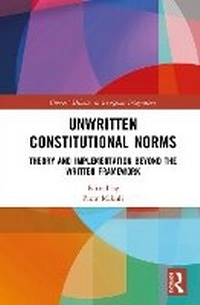
Unwritten Constitutional Norms
Theory and Implementation Beyond the Written Framework
1st Edition
Will be published approx. on 1. October 2026
Book
Hardback
330 pages
978-1-041-27632-6 (ISBN)
Description
Primarily exploring political systems outside the Anglosphere, this book conducts a theoretical and comparative analysis of unwritten constitutional norms, focusing on their role in legislative and executive functions, as well as their recognition by the judiciary.
It provides an in-depth exploration of selected contexts in which unwritten norms operate across a wide range of constitutional systems, illustrated with concrete examples of how unwritten constitutional norms are applied. The interaction between written and unwritten norms emerges throughout the book as a factor shaping not only institutional behaviour but also patterns of constitutional interpretation. Together, the chapters offer insight into the complexity of contemporary constitutions and the informal dynamics that underpin their practical operation.
This book will be of key interest to scholars and students of constitutional law, legal theory, legal philosophy, and comparative law.
It provides an in-depth exploration of selected contexts in which unwritten norms operate across a wide range of constitutional systems, illustrated with concrete examples of how unwritten constitutional norms are applied. The interaction between written and unwritten norms emerges throughout the book as a factor shaping not only institutional behaviour but also patterns of constitutional interpretation. Together, the chapters offer insight into the complexity of contemporary constitutions and the informal dynamics that underpin their practical operation.
This book will be of key interest to scholars and students of constitutional law, legal theory, legal philosophy, and comparative law.
More details
Series
Language
English
Place of publication
London
United Kingdom
Publishing group
Taylor & Francis Ltd
Target group
College/higher education
Professional and scholarly
Academic, Postgraduate, and Undergraduate Advanced
Dimensions
Height: 234 mm
Width: 156 mm
ISBN-13
978-1-041-27632-6 (9781041276326)
Copyright in bibliographic data and cover images is held by Nielsen Book Services Limited or by the publishers or by their respective licensors: all rights reserved.
Schweitzer Classification
Person
Piotr Mikuli is Full Professor of Law at the Jagiellonian University in Krakow, Poland, and the Chair of the Department of Comparative Constitutional Law.
Content
1. Introduction Part I: Theoretical and Comparative Insights 2. Unwritten constitutional rules and their potential within a written constitution's operation 3. Constitutionalism's informal turn: Some issues 4. Constitutional appropriateness, unwritten norms and the hermeneutic circle 5. Constitutional customs, conventions, and unwritten legal norms within the legislative power 6. Constitutional conventions and other unwritten norms within the executive power and systems of government 7. Unwritten constitutional norms in the EU legal order: Constitutional resilience through evolving constitutionalisation 8. Unwritten fiscal constitutions and the foundations of state budgeting Part II: Unwritten Constitutional Norms and the Constitutional Systems 9. The parliamentary dissolution in France and the United Kingdom: How constitutional practices reinforce executive domination 10. Competences, fundamental rights and parliamentary conventions in the unwritten German constitution 11. Unwritten constitutional principles and implicit normativity in Italy: A multilevel perspective 12. Debating the status of unwritten constitutional norms in Spain 13. The issue of unwritten constitutional norms related to the right to pardon in Poland 14. Constitutional conventions in Czechia 15. Unwritten constitutional norms in Hungary 16. How to amend the unwritten Romanian constitution 17. Unwritten role of constitutional law and its impact on judicial independence in Serbia 18. The intricacies of unwritten constitutional norms: Concluding thoughts