

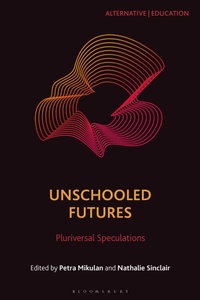
Unschooled Futures
Pluriversal Speculations
Will be published approx. on 19. March 2026
Book
Hardback
304 pages
978-1-350-52860-4 (ISBN)
Description
This volume stages a series of radical provocations that seek to reorient the very conditions under which learning becomes thinkable. Refusing the redemptive pull of schooling as a salvageable public good, the collection foregrounds the necessity of undisciplining education, dislodging it from its colonial grammars, disciplinary enclosures, and anthropocentric imaginaries.
Schools, far from neutral spaces of knowledge transmission, are infrastructural technologies of late capitalist governance: disciplining bodies, managing time, and sustaining the ongoing occupation of Indigenous lands under the guise of progress and order. Drawing from grotesque materialisms, Indigenous epistemologies, and speculative philosophies, the volume positions pluriversal indeterminacy as a generative ontological condition, contesting the closure-driven logics of Western educational taxonomy. If schools operate as entropy-displacement machines, maintaining systemic stability through the externalization of collapse, then what is required is not critique alone, but a methodological insurgency capable of abolishing education's epistemic foundations. To this end, contributors-traversing anthropology, architecture, mathematics, biology, Indigenous studies, art, philosophy, and literature-articulate a constellation of non-disciplined pedagogical experiments that emerge from the current unraveling of education itself. Through deliberate acts of epistemic undoing, authors inhabit a space where fixed categories, such as human/nonhuman, past/future, knowledge/ignorance are rendered inoperative, making room for learning that reconfigures the possible.
Schools, far from neutral spaces of knowledge transmission, are infrastructural technologies of late capitalist governance: disciplining bodies, managing time, and sustaining the ongoing occupation of Indigenous lands under the guise of progress and order. Drawing from grotesque materialisms, Indigenous epistemologies, and speculative philosophies, the volume positions pluriversal indeterminacy as a generative ontological condition, contesting the closure-driven logics of Western educational taxonomy. If schools operate as entropy-displacement machines, maintaining systemic stability through the externalization of collapse, then what is required is not critique alone, but a methodological insurgency capable of abolishing education's epistemic foundations. To this end, contributors-traversing anthropology, architecture, mathematics, biology, Indigenous studies, art, philosophy, and literature-articulate a constellation of non-disciplined pedagogical experiments that emerge from the current unraveling of education itself. Through deliberate acts of epistemic undoing, authors inhabit a space where fixed categories, such as human/nonhuman, past/future, knowledge/ignorance are rendered inoperative, making room for learning that reconfigures the possible.
Reviews / Votes
It is never enough to say, "long live the pluriverse!". The pluriverse must be made. And it must be made endlessly, collectively unschooling our practices of imagination and unmaking the modern world at every turn. Teeming with insurgent ideas and speculative propositions, this thought-provoking book opens up multiple paths. -- Martin Savransky, Reader in Social and Environmental Thought, University of Bath, UK Unschooled Futures invites readers into the "pluriverse," where learning is not a fixed path but a generative, unfinished process-one that studies with in a practice of mutual experimentation and refusal. In doing so, it invites us to linger in the unfinished, to see possibility in the mess, and to join in the ongoing work of reimagining learning otherwise. -- Marquis Bey, Professor of Black Studies and Gender & Sexuality Studies, Northwestern University, USAMore details
Series
Language
English
Place of publication
London
United Kingdom
Publishing group
Bloomsbury Publishing PLC
Target group
Professional and scholarly
Illustrations
10 bw illus
Dimensions
Height: 240 mm
Width: 161 mm
Thickness: 21 mm
Weight
622 gr
ISBN-13
978-1-350-52860-4 (9781350528604)
Copyright in bibliographic data and cover images is held by Nielsen Book Services Limited or by the publishers or by their respective licensors: all rights reserved.
Schweitzer Classification
Other editions
Additional editions
E-Book
02/2026
1st Edition
Bloomsbury Academic
€100.99
Available for download
E-Book
02/2026
1st Edition
Bloomsbury Academic
€100.99
Available for download
Persons
Petra Mikulan teaches in the Department of Educational Studies at the University of British Columbia, Canada, where she completed SSHRC and Killam funded postdoctoral fellowship.
Nathalie Sinclair is Distinguished University Professor at Simon Fraser University, Canada. She is co-author of Mathematics and the Body: Material Entanglements in the Classroom (2014).
Nathalie Sinclair is Distinguished University Professor at Simon Fraser University, Canada. She is co-author of Mathematics and the Body: Material Entanglements in the Classroom (2014).
Content
Introduction: In the Pluriverse, 'the Moon Breeds like a Rabbit' and She is Laughing, Petra Mikulan (University of British Columbia, Canada) and Nathalie Sinclair (Simon Fraser University, Canada)
Orbit I: Trading Places
Watercolour 1: Trading Places, jessie beier
1. People Get Ready: Stepping in the Same River Twice, Adam Gaudry (University of Alberta, Canada) and Matt Hern (Solid State, Canad)
2. Critical Deep Play and Pluriversal Pedagogy: Notes from a Field Research Methods Class at a Youth Baseball Program, Suzanne Scheld (California State University, USA)
3. Futures? What Futures? A Post-Anthropocene Perspective, Peter Appelbaum (Arcadia University, USA)
Orbit II: Viewing Points
Watercolour 2: Viewing Points, jessie beier
4. 11 Theses Towards an Insurgent Pedagogy, Marina Grzinic (Academy of Fine Arts Vienna, Austria)
5. Subjects as Effects of Affects: A Pedagogy of the Senses, Andrej Radman (Delft University of Technology, the Netherlands)
6. Speculative Dimensions of Learning Futures: A Rejoinder to Andrej Radman, Petra Mikulan (University of British Columbia, Canada)
7. Why Not Moose Nose, Not Bologna?, Jade Brass (University of British Columbia, Canada)
8. 'The Heart Might Be the Hardest Part to Learn': Transhuman Education in Klara and the Sun, Aparna Mishra Tarc (York University, Canada)
Orbit III: Scaling Through
Watercolour 3: Scaling Through, jessie beier
9. Education as Embassy: Pluriversal Pedagogies and Transknowledging, Tyson Yunkaporta (Deakin University, Australia) and John Davis (Deakin University, Australia)
10. Educational Un/Commoning in the Face of Climate Injustice, Petra Mikulan (University of British Columbia, Canada) and Nathalie Sinclair (Simon Fraser University, Canada)
Chapter 11: Cultivating Nepantla: A Decolonial Bridge to an Indeterminate Pluriverse, Daniel Gallardo (University of British Columbia, Canada)
Orbit IV: Breaking Stories
Watercolour 4: Breaking Stories, jessie beier
12. Re-membering, Sofia Abreu (Michigan State University, USA)
13. 'You Complete Me': A Conversation About Drawing Attention to Cooperation in Biology Education, Scott Gilbert (Swarthmore College, USA) and David Moore (Pitzer College, USA)
14. Filtered-out: Stemming the Tide with an Afrocentric Pluriversal Approach, Adam Rudder (Fairleigh Dickinson University, USA)
15. The 'Properly Aesthetic' Classroom of the Future, Ayush Mukherjee (Simon Fraser University, Canada)
A Reckoning
16. A Reckoning: Speculative Reconfigurations of Unschooled Futures Pedagogies with Terra Forma Cartographies, Kelly Paton (University of British Columbia, Canada)
Orbit I: Trading Places
Watercolour 1: Trading Places, jessie beier
1. People Get Ready: Stepping in the Same River Twice, Adam Gaudry (University of Alberta, Canada) and Matt Hern (Solid State, Canad)
2. Critical Deep Play and Pluriversal Pedagogy: Notes from a Field Research Methods Class at a Youth Baseball Program, Suzanne Scheld (California State University, USA)
3. Futures? What Futures? A Post-Anthropocene Perspective, Peter Appelbaum (Arcadia University, USA)
Orbit II: Viewing Points
Watercolour 2: Viewing Points, jessie beier
4. 11 Theses Towards an Insurgent Pedagogy, Marina Grzinic (Academy of Fine Arts Vienna, Austria)
5. Subjects as Effects of Affects: A Pedagogy of the Senses, Andrej Radman (Delft University of Technology, the Netherlands)
6. Speculative Dimensions of Learning Futures: A Rejoinder to Andrej Radman, Petra Mikulan (University of British Columbia, Canada)
7. Why Not Moose Nose, Not Bologna?, Jade Brass (University of British Columbia, Canada)
8. 'The Heart Might Be the Hardest Part to Learn': Transhuman Education in Klara and the Sun, Aparna Mishra Tarc (York University, Canada)
Orbit III: Scaling Through
Watercolour 3: Scaling Through, jessie beier
9. Education as Embassy: Pluriversal Pedagogies and Transknowledging, Tyson Yunkaporta (Deakin University, Australia) and John Davis (Deakin University, Australia)
10. Educational Un/Commoning in the Face of Climate Injustice, Petra Mikulan (University of British Columbia, Canada) and Nathalie Sinclair (Simon Fraser University, Canada)
Chapter 11: Cultivating Nepantla: A Decolonial Bridge to an Indeterminate Pluriverse, Daniel Gallardo (University of British Columbia, Canada)
Orbit IV: Breaking Stories
Watercolour 4: Breaking Stories, jessie beier
12. Re-membering, Sofia Abreu (Michigan State University, USA)
13. 'You Complete Me': A Conversation About Drawing Attention to Cooperation in Biology Education, Scott Gilbert (Swarthmore College, USA) and David Moore (Pitzer College, USA)
14. Filtered-out: Stemming the Tide with an Afrocentric Pluriversal Approach, Adam Rudder (Fairleigh Dickinson University, USA)
15. The 'Properly Aesthetic' Classroom of the Future, Ayush Mukherjee (Simon Fraser University, Canada)
A Reckoning
16. A Reckoning: Speculative Reconfigurations of Unschooled Futures Pedagogies with Terra Forma Cartographies, Kelly Paton (University of British Columbia, Canada)