

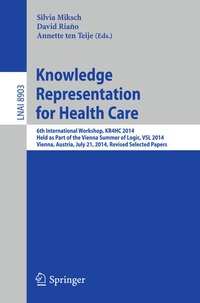
Knowledge Representation for Health Care
6th International Workshop, KR4HC 2014, held as part of the Vienna Summer of Logic, VSL 2014, Vienna, Austria, July 21, 2014. Revised Selected Papers
Published on 15. December 2014
Book
Paperback/Softback
X, 175 pages
978-3-319-13280-8 (ISBN)
Description
This book constitutes the refereed proceedings of the 6th International Workshop on Knowledge Representation for Health Care, KR4HC 2014, held as part of the Vienna Summer of Logic, VSL 2014, in Vienna, Austria, in July 2014. The workshop aimed at attracting the interest of novel research and advances contributing in the definition, representation and exploitation of health care knowledge in medical informatics. The 12 revised full research papers and 4 short papers presented in this book were carefully reviewed and selected from 26 submissions.
More details
Series
Edition
2014 ed.
Language
English
Place of publication
Cham
Switzerland
Publishing group
Springer International Publishing
Target group
Professional and scholarly
Research
Illustrations
48 s/w Abbildungen
X, 175 p. 48 illus.
Dimensions
Height: 235 mm
Width: 155 mm
Thickness: 11 mm
Weight
295 gr
ISBN-13
978-3-319-13280-8 (9783319132808)
DOI
10.1007/978-3-319-13281-5
Schweitzer Classification
Other editions
Additional editions

Silvia Miksch | David Riaño | Annette ten Teije
Knowledge Representation for Health Care
6th International Workshop, KR4HC 2014, held as part of the Vienna Summer of Logic, VSL 2014, Vienna, Austria, July 21, 2014. Revised Selected Papers
E-Book
12/2014
Springer
€42.79
Available for download
Content
Knowledge-intensive medical process similarity.- Preliminary result on finding treatments for patients with comorbidity.- Towards a conceptual model for enhancing reasoning about clinical guidelines.- Using first-order logic to represent clinical practice guidelines and to mitigate adverse interactions.- Conformance analysis of the execution of clinical guidelines with basic medical knowledge and clinical terminology.- Semantic representation of evidence-based clinical guidelines.- A meta-system for defining your own CIG system.- Architecture and acquisition.- Assessment of clinical guideline models based on metrics for business process models.- An algorithm for guideline transformation: from BPMN to PROforma.- A process-oriented methodology for modelling cancer treatment trial protocols.- Training residents in the application of clinical guidelines for differential diagnosis of the most frequent causes of arterial hypertension with decision tables.- Exploiting the relation between environmental factors and diseases: a case study on chronic obstructive pulmonary disease.Preliminary result on finding treatments for patients with comorbidity.- Towards a conceptual model for enhancing reasoning about clinical guidelines.- Using first-order logic to represent clinical practice guidelines and to mitigate adverse interactions.- Conformance analysis of the execution of clinical guidelines with basic medical knowledge and clinical terminology.- Semantic representation of evidence-based clinical guidelines.- A meta-system for defining your own CIG system.- Architecture and acquisition.- Assessment of clinical guideline models based on metrics for business process models.- An algorithm for guideline transformation: from BPMN to PROforma.- A process-oriented methodology for modelling cancer treatment trial protocols.- Training residents in the application of clinical guidelines for differential diagnosis of the most frequent causes of arterial hypertension withdecision tables.- Exploiting the relation between environmental factors and diseases: a case study on chronic obstructive pulmonary disease.