

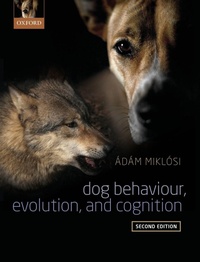
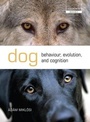
Dog Behaviour, Evolution, and Cognition
2nd Edition
Published on 11. December 2014
Book
Hardback
400 pages
978-0-19-964666-1 (ISBN)
Description
This is the first book to collate and synthesize the recent burgeoning primary research literature on dog behaviour, evolution, and cognition. The author presents a new ecological approach to the understanding of dog behaviour, demonstrating how dogs can be the subject of rigorous and productive scientific study without the need to confine them to a laboratory environment.
This second, fully updated edition of Dog Behaviour, Evolution and Cognition starts with an overview of the conceptual and methodological issues associated with the study of the dog, followed by a brief description of their role in human society. An evolutionary perspective is then introduced with a summary of current research into the process of domestication. The central part of the book is devoted to issues relating to the cognitive aspects of behaviour which have received particular attention in recent years from both psychologists and ethologists. The book's final chapters introduce the reader to many novel approaches to dog behaviour, set in the context of behavioural development and genetics. This second edition recognises and discusses the fact that dogs are increasingly being used as model organisms for studying aspects of human biology, such as genetic diseases and ageing. Specific attention is also given in this edition to attachment behaviour which emerges between humans and dogs, the importance of inter-specific communication in the success of dogs in human communities and the broad aspects of social cognition and how this may contribute to human-dog cooperation
Directions for future research are highlighted throughout the text which also incorporates links to human and primate research by drawing on homologies and analogies in both evolution and behaviour. The book will therefore be of relevance and use to anyone with an interest in behavioural ecology including graduate students of animal behaviour and cognition, as well as a more general audience of dog enthusiasts, biologists, psychologists, veterinarians, and sociologists.
This second, fully updated edition of Dog Behaviour, Evolution and Cognition starts with an overview of the conceptual and methodological issues associated with the study of the dog, followed by a brief description of their role in human society. An evolutionary perspective is then introduced with a summary of current research into the process of domestication. The central part of the book is devoted to issues relating to the cognitive aspects of behaviour which have received particular attention in recent years from both psychologists and ethologists. The book's final chapters introduce the reader to many novel approaches to dog behaviour, set in the context of behavioural development and genetics. This second edition recognises and discusses the fact that dogs are increasingly being used as model organisms for studying aspects of human biology, such as genetic diseases and ageing. Specific attention is also given in this edition to attachment behaviour which emerges between humans and dogs, the importance of inter-specific communication in the success of dogs in human communities and the broad aspects of social cognition and how this may contribute to human-dog cooperation
Directions for future research are highlighted throughout the text which also incorporates links to human and primate research by drawing on homologies and analogies in both evolution and behaviour. The book will therefore be of relevance and use to anyone with an interest in behavioural ecology including graduate students of animal behaviour and cognition, as well as a more general audience of dog enthusiasts, biologists, psychologists, veterinarians, and sociologists.
Reviews / Votes
This book combines knowledge on dog behavior, cognition, evolution and even covers some societal aspects. As such, it should find an honorable place in the bookshelves of diverse reader audiences, from researchers interested in specific questions in animal cognition to deeply interested pet owners. * Dr. Kristina Noreikiene, Estonian University of Life Sciences, ISBE Newsletter * A must read for anyone with an interest in the history and recent advances of scientific research into companion animals, from veterinarians and behavioural practitioners to students of animal cognition and behaviour. * Victoria Ratcliffe and David Reby, Animal Behaviour * This is the first book to collate and synthesize the recent burgeoning primary research literature on dog behaviour, evolution, and cognition. ... I highly recommend it for all people interested in the behavior of dogs and some of their wild relatives. ... Each time I go to it I'm amazed by its breadth and the care with which Dr. Miklosi covers numerous diverse topics. * Marc Bekoff, Psychology Today *More details
Edition
2nd Revised edition
Language
English
Place of publication
Oxford
United Kingdom
Target group
College/higher education
Edition type
Revised edition
Dimensions
Height: 260 mm
Width: 208 mm
Thickness: 26 mm
Weight
1073 gr
ISBN-13
978-0-19-964666-1 (9780199646661)
Copyright in bibliographic data and cover images is held by Nielsen Book Services Limited or by the publishers or by their respective licensors: all rights reserved.
Schweitzer Classification
Other editions
Additional editions
Adam Miklosi
Dog Behaviour, Evolution, and Cognition
Book
07/2016
2nd Edition
Oxford University Press
€73.50
Available immediately
Adam Miklosi
Dog Behaviour, Evolution, and Cognition
E-Book
12/2014
2nd Edition
OUP eBook
€53.99
Available for download
Adam Miklosi
Dog Behaviour, Evolution, and Cognition
E-Book
12/2014
2nd Edition
OUP eBook
€53.99
Available for download
Previous edition
Adam Miklosi
Dog Behaviour, Evolution, and Cognition
Book
10/2007
Oxford University Press
€74.34
Article exhausted; check for reprint
Person
Content
1. Dogs in historical perspective ; 2. Concepts in the study of dog behaviour ; 3. Methodological issues in the behavioural study of the dog ; 4. Dogs in anthropogenic environments: family and society ; 5. Comparative overview of Canis ; 6. The story of domestication: Archaeological and phylogenetic evidence ; 7. The emergence of phenotypic novelty ; 8. Intra-specific social organization in dogs and related forms ; 9. The perceptual world of the dog ; 10. Physical-ecological problem solving ; 11. Affiliative and agonistic social relationships ; 12. Communication, play and collaboration ; 13. Social learning and social problem solving ; 14. Change of behaviour in time: From birth to death ; 15. The organisation of individual behaviour ; 16. The genetic contribution to behaviour