

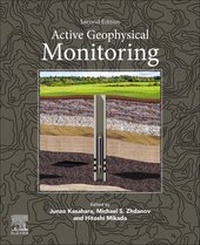
Active Geophysical Monitoring
2nd Edition
Published on 17. October 2019
Book
Paperback/Softback
646 pages
978-0-08-102684-7 (ISBN)
Description
Active Geophysical Monitoring, Second Edition, presents a key method for studying time-evolving structures and states in the tectonically active Earth's lithosphere. Based on repeated time-lapse observations and interpretation of rock-induced changes in geophysical fields periodically excited by controlled sources, active geophysical monitoring can be applied to a variety of fields in geophysics, from exploration, to seismology and disaster mitigation. This revised edition presents the results of strategic systematic development and the application of new technologies. It demonstrates the impact of active monitoring on solid Earth geophysics, also delving into key topics, such as carbon capture and storage, geodesy, and new technological tools.
This book is an essential for graduate students, researchers and practitioners across geophysics.
This book is an essential for graduate students, researchers and practitioners across geophysics.
More details
Edition
2nd edition
Language
English
Place of publication
London
United Kingdom
Publishing group
Elsevier Health Sciences
Target group
Professional and scholarly
Graduate students, researchers, and professionals in geophysics, including geodesy, seismology, disaster migration, and exploration geology
Dimensions
Height: 235 mm
Width: 191 mm
Weight
1330 gr
ISBN-13
978-0-08-102684-7 (9780081026847)
Copyright in bibliographic data and cover images is held by Nielsen Book Services Limited or by the publishers or by their respective licensors: all rights reserved.
Schweitzer Classification
Other editions
New editions
Hitoshi Mikada | Michael S. Zhdanov | Junzo Kasahara
Active Geophysical Monitoring
Book
10/2025
3rd Edition
Elsevier
€185.50
Shipment within 15-20 days
Additional editions
Hitoshi Mikada | Michael S. Zhdanov | Junzo Kasahara
Active Geophysical Monitoring
E-Book
10/2019
2nd Edition
Elsevier
€170.00
Available for download
Previous edition
Junzo Kasahara | Valeri Korneev | Michael S. Zhdanov
Active Geophysical Monitoring: Volume 40
Book
03/2010
Elsevier
€170.84
Withdrawn from sale
Persons
Hitoshi Mikada was a professor and is now an emeritus professor at Kyoto University, Japan. He received both M.S. and D.Sc. degrees in geophysics from the University of Tokyo in 1983 and 1994, respectively. He started his professional career as an interpretation engineer in the petroleum industry. In 1991, he started his academic career as a research associate at the Volcano Research Center of the Earthquake Research Institute of the University of Tokyo and as a senior scientist in the Deep-Sea Research Department of Japan Agency for Marine-Earth Science and Technology (JAMSTEC) from 1999 to 2004. In 2004, he moved to Kyoto University to become in charge of the geophysics laboratory. His main interests include research on theories and praxis in seismic scattering, wave propagation in attenuating and anisotropic media, seismic data processing,
electromagnetic exploration, geophysical logging, etc. Michael Zhdanov has been a professor at the University of Utah, Utah, United States, since 1993 and has been the director of CEMI since 1995. He
received a Ph.D. in 1970 from Moscow State University. He was a professor at the Moscow Academy of Oil and Gas and head of the Department of Deep Electromagnetic Study before moving to the University of Utah. He was awarded an Honorary Diploma of Gauss Professorship by the Goettingen Academy of Sciences, Germany, in 1990 and was elected a full member of the Russian Academy of Natural Sciences in 1991. He received an Honorary Professorship from the China National Center of Geological Exploration Technology in 1997 and an Honorary Membership Award from the Society of Exploration Geophysicists in 2013. Dr. Zhdanov was elected as a distinguished professor at the University of Utah in 2016. He has been a Fellow of the Electromagnetics Academy since 2002. Junzo Kasahara received B.S., M.S., and D.Sc. degrees in geophysics from Nagoya University in 1965, 1967, and 1970, respectively. From 1970 to
1986, and then from 1988 to 2004, he was an assistant, associate, and full professor at the University of Tokyo. He worked in marine seismology. During 1974, 1976, and 1979, he was a visiting associate professor at the University of Hawaii. In 1986, he joined Schlumberger Japan as a manager for seismic interpretation and logging tool design. During his academic work, he published three books with the University of Tokyo Press. He was awarded the title of professor emeritus at the University of Tokyo. In 2004, he joined the Tono Geoscience Center as a senior researcher, where he worked on the ACROSS project. Between 2004 and 2008, he served for the extension of the Japan Continental Shelf. Currently, he is the principal
investigator of the geothermal project and a visiting professor at the University of Shizuoka.
electromagnetic exploration, geophysical logging, etc. Michael Zhdanov has been a professor at the University of Utah, Utah, United States, since 1993 and has been the director of CEMI since 1995. He
received a Ph.D. in 1970 from Moscow State University. He was a professor at the Moscow Academy of Oil and Gas and head of the Department of Deep Electromagnetic Study before moving to the University of Utah. He was awarded an Honorary Diploma of Gauss Professorship by the Goettingen Academy of Sciences, Germany, in 1990 and was elected a full member of the Russian Academy of Natural Sciences in 1991. He received an Honorary Professorship from the China National Center of Geological Exploration Technology in 1997 and an Honorary Membership Award from the Society of Exploration Geophysicists in 2013. Dr. Zhdanov was elected as a distinguished professor at the University of Utah in 2016. He has been a Fellow of the Electromagnetics Academy since 2002. Junzo Kasahara received B.S., M.S., and D.Sc. degrees in geophysics from Nagoya University in 1965, 1967, and 1970, respectively. From 1970 to
1986, and then from 1988 to 2004, he was an assistant, associate, and full professor at the University of Tokyo. He worked in marine seismology. During 1974, 1976, and 1979, he was a visiting associate professor at the University of Hawaii. In 1986, he joined Schlumberger Japan as a manager for seismic interpretation and logging tool design. During his academic work, he published three books with the University of Tokyo Press. He was awarded the title of professor emeritus at the University of Tokyo. In 2004, he joined the Tono Geoscience Center as a senior researcher, where he worked on the ACROSS project. Between 2004 and 2008, he served for the extension of the Japan Continental Shelf. Currently, he is the principal
investigator of the geothermal project and a visiting professor at the University of Shizuoka.
Content
Part 1 General Concepts and Historical Review
1. General Concept of Active Geophysical Monitoring
2. Active Monitoring Targets
Part 2 Theory and Technology of Active Monitoring
3. Technology of Active Monitoring
4. Signal Processing and Accuracy Control in Active Monitoring
5. Theory of Data Analysis and Interpretation
Part 3 Case Histories
6. Regional Active Monitoring Experiments
7. Monitoring in CCS (Carbon Capture and Storage) and EOR
1. General Concept of Active Geophysical Monitoring
2. Active Monitoring Targets
Part 2 Theory and Technology of Active Monitoring
3. Technology of Active Monitoring
4. Signal Processing and Accuracy Control in Active Monitoring
5. Theory of Data Analysis and Interpretation
Part 3 Case Histories
6. Regional Active Monitoring Experiments
7. Monitoring in CCS (Carbon Capture and Storage) and EOR