

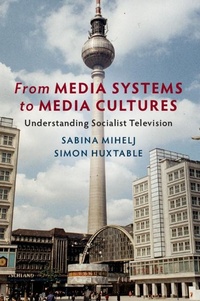
From Media Systems to Media Cultures
Understanding Socialist Television
Published on 21. January 2021
Book
Paperback/Softback
386 pages
978-1-108-43559-8 (ISBN)
Description
In From Media Systems to Media Cultures: Understanding Socialist Television, Sabina Mihelj and Simon Huxtable delve into the fascinating world of television under communism, using it to test a new framework for comparative media analysis. To understand the societal consequences of mass communication, the authors argue that we need to move beyond the analysis of media systems, and instead focus on the role of the media in shaping cultural ideals and narratives, everyday practices and routines. Drawing on a wealth of original data derived from archival sources, programme and schedule analysis, and oral history interviews, the authors show how communist authorities managed to harness the power of television to shape new habits and rituals, yet failed to inspire a deeper belief in communist ideals. This book and their analysis contains important implications for the understanding of mass communication in non-democratic settings, and provides tools for the analysis of media cultures globally.
Reviews / Votes
'From Media Systems to Media Cultures is a wonderful contribution to comparative media studies. It theorizes the complex and little-known world of state socialist television, and provides a compelling example of what it means to compare media cultures, and how this is related to the study of media systems.' Daniel C. Hallin, University of California, San Diego 'This ambitious volume performs exemplary comparative research on socialist television, shifting the emphasis from media systems to media cultures. This book makes a major contribution to the study of mass communication under authoritarian rule and is a significant intervention in global communication and media research.' Aniko Imre, author of TV Socialism 'This book fruitfully uses the state socialist TV landscape to reset our notions of media culture across diverse national contexts. Refracting the idea of comparative media through the gaze of entangled modernities, it complicates existing understandings of Cold War TV and recasts it in terms more consonant with culture. A creative and generative study that promises to have decisive impact on how we think about comparative media research.' Barbie Zelizer, Raymond Williams Professor of Communication, University of Pennsylvania 'In this pioneering, deeply researched and remarkably wide-ranging study, Mihelj and Huxtable have brought the insights of media studies to bear on the history of socialist television. They are sensitive to cultural particularities but always alive to comparisons and connections, both between individual socialist countries and between socialist 'East' and liberal democratic 'West'. Historians and theorists of Western media will have much to learn from this book as they reflect on their own fields.' Stephen Lovell, King's College LondonMore details
Series
Language
English
Place of publication
Cambridge
United Kingdom
Target group
Professional and scholarly
Product notice
Paperback (trade)
Illustrations
Worked examples or Exercises; 9 Tables, black and white; 11 Line drawings, color; 10 Line drawings, black and white
Dimensions
Height: 229 mm
Width: 152 mm
Thickness: 22 mm
Weight
562 gr
ISBN-13
978-1-108-43559-8 (9781108435598)
Copyright in bibliographic data and cover images is held by Nielsen Book Services Limited or by the publishers or by their respective licensors: all rights reserved.
Schweitzer Classification
Other editions
Additional editions
Sabina Mihelj | Simon Huxtable
From Media Systems to Media Cultures
Understanding Socialist Television
Book
08/2018
Cambridge University Press
€139.50
Shipment within 15-20 days
Persons
Sabina Mihelj is Professor of Media and Cultural Analysis at the Centre for Research in Communication and Culture at Loughborough University. She has written extensively on issues of media and nationalism, comparative media research, television studies, Eastern and Central European media, and Cold War media and culture. Her books include Media Nations: Communicating Belonging and Exclusion in the Modern World (2011) and Central and Eastern European Media in Comparative Perspective: Politics, Economy and Culture (2012). Her research was funded by the Arts and Humanities Research Council, the Economic and Social Research Council, the British Academy, and the Leverhulme Trust.
Content
1. Introduction; 2. Media cultures; 3. Historical context; 4. Varieties of modernity; 5. Publications; 6. Privacy; 7. Transnationalism; 8. Everyday time; 9. History; 10. Extraordinary time; 11. Conclusion.