

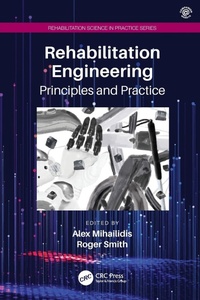
Rehabilitation Engineering
Principles and Practice
1st Edition
Published on 19. December 2024
Book
Paperback/Softback
672 pages
978-1-032-35482-8 (ISBN)
Description
This book will provide an overview of the rehabilitation engineering field, including key concepts that are required to provide a solid foundation about the discipline. It will present these concepts through a mix of basic and applied knowledge from rehabilitation engineering research and practice. It's written as an introductory text in order to provide access to the field by those without previous experience or background in the field.These concepts will include those related to engineering and health that are necessary to understand the application of rehabilitation engineering to support human function.
More details
Series
Language
English
Place of publication
London
United Kingdom
Publishing group
Taylor & Francis Ltd
Illustrations
149 s/w Abbildungen, 125 s/w Photographien bzw. Rasterbilder, 24 s/w Zeichnungen, 24 s/w Tabellen
24 Tables, black and white; 24 Line drawings, black and white; 125 Halftones, black and white; 149 Illustrations, black and white
Dimensions
Height: 234 mm
Width: 156 mm
Thickness: 37 mm
Weight
1027 gr
ISBN-13
978-1-032-35482-8 (9781032354828)
Copyright in bibliographic data and cover images is held by Nielsen Book Services Limited or by the publishers or by their respective licensors: all rights reserved.
Schweitzer Classification
Other editions
Additional editions
Book
11/2022
1st Edition
CRC Press
€175.10
Shipment within 10-20 days
E-Book
11/2022
1st Edition
CRC Press
€64.49
Available for download
E-Book
11/2022
1st Edition
CRC Press
€64.49
Available for download
Persons
Alex Mihailidis, Ph.D., P. Eng, is the Barbara G. Stymiest Research Chair in Rehabilitation Technology at the University of Toronto and Toronto Rehabilitation Institute.
Roger Smith, MD, Ph.D., O.T., FAOTA, RESNA Fellow is Director of the Rehabilitation Research Design and Disability Center at the University of Wisconsin-Milwaukee.
Roger Smith, MD, Ph.D., O.T., FAOTA, RESNA Fellow is Director of the Rehabilitation Research Design and Disability Center at the University of Wisconsin-Milwaukee.
Content
Part 1: Introduction and Overview. 1. History of Rehabilitation Engineering. 2. Assistive Technology. 3. Key Human Anatomy and Physiology Principles as They Relate to Rehabilitation Engineering. 4. Psychosocial and Cultural Aspects of Rehabilitation Engineering Interventions. 5. Overview of Disease, Disability, and Impairment. 6. Rehabilitation Engineering across the Lifespan. Part 2: Key Topics in Rehabilitation Engineering. 7. Policy and Regulations in Rehabilitation Engineering. 8. Ethical Issues in Rehabilitation Engineering. 9. Rehabilitation Engineering in the Assistive Technology Industry. 10. Understanding the End-User. 11. Rehabilitation Engineering in Less Resourced Settings. Part 3: Rehabilitation Engineering and Areas of Application. 12. Rehabilitation Engineering Seating & Mobility Chapter. 13. Universal Design and the Built Environment. 14. Wireless Technologies. 15. Transporation Access. 16. Rehabilitation Robotics. 17. Universal Interfaces and Information Technology. 18. AAC in the 21st Century: The Outcome of Technology: Advancements and Amended Societal Attitudes. 19. Cognitive Technologies. 20. Technology for Sensory Impairments (Vision and Hearing). 21. Prosthetic & Orthotic Devices. 22. Neural Engineering. Part 4: Outcomes and Assessemnts. 23. Assessment Approaches in Rehabilitation Engineering. 24. Product Usability Testing and Outcomes: What Works? For Whom? and Why?