

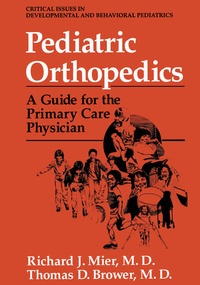
Pediatric Orthopedics
A Guide for the Primary Care Physician
Published on 21. October 2012
Book
Paperback/Softback
XI, 327 pages
978-1-4613-6080-3 (ISBN)
Description
Many residency programs in primary care specialties do not provide the education in pediatric orthopedics necessary to effectively deal with the field's challenges. Here, the authors present a framework for the effective evaluation of childhood musculoskeletal problems in a practical and problem-based manner. The volume contains case studies and
over 200 illustrations.
More details
Series
Edition
Softcover reprint of the original 1st ed. 1994
Language
English
Place of publication
New York
United States
Target group
Professional and scholarly
Research
Illustrations
XI, 327 p.
Dimensions
Height: 254 mm
Width: 178 mm
Thickness: 19 mm
Weight
641 gr
ISBN-13
978-1-4613-6080-3 (9781461360803)
DOI
10.1007/978-1-4615-2534-9
Schweitzer Classification
Other editions
Additional editions
Book
10/1994
Kluwer Academic / Plenum Publishers
€96.00
Shipment within 10-15 days
Persons
Content
1. The Orthopedic Examination.- 1.1. Introduction.- 1.2. Children Are Different.- 1.3. The General Physical Examination.- 1.4. The Orthopedic Examination.- 2. Evaluation of the Child with Extremity Pain or Limp.- 2.1. Introduction.- 2.2. Presentation.- 2.3. The History.- 2.4. The Physical Examination.- 2.5. Extremity Pain without Systemic Symptoms.- 2.6. Extremity Pain with Modest Systemic Symptoms.- 2.7. Extremity Pain with Significant Systemic Symptoms.- 2.8. Diagnosis.- 2.9. Therapy.- 3. Musculoskeletal Manifestations of Child Abuse.- 3.1. Introduction.- 3.2. Epidemiology.- 3.3. Risk Factors.- 3.4. The Physician's Role.- 3.5. Patterns of Injury.- 3.6. Bony Lesions Specific to Child Abuse.- 3.7. Injuries Suggestive of Child Abuse.- 3.8. Nonspecific Injuries.- 3.9. Asking Questions.- 3.10. Differential Diagnosis.- 3.11. Differential Diagnosis of Multiple Fractures.- 4. Developmental Orthopedics.- 4.1. Introduction.- 4.2. Intoeing.- 4.3. Outtoeing.- 4.4. Bowleg.- 4.5. Back Knees.- 4.6. Knock-Knees (Genu Valgum).- 4.7. Flat Feet.- 4.8. Cavus Foot Deformities.- 4.9. Leg Length Discrepancies.- 4.10. Toe-Walking.- 4.11. Bunions.- 4.12. Children's Shoes.- 5. Caring for the Child with Motor Delay.- 5.1. Introduction.- 5.2. Specific Causes of Motor Delays.- 5.3. Assessment of the Child with Motor Problems.- 5.4. Treatment of the Child with Motor Delay.- 6. Congenital and Related Defects of the Skeleton.- 6.1. Introduction.- 6.2. Causal Mechanisms.- 6.3. Specific Defects.- 7. Abnormalities of Skeletal Growth.- 7.1. Introduction.- 7.2. Measuring.- 7.3. Short Stature.- 7.4. The Tall Child.- 8. Sports Injuries in Children.- 8.1. Introduction.- 8.2. Epidemiology.- 8.3. General Guidelines for Acute Care of the Injured Athlete.- 8.4. Sports Injuries to the Foot, Ankle, or Leg.-8.5. Sports Injuries to the Knee, Thigh, or Hip.- 8.6. Sports Injuries to the Spine.- 8.7. Sports Injuries to the Shoulder, Arm, or Elbow.- 8.8. Sports Injuries to the Forearm, Wrist, or Hand.- 9. Spinal Disease in Childhood.- 9.1. Introduction.- 9.2. Physical Examination.- 9.3. Spinal Deformities.- 9.4. Painful Lesions.- 9.5. Other Spinal Conditions.- 10. Musculoskeletal Trauma.- 10.1. Introduction.- 10.2. Common Pediatric Musculoskeletal Injuries.- 10.3. Birth Trauma.- 11. Evaluating the Child with Arthritis and Other Joint Problems.- 11.1. Introduction.- 11.2. Presentation.- 11.3. Differential Diagnosis.- 11.4. Laboratory Evaluation.- 11.5. Treatment.