

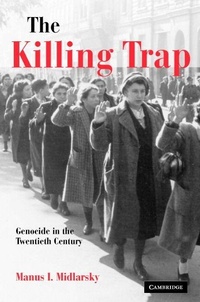
The Killing Trap
Genocide in the Twentieth Century
Published on 20. October 2005
Book
Hardback
480 pages
978-0-521-81545-1 (ISBN)
Description
The Killing Trap offers a comparative analysis of the genocides, politicides and ethnic cleansings of the twentieth century, which are estimated to have cost upwards of forty million lives. The book seeks to understand both the occurrence and magnitude of genocide, based on the conviction that such comparative analysis may contribute towards prevention of genocide in the future. Manus Midlarsky compares socio-economic circumstances and international contexts and includes in his analysis the Jews of Europe, Armenians in the Ottoman Empire, Tutsi in Rwanda, black Africans in Darfur, Cambodians, Bosnians, and the victims of conflict in Ireland. The occurrence of genocide is explained by means of a framework that gives equal emphasis to the non-occurrence of genocide, a critical element not found in other comparisons, and victims are given a prominence equal to that of perpetrators in understanding the magnitude of genocide.
Reviews / Votes
'Manus Midlarsky, a leading scholar of war, has written a book of monumental significance. He emerges here as the pioneering thinker who has produced the first truly rigorous and comparative theory of genocide. As must be true of any ground-breaking effort to understand such a fundamental and horrific phenomenon, his book will elicit much deserved praise and will provoke counter arguments and intelligent debate. However the field of genocide studies will evolve, this book will be the benchmark against which all future work will be compared. Not only is his theory highly original and compelling, but it is also written with a depth of feeling and beauty of language that recommends it to any reader concerned to improve the world and to save even one human life.' Bruce Bueno de Mesquita. Silver Professor and Chair, New York University, and Senior Fellow, Hoover Institution, Stanford University 'The Killing Trap is a major contribution to the field of genocide studies and deserves to be widely read. I am impressed by the combination of analytic rigor and richness of empirical data, by the breadth of historical dimensions incorporated into the discussion, by the author's erudition and the elegant parsimony of his comparative frame.' Rene Lemarchand, Emeritus Professor, University of Florida '... impressive volume ... This is a comprehensive, well-researched and insightful book. ... this volume significantly advances our understanding of genocide.' Political Studies ReviewMore details
Language
English
Place of publication
Cambridge
United Kingdom
Target group
Professional and scholarly
College/higher education
Dimensions
Height: 235 mm
Width: 157 mm
Thickness: 30 mm
Weight
840 gr
ISBN-13
978-0-521-81545-1 (9780521815451)
Copyright in bibliographic data and cover images is held by Nielsen Book Services Limited or by the publishers or by their respective licensors: all rights reserved.
Schweitzer Classification
Other editions
Additional editions
E-Book
01/2006
1st Edition
Cambridge University Press
€49.99
Available for download
Person
Manus I. Midlarsky is the Moses and Annuta Back Professor of International Peace and Conflict Resolution at Rutgers University, New Brunswick. He has authored or edited eleven books and 65 articles and book chapters. His publications include The Evolution of Inequality: War, State Survival, and Democracy in Comparative Perspectives and the edited volumes Inequality, Democracy, and Economic Development (Cambridge, 1997), and the Handbook of War Studies II.
Content
Preface; Part I. Introduction: 1. Preliminary considerations; 2. Case selection; Part II. Explaining Perpetrators: Theoretical Foundations: 3. Continuity and validation; 4. Prologue to theory; 5. A theoretical framework; Part III. The Theory Applied: 6. Threat of numbers, realpolitik, and ethnic cleansing; 7. Realpolitik and loss; 8. The need for unity and altruistic punishment; 9. Perpetrating states; Part IV. Victim Vulnerability: Explaining Magnitude and Manner of Dying: 10. Raison d'etat, raison d'eglise; 11. Cynical realpolitik and the unwanted; 12. High victimization: the role of realpolitik; 13. Inequality and absence of identification; 14. On the possibility of revolt and altruistic punishment; Part V. Exceptions: 15. A dog of different nature: the Cambodian Politicide; 16. Dogs that didn't bark I: realpolitik and the absence of loss; 17. Dogs that didn't bark II: affinity and vulnerability reduction; Part VI. Conclusion: 18. Findings, consequences, and prevention.