

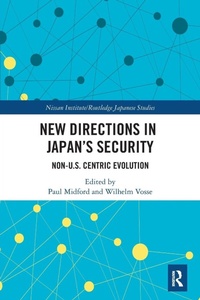
New Directions in Japan's Security
Non-U.S. Centric Evolution
1st Edition
Published on 29. April 2022
Book
Paperback/Softback
286 pages
978-0-367-54399-0 (ISBN)
Description
While the US-Japan alliance has strengthened since the end of the Cold War, Japan has, almost unnoticed, been building security ties with other partners, in the process reducing the centrality of the US in Japan's security. This book explains why this is happening.
Japan pursued security isolationism during the Cold War, but the US was the exception. Japan hosted US bases and held joint military exercises even while shunning contacts with other militaries. Japan also made an exception to its weapons export ban to allow exports to the US. Yet, since the end of the Cold War, Japan's security has undergone a quiet transformation, moving away from a singular focus on the US as its sole security partner. Tokyo has begun diversifying its security ties. This book traces and explains this diversification. The country has initiated security dialogues with Asian neighbors, assumed a leadership role in promoting regional multilateral security cooperation, and begun building bilateral security ties with a range of partners, from Australia and India to the European Union. Japan has even lifted its ban on weapons exports and co-development with non-US partners. This edited volume explores this trend of decreasing US centrality alongside the continued, and perhaps even growing, security (inter) dependence with the US.
New Directions in Japan's Security is an essential resource for scholars focused on Japan's national security. It will also interest on a wider basis those wishing to understand why Japan is developing non-American directions in its security strategy.
Japan pursued security isolationism during the Cold War, but the US was the exception. Japan hosted US bases and held joint military exercises even while shunning contacts with other militaries. Japan also made an exception to its weapons export ban to allow exports to the US. Yet, since the end of the Cold War, Japan's security has undergone a quiet transformation, moving away from a singular focus on the US as its sole security partner. Tokyo has begun diversifying its security ties. This book traces and explains this diversification. The country has initiated security dialogues with Asian neighbors, assumed a leadership role in promoting regional multilateral security cooperation, and begun building bilateral security ties with a range of partners, from Australia and India to the European Union. Japan has even lifted its ban on weapons exports and co-development with non-US partners. This edited volume explores this trend of decreasing US centrality alongside the continued, and perhaps even growing, security (inter) dependence with the US.
New Directions in Japan's Security is an essential resource for scholars focused on Japan's national security. It will also interest on a wider basis those wishing to understand why Japan is developing non-American directions in its security strategy.
More details
Series
Language
English
Place of publication
London
United Kingdom
Publishing group
Taylor & Francis Ltd
Target group
College/higher education
Postgraduate and Undergraduate Advanced
Illustrations
5 s/w Abbildungen, 5 s/w Zeichnungen, 4 s/w Tabellen
4 Tables, black and white; 5 Line drawings, black and white; 5 Illustrations, black and white
Dimensions
Height: 234 mm
Width: 156 mm
Thickness: 16 mm
Weight
442 gr
ISBN-13
978-0-367-54399-0 (9780367543990)
Copyright in bibliographic data and cover images is held by Nielsen Book Services Limited or by the publishers or by their respective licensors: all rights reserved.
Schweitzer Classification
Other editions
Additional editions
Book
09/2020
1st Edition
Routledge
€206.70
Shipment within 15-20 days
E-Book
09/2020
1st Edition
Routledge
€59.49
Available for download
E-Book
09/2020
1st Edition
Routledge
€59.49
Available for download
Persons
Paul Midford is Professor and Director of the Japan Program at the Norwegian University for Science and Technology (NTNU) in Trondheim.
Wilhelm Vosse is Professor of Political Science and International Relations at the International Christian University (ICU) in Tokyo, Japan.
Wilhelm Vosse is Professor of Political Science and International Relations at the International Christian University (ICU) in Tokyo, Japan.
Content
1. Introduction 2. Decentering and Recentering in Security Strategy Part I. Non-American Directions in Defense Policy 3. Centered on the fight within: the inward-looking nature of the Japanese debate on constitutional reinterpretation with a diluted US focus 4. Lifting the ban on Defense Industrial Production Cooperation with Non-US Partners Part II. Diversifying Security Partners 5. Japan's 'special' strategic partnership with Australia: 'Decentering' underwrites 're-centering' 6. Japan's policy toward India since 2000 and US leadership in East Asia 7. Japan's security cooperation with the Philippines and Vietnam Part III. Japan's Focus on Multilateral Security Cooperation 8. From a Decentering and Recentering Imperative: Japan's Approach to Asian Security Multilateralism 9. Is Japan's Engagement in Counter-Piracy Missions a Step Towards Decentering of Its Security Policy? 10. Japan's Cooperation with the EU in the Nexus of Development and Security 11. Evolution of Japan's Non-US Centric Security Strategy and European Influences on Japan's Peace-Building Policy Part IV. Reflections on Japan's Non-American Focused Initiatives 12. The Continued Centrality of the United States to Japan's Security Doctrine in an Era of Expanding Security Partnerships 13. Non-US Directions in Japan's Security Strategy: A Chinese View 14. Conclusions