

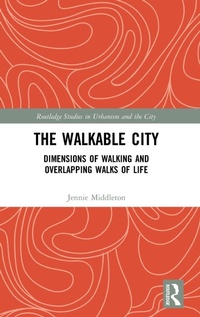
The Walkable City
Dimensions of Walking and Overlapping Walks of Life
1st Edition
Published on 19. August 2021
Book
Hardback
178 pages
978-1-138-69771-3 (ISBN)
Description
This book explores everyday walking in contemporary urban life. It brings together important theoretical and empirical insights to understand how the 'walkability' of urban spaces can be imagined, planned for, and experienced.
The book focuses on the everyday experiences of the urban walker, the bodily experiences of walking, and different walking research methods. It goes beyond the conventional focus on walkable places by delving into the ways in which urban space is consumed and produced through different ways of walking. Drawing on fieldwork in the UK and international secondary sources, the book examines how walking is socially and materially co-produced, focusing on pedestrian practices, infrastructures, and the social nature of walking. Chapters in the book offer key explorations of the cultural and social inclusions and exclusions of navigating the city on foot. The book considers transport planning and policy promoting pedestrian movement, pedestrian infrastructures, the politics of walking, and social interactions of urban pedestrians. The book offers vital analyses of how different but overlapping dimensions of walking and their relationship with urban space are often overlooked, and the importance of centring the lived experiences of walking in understandings of pedestrian practices.
This book provides a timely contribution to the field of mobilities due to a growing interest in urban walking. It will be of interest to students and scholars of urban studies, human geography, sociology, and public health.
The book focuses on the everyday experiences of the urban walker, the bodily experiences of walking, and different walking research methods. It goes beyond the conventional focus on walkable places by delving into the ways in which urban space is consumed and produced through different ways of walking. Drawing on fieldwork in the UK and international secondary sources, the book examines how walking is socially and materially co-produced, focusing on pedestrian practices, infrastructures, and the social nature of walking. Chapters in the book offer key explorations of the cultural and social inclusions and exclusions of navigating the city on foot. The book considers transport planning and policy promoting pedestrian movement, pedestrian infrastructures, the politics of walking, and social interactions of urban pedestrians. The book offers vital analyses of how different but overlapping dimensions of walking and their relationship with urban space are often overlooked, and the importance of centring the lived experiences of walking in understandings of pedestrian practices.
This book provides a timely contribution to the field of mobilities due to a growing interest in urban walking. It will be of interest to students and scholars of urban studies, human geography, sociology, and public health.
Reviews / Votes
"Middleton examines walking as a lived, embodied, and relational practice. She argues that too often, walkability is reduced to technical metrics, and urges us to consider how walking feels, and how it intersects with gender, age, ability, and emotion. By emphasizing the diversity of walking experiences, the book reveals how even walkable environments can perpetuate inequality if they overlook the complexities of everyday life."Jordi Honey-Roses, Associate Professor, University of British Columbia
More details
Series
Language
English
Place of publication
London
United Kingdom
Publishing group
Taylor & Francis Ltd
Target group
College/higher education
Illustrations
4 s/w Abbildungen, 4 s/w Photographien bzw. Rasterbilder
4 Halftones, black and white; 4 Illustrations, black and white
Dimensions
Height: 240 mm
Width: 161 mm
Thickness: 15 mm
Weight
461 gr
ISBN-13
978-1-138-69771-3 (9781138697713)
Copyright in bibliographic data and cover images is held by Nielsen Book Services Limited or by the publishers or by their respective licensors: all rights reserved.
Schweitzer Classification
Other editions
Additional editions
Book
05/2023
1st Edition
Routledge
€65.00
Shipment within 10-20 days
E-Book
08/2021
1st Edition
Routledge
€59.49
Available for download
E-Book
08/2021
1st Edition
Routledge
€59.49
Available for download
Person
Jennie Middleton is Associate Professor in Human Geography in the Transport Studies Unit and the School of Geography and the Environment at the University of Oxford. She is a human geographer with interests in everyday mobilities, care in the city, and innovative methodologies for urban research.
Content
1. Introducing the 'Walkable City' 2. Pedestrian Infrastructures 3. Walking as Social Differentiation 4. Walking Rhythms and the Politics of Time 5. Pedestrian Politics of (Non) Encounters 6. Walking Bodies, Emotional Geographies, and Mobile Methods 7. Stepping Forwards: Some Concluding Thoughts