

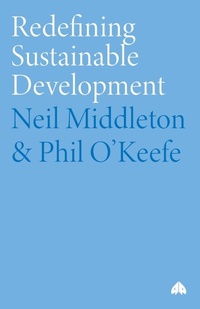
Redefining Sustainable Development
Published on 20. March 2001
Book
Paperback/Softback
192 pages
978-0-7453-1605-5 (ISBN)
Description
Development and assistance in disasters is about helping people to help themselves. It is to do with facilitating 'sustainable livelihoods' and addressing the ills of social discrimination. These seem to be self-evident propositions. In fact, they are a minefield.
If development workers intervene to assist in the creation of environmentally sustainable livelihoods, what judgemental codes are contained in the everyday cultural and linguistic assumptions of development practitioners? What account do they give of the environment and people's relationship to it? If livelihoods are to be economically sustainable, by which economic criteria is the judgement made? Is the objective to keep projects going until the funds run out, or, like cancer patients, to survive for five years, or to knit people into the world's trading systems? If projects are to be sustainable, they must be socially just. By whose justice do we judge? At present, much development and disaster relief work derives its importance solely from providing opportunities for honing survival skills.
The authors of this book examine these questions and others in detail and argue that the assumptions of the social-democratic world, including those of international NGOs, are tied to the perpetuation of capitalism. Neil Middleton and Phil O'Keefe suggest that the issue, in the face of anarchic global financial power, is to rethink the nature of class in a late capitalist world and to recognise indigenous NGOs as the new political vehicles for its struggle.
If development workers intervene to assist in the creation of environmentally sustainable livelihoods, what judgemental codes are contained in the everyday cultural and linguistic assumptions of development practitioners? What account do they give of the environment and people's relationship to it? If livelihoods are to be economically sustainable, by which economic criteria is the judgement made? Is the objective to keep projects going until the funds run out, or, like cancer patients, to survive for five years, or to knit people into the world's trading systems? If projects are to be sustainable, they must be socially just. By whose justice do we judge? At present, much development and disaster relief work derives its importance solely from providing opportunities for honing survival skills.
The authors of this book examine these questions and others in detail and argue that the assumptions of the social-democratic world, including those of international NGOs, are tied to the perpetuation of capitalism. Neil Middleton and Phil O'Keefe suggest that the issue, in the face of anarchic global financial power, is to rethink the nature of class in a late capitalist world and to recognise indigenous NGOs as the new political vehicles for its struggle.
Reviews / Votes
'A roller-coaster ride through competing theories of linguistics, ecological philosophy, economics and redistributive justice' -- Green SocialistMore details
Language
English
Place of publication
London
United Kingdom
Target group
Professional and scholarly
Product notice
Paperback (UK-trade)
Illustrations
4 b&w figures
Dimensions
Height: 216 mm
Width: 140 mm
Thickness: 11 mm
Weight
254 gr
ISBN-13
978-0-7453-1605-5 (9780745316055)
Copyright in bibliographic data and cover images is held by Nielsen Book Services Limited or by the publishers or by their respective licensors: all rights reserved.
Schweitzer Classification
Other editions
Additional editions
Neil Middleton | Phil O'Keefe
Redefining Sustainable Development
E-Book
03/2001
1st Edition
Pluto Press
€122.99
Available for download
Persons
Neil Middleton was the author of Disaster and Development (Pluto, 1997), Negotiating Poverty (Pluto, 2001) and Rio Plus Ten (Pluto, 2003). He is also co-author, with Phil O'Keefe, of Redefining Sustainable Development (Pluto, 2001).
Phil O'Keefe was Professor of Economic Development and Environmental Management at Northumbria University. He is also the Director of ETC-UK and co-author with Neil Middleton of Disaster and Development (Pluto, 1997), Redefining Sustainable Development (Pluto, 2001), Rio Plus Ten (Pluto, 2003) and co-editor of Negotiating Poverty (Pluto, 2003).
Phil O'Keefe was Professor of Economic Development and Environmental Management at Northumbria University. He is also the Director of ETC-UK and co-author with Neil Middleton of Disaster and Development (Pluto, 1997), Redefining Sustainable Development (Pluto, 2001), Rio Plus Ten (Pluto, 2003) and co-editor of Negotiating Poverty (Pluto, 2003).
Content
1. Introduction: The Rich Wage War, the Poor Die
2. Polite Meaningless Words
3. All Nature Is But Art
4. Opportunities Legally Monopolised
5. Si Quid Usquam Iustitia
6. Everlasting Groans
Abbreviations
References
2. Polite Meaningless Words
3. All Nature Is But Art
4. Opportunities Legally Monopolised
5. Si Quid Usquam Iustitia
6. Everlasting Groans
Abbreviations
References