

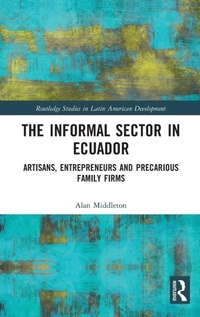
The Informal Sector in Ecuador
Artisans, Entrepreneurs and Precarious Family Firms
1st Edition
Published on 13. August 2019
Book
Hardback
292 pages
978-0-367-19210-5 (ISBN)
Description
This book looks back over the last forty years of change and development in Ecuador, showing how macro level changes have impacted families and workplaces on the local level. Traditionally a dependent economy reliant on agricultural exports, the impact of neoliberalism and new sources of income from oil have transformed the informal and artisanal sectors in Ecuador. Exploring these dynamics using a combination of micro and macro analyses, this book demonstrates how the social relations of the sector are connected to the wider social, economic and political systems in which they operate.
The book dives into the links between micro-production and the wider economy, including the relationships between different types of artisanal enterprises and their customers, their connections to the private sector and the state, the importance of social networks and social capital and the relevance of finance capital in microenterprise development. Overall, the analysis investigates how artisans, entrepreneurs and family-based enterprises seek to protect their interests when faced with neoliberal policies and the impacts of globalisation.
This remarkable longitudinal study will be of considerable interest to researchers of development studies, economics, sociology, anthropology, geography and Latin American Studies.
The book dives into the links between micro-production and the wider economy, including the relationships between different types of artisanal enterprises and their customers, their connections to the private sector and the state, the importance of social networks and social capital and the relevance of finance capital in microenterprise development. Overall, the analysis investigates how artisans, entrepreneurs and family-based enterprises seek to protect their interests when faced with neoliberal policies and the impacts of globalisation.
This remarkable longitudinal study will be of considerable interest to researchers of development studies, economics, sociology, anthropology, geography and Latin American Studies.
Reviews / Votes
"Alan Middleton's landmark book is a longitudinal study of artisans, entrepreneurs and precarious family firms in Quito, one of the two major cities in Ecuador. He relates his research to the global literature on economic development, informality, regulation, micro-enterprise, micro-credit and social capital, and he exposes the failings of many famous authors who have made grand assertions on the basis of superficial studies. Covering the 40 years from 1975 to 2015, the research is innovative and multi-faceted, giving us a detailed understanding of how family and home-based enterprises respond to dramatic changes in national economies and government policies." -Ray Bromley, Professor of Geography, Planning and Latin American Studies, State University of New York at Albany, USAMore details
Series
Language
English
Place of publication
London
United Kingdom
Publishing group
Taylor & Francis Ltd
Target group
General
Illustrations
20 s/w Abbildungen, 1 s/w Photographie bzw. Rasterbild, 19 s/w Zeichnungen, 41 s/w Tabellen
41 Tables, black and white; 19 Line drawings, black and white; 1 Halftones, black and white; 20 Illustrations, black and white
Dimensions
Height: 240 mm
Width: 161 mm
Thickness: 21 mm
Weight
631 gr
ISBN-13
978-0-367-19210-5 (9780367192105)
Copyright in bibliographic data and cover images is held by Nielsen Book Services Limited or by the publishers or by their respective licensors: all rights reserved.
Schweitzer Classification
Other editions
Additional editions

Book
05/2023
1st Edition
Routledge
€76.93
Shipment within 10-20 days
E-Book
08/2019
1st Edition
Routledge
€60.49
Available for download
E-Book
08/2019
1st Edition
Routledge
€60.49
Available for download
Person
Alan Middleton is Emeritus Professor of Urban Studies at Birmingham City University, UK, Leverhulme Emeritus Fellow, and Chief Executive Officer of the Governance Foundation.
Content
1. Artisans and the informal sector in Ecuador 2. Informals, entrepreneurs and artisans 3. Artisans in Quito, 1975-2015 4. Neoliberalism in Ecuador 5. Choosing informality 6. Formal-informal relations: backward linkages 7. Customers, clients and formal markets 8. Family firms, homeworkers and home-based enterprises 9. Social networks and the theft of social capital 10. Artisans and the state 11. Microfinance and micro-firm development in context 12. Artisan perspectives on bank credit 13. Main issues and future prospects 14. Conclusions: theory, ideology and evidence