

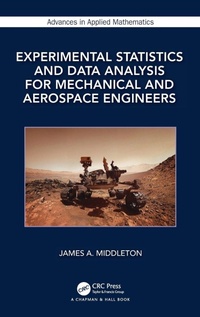
Experimental Statistics and Data Analysis for Mechanical and Aerospace Engineers
1st Edition
Published on 24. November 2021
Book
Hardback
586 pages
978-0-367-55596-2 (ISBN)
Description
This book develops foundational concepts in probability and statistics with primary applications in mechanical and aerospace engineering. It develops the mindset a data analyst must have to interpret an ill-defined problem, operationalize it, collect or interpret data, and use this evidence to make decisions that can improve the quality of engineered products and systems. It was designed utilizing the latest research in statistics learning and in engagement teaching practices
The author's focus is on developing students' conceptual understanding of statistical theory with the goal of effective design and conduct of experiments. Engineering statistics is primarily a form of data modeling. Emphasis is placed on modelling variation in observations, characterizing its distribution, and making inferences with regards to quality assurance and control. Fitting multivariate models, experimental design and hypothesis testing are all critical skills developed. All topics are developed utilizing real data from engineering projects, simulations, and laboratory experiences. In other words, we begin with data, we end with models.
The key features are:
Realistic contexts situating the learning of the statistics in actual engineering practice.
A balance of rigorous mathematics, conceptual scaffolding, and real, messy data, to ensure that students learn the important concepts and can apply them in practice.
The consistency of text, lecture notes, data sets, and simulations yield a coherent set of instructional resources for the instructor and a coherent set of learning experiences for the students.
MatLab is used as a computational tool. Other tools are easily substituted.
Table of Contents
1. Introduction
2. Dealing with Variation
3. Types of Data
4. Introduction to Probability
5. Sampling Distribution of the Mean
6. The Ten Building Blocks of Experimental Design
7. Sampling Distribution of the Proportion
8. Hypothesis Testing Using the 1-sample Statistics
9. 2-sample Statistics
10. Simple Linear Regression
11. The General Linear Model: Regression with Multiple Predictors
12. The GLM with Categorical Independent Variables: The Analysis of Variance
13. The General Linear Model: Randomized Block Factorial ANOVA
14. Factorial Analysis of Variance
15. The Bootstrap
16. Data Reduction: Principal Components Analysis
Index
Author Biography
James A. Middleton is Professor of Mechanical and Aerospace Engineering and former Director of the Center for Research on Education in Science, Mathematics, Engineering, and Technology at Arizona State University. Previously, he held the Elmhurst Energy Chair in STEM education at the University of Birmingham in the UK. He received his Ph.D. from the University of Wisconsin-Madison. He has been Senior co-Chair of the Special Interest Group for Mathematics Education in the American Educational Research Association, and as Chair of the National Council of Teachers of Mathematics' Research Committee. He has been a consultant for the College Board, the Rand Corporation, the National Academies, the American Statistical Association, the IEEE, and numerous school systems around the United States, the UK, and Australia. He has garnered over $30 million in grants to study and improve mathematics education in urban schools.
The author's focus is on developing students' conceptual understanding of statistical theory with the goal of effective design and conduct of experiments. Engineering statistics is primarily a form of data modeling. Emphasis is placed on modelling variation in observations, characterizing its distribution, and making inferences with regards to quality assurance and control. Fitting multivariate models, experimental design and hypothesis testing are all critical skills developed. All topics are developed utilizing real data from engineering projects, simulations, and laboratory experiences. In other words, we begin with data, we end with models.
The key features are:
Realistic contexts situating the learning of the statistics in actual engineering practice.
A balance of rigorous mathematics, conceptual scaffolding, and real, messy data, to ensure that students learn the important concepts and can apply them in practice.
The consistency of text, lecture notes, data sets, and simulations yield a coherent set of instructional resources for the instructor and a coherent set of learning experiences for the students.
MatLab is used as a computational tool. Other tools are easily substituted.
Table of Contents
1. Introduction
2. Dealing with Variation
3. Types of Data
4. Introduction to Probability
5. Sampling Distribution of the Mean
6. The Ten Building Blocks of Experimental Design
7. Sampling Distribution of the Proportion
8. Hypothesis Testing Using the 1-sample Statistics
9. 2-sample Statistics
10. Simple Linear Regression
11. The General Linear Model: Regression with Multiple Predictors
12. The GLM with Categorical Independent Variables: The Analysis of Variance
13. The General Linear Model: Randomized Block Factorial ANOVA
14. Factorial Analysis of Variance
15. The Bootstrap
16. Data Reduction: Principal Components Analysis
Index
Author Biography
James A. Middleton is Professor of Mechanical and Aerospace Engineering and former Director of the Center for Research on Education in Science, Mathematics, Engineering, and Technology at Arizona State University. Previously, he held the Elmhurst Energy Chair in STEM education at the University of Birmingham in the UK. He received his Ph.D. from the University of Wisconsin-Madison. He has been Senior co-Chair of the Special Interest Group for Mathematics Education in the American Educational Research Association, and as Chair of the National Council of Teachers of Mathematics' Research Committee. He has been a consultant for the College Board, the Rand Corporation, the National Academies, the American Statistical Association, the IEEE, and numerous school systems around the United States, the UK, and Australia. He has garnered over $30 million in grants to study and improve mathematics education in urban schools.
More details
Series
Language
English
Place of publication
Oxford
United Kingdom
Publishing group
Taylor & Francis Ltd
Target group
College/higher education
Illustrations
222 s/w Abbildungen, 222 s/w Zeichnungen, 107 s/w Tabellen
107 Tables, black and white; 222 Line drawings, black and white; 222 Illustrations, black and white
Dimensions
Height: 240 mm
Width: 161 mm
Thickness: 36 mm
Weight
1039 gr
ISBN-13
978-0-367-55596-2 (9780367555962)
Copyright in bibliographic data and cover images is held by Nielsen Book Services Limited or by the publishers or by their respective licensors: all rights reserved.
Schweitzer Classification
Other editions
Additional editions
E-Book
11/2021
1st Edition
Chapman & Hall/CRC
€165.99
Available for download
E-Book
11/2021
1st Edition
Chapman & Hall/CRC
€165.99
Available for download
Person
James A. Middleton is Professor of Mechanical and Aerospace Engineering and former Director of the Center for Research on Education in Science, Mathematics, Engineering, and Technology at Arizona State University. Previously, he held the Elmhurst Energy Chair in STEM education at the University of Birmingham in the UK. He received his Ph.D. from the University of Wisconsin-Madison. He has been Senior co-Chair of the Special Interest Group for Mathematics Education in the American Educational Research Association, and as Chair of the National Council of Teachers of Mathematics' Research Committee. He has been a consultant for the College Board, the Rand Corporation, the National Academies, the American Statistical Association, the IEEE, and numerous school systems around the United States, the UK, and Australia. He has garnered over $30 million in grants to study and improve mathematics education in urban schools.
Content
1. Introduction
2. Dealing with Variation
3. Types of Data
4. Introduction to Probability
5. Sampling Distribution of the Mean
6. Experimental Designs
7. Sampling Distribution of the Proportion
8. Hypothesis Testing Using the Normal Distribution
9. Two-sample Statistics
10. Simple Linear Regression
11. The General Linear Model
12. The GLM with Categorical Independent Variables
13. Factorial ANOVA
14. Bootstrap
15. Principal Components Analysis
2. Dealing with Variation
3. Types of Data
4. Introduction to Probability
5. Sampling Distribution of the Mean
6. Experimental Designs
7. Sampling Distribution of the Proportion
8. Hypothesis Testing Using the Normal Distribution
9. Two-sample Statistics
10. Simple Linear Regression
11. The General Linear Model
12. The GLM with Categorical Independent Variables
13. Factorial ANOVA
14. Bootstrap
15. Principal Components Analysis