

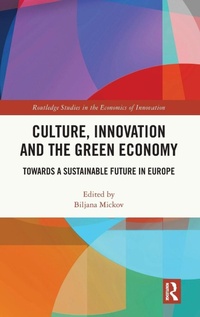
Culture, Innovation and the Green Economy
Towards a Sustainable Future in Europe
1st Edition
Published on 25. June 2025
Book
Hardback
252 pages
978-1-032-95277-2 (ISBN)
Description
The book offers a theoretical and practical analysis of the contemporary approach to art, culture and innovation, with special emphasis on the relationship between culture, innovation and the economy, in the context of green transition, as an indispensable sustainability factor.
It presents new models that can be implemented, especially within strategic cultural planning, serving to ensure future development and attain certain levels of stability. The book argues that the cultural ecosystem should not be treated as merely a segment of the economy, but rather as a system that contains the economy. One of the main issues covered in the book is climate change. More than fifty years have passed since the first major conference of the United Nations (UN) on the Environment held in Stockholm in 1972, which gave birth to the "Stockholm Declaration", and also cemented the global environmental movement. Thanks to Agenda 2030, the 17 Sustainable Development Goals and the Paris Agreement, there is an increased awareness of the dangers posed by climate change and of the need to switch to sustainable energy sources and a circular economy in the hope of preventing environmental problems that threaten life on Earth. Each chapter provides an accessible bank of knowledge on which existing theory and practice can be developed and new projects undertaken.
The book adopts a highly interdisciplinary approach for open science, bridging theoretical insights with practical applications, and offers a comprehensive perspective that is both informative and actionable, so it can be used by academics, researchers, policy makers and cultural professionals for planning and development within the cultural sector.
Biljana Mickov is a cultural researcher and professor. She holds a PhD from University of Reims Champagne - Ardeen.
It presents new models that can be implemented, especially within strategic cultural planning, serving to ensure future development and attain certain levels of stability. The book argues that the cultural ecosystem should not be treated as merely a segment of the economy, but rather as a system that contains the economy. One of the main issues covered in the book is climate change. More than fifty years have passed since the first major conference of the United Nations (UN) on the Environment held in Stockholm in 1972, which gave birth to the "Stockholm Declaration", and also cemented the global environmental movement. Thanks to Agenda 2030, the 17 Sustainable Development Goals and the Paris Agreement, there is an increased awareness of the dangers posed by climate change and of the need to switch to sustainable energy sources and a circular economy in the hope of preventing environmental problems that threaten life on Earth. Each chapter provides an accessible bank of knowledge on which existing theory and practice can be developed and new projects undertaken.
The book adopts a highly interdisciplinary approach for open science, bridging theoretical insights with practical applications, and offers a comprehensive perspective that is both informative and actionable, so it can be used by academics, researchers, policy makers and cultural professionals for planning and development within the cultural sector.
Biljana Mickov is a cultural researcher and professor. She holds a PhD from University of Reims Champagne - Ardeen.
More details
Series
Language
English
Place of publication
London
United Kingdom
Publishing group
Taylor & Francis Ltd
Target group
College/higher education
Postgraduate
Illustrations
3 s/w Tabellen, 23 s/w Abbildungen, 3 s/w Zeichnungen, 20 s/w Photographien bzw. Rasterbilder
3 Tables, black and white; 3 Line drawings, black and white; 20 Halftones, black and white; 23 Illustrations, black and white
Dimensions
Height: 240 mm
Width: 161 mm
Thickness: 19 mm
Weight
578 gr
ISBN-13
978-1-032-95277-2 (9781032952772)
Copyright in bibliographic data and cover images is held by Nielsen Book Services Limited or by the publishers or by their respective licensors: all rights reserved.
Schweitzer Classification
Other editions
Additional editions
E-Book
06/2025
Routledge
€60.49
Available for download
E-Book
06/2025
Routledge
€60.49
Available for download
Person
Biljana Mickov is a cultural researcher and professor. She holds a PhD from University of Reims Champagne - Ardeen.
Content
Introduction Biljana Mickov Part 1: Culture and Sustainability 1. The Culture Policy of European Cities in the Process of Green Transition Biljana Mickov 2. Decarbonizing Culture: a French overview over sustainable practices in the arts and in cultural policies Loic Meuley 3. Urban Green Revolution: Cultivating Community Engagement and Cultural Change for Sustainable CityScapes Sonja Pejic 4. Green Renaissance: Engaging Communities in the Participatory Revival of Industrial Heritage Katarina Vitalisova, Kamila Borsekova, Darina Rojikova and Anna Vanova 5. Innovative Practices in European Museums Arts Management Zoran Eric and Biljana Mickov Part 2: Innovation and the Arts 6. Towards a social ecology of urban art. Participation, community and Sustainability Ricardo Klein 7. Eco-social Crisis and Art Zoran Eric 8. From Net Art to AI Art: Questioning the Post-Internet/Post-digital and New Aesthetic Art Discourse Vera Mevorah and Jelena Guga 9. Enter Active in Re: Public Digital and Live Sphere of Mass Time Design Ivan Pravdic 10. The Untapped Economic Opportunity of Mainstreaming Skills and Slipovers from Arts and Design to Other Fields of Practice Johanna Kouzmine-Karavaieff Part 3: The Creative Economy in Green Transition - Innovation and Research 11. Cultural and Creative Sectors and Green Transition. Some Evidence and Reflections Pau Rausell-Koester, Rauel Abeledo-Sanchis, and Jordi Sanjuan 12. Creative Urban Green Economy: Contemporary design of Green City Spaces Darko Reba 13. Designing Transitions and Transformation Cultural and Creative Industries in Germany: An urban governance perspective from Mannheim Matthias Rauch 14. Responsible financing and creative sector: global context and Serbia Hristina Mikic 15. What a wonderful world: How the Sismograf and Som(riu) festivals foster sustainable innovation in rural settings Manel Gonzalez-Pinero