

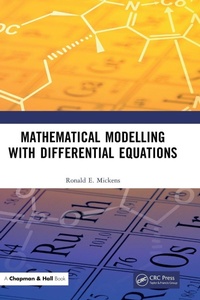
Mathematical Modelling with Differential Equations
1st Edition
Published on 23. May 2022
Book
Hardback
284 pages
978-1-032-01445-6 (ISBN)
Description
Mathematical Modelling with Differential Equations aims to introduce various strategies for modelling systems using differential equations. Some of these methodologies are elementary and quite direct to comprehend and apply while others are complex in nature and require thoughtful, deep contemplation. Many topics discussed in the chapter do not appear in any of the standard textbooks and this provides users an opportunity to consider a more general set of interesting systems that can be modelled. For example, the book investigates the evolution of a "toy universe," discusses why "alternate futures" exists in classical physics, constructs approximate solutions to the famous Thomas-Fermi equation using only algebra and elementary calculus, and examines the importance of "truly nonlinear" and oscillating systems.
Features
Introduces, defines, and illustrates the concept of "dynamic consistency" as the foundation of modelling.
Can be used as the basis of an upper-level undergraduate course on general procedures for mathematical modelling using differential equations.
Discusses the issue of dimensional analysis and continually demonstrates its value for both the construction and analysis of mathematical modelling.
Features
Introduces, defines, and illustrates the concept of "dynamic consistency" as the foundation of modelling.
Can be used as the basis of an upper-level undergraduate course on general procedures for mathematical modelling using differential equations.
Discusses the issue of dimensional analysis and continually demonstrates its value for both the construction and analysis of mathematical modelling.
More details
Language
English
Place of publication
Oxford
United Kingdom
Publishing group
Taylor & Francis Ltd
Target group
College/higher education
Illustrations
4 s/w Tabellen, 49 s/w Abbildungen, 49 s/w Zeichnungen
4 Tables, black and white; 49 Line drawings, black and white; 49 Illustrations, black and white
Dimensions
Height: 260 mm
Width: 183 mm
Thickness: 20 mm
Weight
734 gr
ISBN-13
978-1-032-01445-6 (9781032014456)
Copyright in bibliographic data and cover images is held by Nielsen Book Services Limited or by the publishers or by their respective licensors: all rights reserved.
Schweitzer Classification
Other editions
Additional editions
Ronald E. Mickens
Mathematical Modelling with Differential Equations
Book
05/2024
1st Edition
Chapman & Hall/CRC
€69.60
Shipment within 10-20 days
Ronald E. Mickens
Mathematical Modelling with Differential Equations
E-Book
05/2022
1st Edition
Chapman & Hall/CRC
€64.49
Available for download
Ronald E. Mickens
Mathematical Modelling with Differential Equations
E-Book
05/2022
1st Edition
Chapman & Hall/CRC
€64.49
Available for download
Person
Ronald E. Mickens is an Emeritus Professor at Clark Atlanta University, Atlanta, GA, and is a Fellow of several professional organizations, including the American Physical Society. He has written or edited seventeen books and published more than 350 peer-reviewed research articles.
Content
0. Preliminaries. 0.1. Introduction. 0.2. Mathematical Modeling. 0.3. Elementary Modeling Examples. 0.4. What is Science? 0.5. Scaling of Variables. 0.6. Dominant Balance and Approximations. 0.7. Use of Handbooks. 0.8. The Use OF Wikipedia. 0.9. Discussion. 0.10. Notes and References. 1. What is the ?N? 1.1. Introduction. 1.2. Interative Guessing. 1.3. Series Expansion Method. 1.4. Newton Method Algorithm. 1.5. Discussion. Problems. Notes and References. 2. Damping/Dissipative Forces. 2.1. Introduction. 2.2. Properties of DDF Functions. 2.3. Dimensional Analysis and DDF Functions. 2.4. One Term Power-law DDF Functions. 2.5. Two Term Power-law DDF Functions. 2.6. Discussion. Problems. Notes and References. 3. The Thomas-Fermi Equation. 3.1. Introduction. 3.2. Exact Results. 3.3. Dynamic Consistency. 3.4. Two Rational Approximations. 3.5. Discussion. Problems. Notes and References. 4. Single Population Growth Models. 4.1. Introduction. 4.2. Logistic Equation. 4.3. Gompertz Model. 4.4. Non-logistic Models. 4.5. Allee Effect. 4.6. Discussion. Problems. Notes and References. 5. 1 + 2 + 3 + 4 + 5 + . . . = ?(1/2). 5.1. Introduction. 5.2. Preliminaries. 5.3. Numerical Values of Divergent Series. 5.4. Elementary Function Defined by an Integral. 5.5. Gamma Function. 5.6. Riemann Zeta Function. 5.7. Discussion. Problems. Notes and References. 6. A Truly Nonlinear Oscillator. 6.1. Introduction. 6.2. General Properties of Exact Solutions. 6.3. Approximate Solutions. 6.4. Summary. Problems. Notes and References. 7. Discretization of Differential Equations. 7.1. Introduction. 7.2. Exact Schemes. 7.3. NSFD Methodology. 7.4. NSFD Schemes for One's. 7.5. Partial Differential Equation Applications. 7.6. Discussion. Problems. Notes and References. 8. SIR Models for Disease Spread. 8.1. Introduction. 8.2. SIR Methodology. 8.3. Standard SIR Model. 8.4. Flattening the Curve. 8.5. Solveable SIR Model. 8.6. Resume. Problems. Notes and References. 9. Dieting Model. 9.1 Introduction. 9.2. Mathematical Model. 9.3. Analysis of a Model. 9.4. Approximate Solutions. 9.5. Discussion. Problems. Notes and References. 10. Alternate Futures. 10.1. Introduction. 10.2. Two Systems Exhibiting Alternative Futures. 10.3. Resume of Concepts and Definitions. 10.4. Counterfactual Histories. 10.5. Summary and Discussion. Problems. Notes and References. 11. Toy Model of the Universe.11.1 Introduction. 11.2. In the Beginning: Let There Be Rules. 11.3. Some "Dull" Model Universes. 11.4. Nontrivial TMOU. 11.5. Fibonacci Equation. 11.6. Discussion. Problems. Notes and References. 12. Diffusion and Heat Equations. 12.1. Introduction. 12.2. Heat Equation Derivation. 12.3. Diffusion Equation and Random Walks. 12.4. Diffusion and Probability. 12.5. Derivation Difficulties. 12.6. Heated Rod Problem. 12.7. Comments. Problems. Notes and References. Appendix A. Algebraic Relations. B. Trigonometric Relations. C. Hyperbolic Functions. D. Relations from Calculus. E. Fourier Series. F. Even and Odd Functions. G. Some Nonstandard but Important Functions. H. Differential Equations. I. Linearization of Certain Types of Nonlinear Differential Equations. Bibliography. Index.