

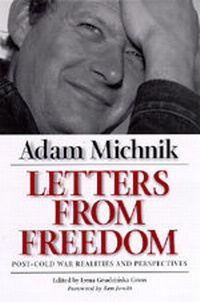
Letters from Freedom
Post-Cold War Realities and Perspectives
1st Edition
Published on 8. September 1998
Book
Paperback/Softback
346 pages
978-0-520-21760-7 (ISBN)
Description
A hero to many, Polish writer Adam Michnik ranks among today's most fearless and persuasive public figures. His imprisonment by Poland's military regime in the 1980s did nothing to quench his outpouring of writings, many of which were published in English as "Letters from Prison". Beginning where that volume ended, "Letters from Freedom" finds Michnik briefly in prison at the height of the 'cold civil war' between authorities and citizens in Poland, then released. Through his continuing essays, articles, and interviews, the reader can follow all the momentous changes of the last decade in Poland and East-Central Europe. Some of the writings have appeared in English in various publications; most are translated here for the first time. Michnik is never detached. His belief that people can get what they want without hatred and violence has always translated into action, and his actions, particularly the activity of writing, have required his contemporaries to think seriously about what it is they want.
His commitment to freedom is absolute, but neither wild-eyed nor humorless; with a characteristic combination of idealism and pragmatism, Michnik says, 'In the end, politics is the art of foreseeing and implementing the possible'. Michnik's blend of conviction and political acumen is perhaps most vividly revealed in the interviews transcribed in the book, whether he is the subject of the interview or is conducting a conversation with Czeslaw Milosz, Vaclav Havel, or Wojciech Jaruzelski. These face-to-face exchanges tell more about the forces at work in contemporary Eastern Europe than could any textbook. Sharing Michnik's intellectual journey through a tumultuous era, we touch on all the subjects important to him in this wide-ranging collection and find they have importance for everyone who values conscience and responsibility. In the words of Jonathan Schell, 'Michnik is one of those who bring honor to the last two decades of the twentieth century'.
His commitment to freedom is absolute, but neither wild-eyed nor humorless; with a characteristic combination of idealism and pragmatism, Michnik says, 'In the end, politics is the art of foreseeing and implementing the possible'. Michnik's blend of conviction and political acumen is perhaps most vividly revealed in the interviews transcribed in the book, whether he is the subject of the interview or is conducting a conversation with Czeslaw Milosz, Vaclav Havel, or Wojciech Jaruzelski. These face-to-face exchanges tell more about the forces at work in contemporary Eastern Europe than could any textbook. Sharing Michnik's intellectual journey through a tumultuous era, we touch on all the subjects important to him in this wide-ranging collection and find they have importance for everyone who values conscience and responsibility. In the words of Jonathan Schell, 'Michnik is one of those who bring honor to the last two decades of the twentieth century'.
More details
Series
Edition
First Edition
Language
English
Place of publication
Berkerley
United States
Target group
Professional and scholarly
Product notice
Paperback (trade)
Illustrations
7 photographs.
Dimensions
Height: 229 mm
Width: 152 mm
Thickness: 28 mm
Weight
544 gr
ISBN-13
978-0-520-21760-7 (9780520217607)
Copyright in bibliographic data and cover images is held by Nielsen Book Services Limited or by the publishers or by their respective licensors: all rights reserved.
Schweitzer Classification
Persons
Adam Michnik is the editor of Gazeta Wyborcza, which he helped to found in 1989. Many of his articles and essays have been translated into other languages, but except for the translation of a 1979 work, The Church and the Left (1992), this is the first collection of his writings to appear in English since Letters from Prison and Other Essays (California, 1986). Irena Grudzinska Gross is the author of The Scar of Revolution: Custine, Tocqueville, and the Romantic Imagination (California, 1991). Jane Cave is the translator of several books from Polish, including Konspira by Maciej Lopinski, Marcin Moskit, and Mariusz Wilk (California, 1990). Ken Jowitt is Professor of Political Science at the University of California, Berkeley, and author of New World Disorder: The Leninist Extinction (California, 1992), among other books.
Content
LIST OF ILLUSTRATIONS
EDITOR'S NOTE
FOREWORD: IN PRAISE OF THE
"ORDINARY" by Ken Jowitt
PART 2: HOPELESSNESS AND HOPE
1 Cold Civil War: Poland Ten Years after the Founding of the Workers' Defense Committee (KOR)
2 Don Quixote and Invective
3 Anti-authoritarian Revolt: A Conversation with Daniel Cohn-Bendit
4 The Dilemma
5 Towards a Civil Society: Hopes for Polish Democracy:Interview with Erica Blair (John Keane)
PART 2: NOTES FROM THE REVOLUTION,1989-1990
6 A Specter Is Haunting Europe
7 After the Round Table
8 Joy ... and a Moment of Reflection
9 Nothing Will Ever Be the Way It Was
1O Your President, Our Prime Minister
11 Farewell to the Brezhnev Doctrine
12 If the President of Poland . . .
13 Poland's Fate Is Being Decided
14 What Next in Russia?
15 Notes from the Revolution
16 Ater the Revolution
17 My Vote against Walesa
PART 3: SPEECHES AND CONVERSATIONS
18 Poland and the Jews
19 Poland and Germanv
20 Three Kinds of Fundamentalism
21 One Has to Rise Early in the Morning: A Conversation with Czcslaw Milosz
22 The Strange Epoch of Post-Communism:A Conversation with Vaclav Havel
23 We Can Talk without Hatred:A Conversation with Wojcicch J Aruzelski
24 I Am a Polish Intellectual:Adam Michnik Talks to Adam Krzcmiriski and Wieslaw Wladyka, Editors of Polityka
25 The Velvet Restoration: A Summing-Up
POSTFACE: GRAY IS BEAUTIFUL: A LETTER TO IRA KATZNELSON
GUIDE TO EVENTS AND PEOPLE
INDEX
EDITOR'S NOTE
FOREWORD: IN PRAISE OF THE
"ORDINARY" by Ken Jowitt
PART 2: HOPELESSNESS AND HOPE
1 Cold Civil War: Poland Ten Years after the Founding of the Workers' Defense Committee (KOR)
2 Don Quixote and Invective
3 Anti-authoritarian Revolt: A Conversation with Daniel Cohn-Bendit
4 The Dilemma
5 Towards a Civil Society: Hopes for Polish Democracy:Interview with Erica Blair (John Keane)
PART 2: NOTES FROM THE REVOLUTION,1989-1990
6 A Specter Is Haunting Europe
7 After the Round Table
8 Joy ... and a Moment of Reflection
9 Nothing Will Ever Be the Way It Was
1O Your President, Our Prime Minister
11 Farewell to the Brezhnev Doctrine
12 If the President of Poland . . .
13 Poland's Fate Is Being Decided
14 What Next in Russia?
15 Notes from the Revolution
16 Ater the Revolution
17 My Vote against Walesa
PART 3: SPEECHES AND CONVERSATIONS
18 Poland and the Jews
19 Poland and Germanv
20 Three Kinds of Fundamentalism
21 One Has to Rise Early in the Morning: A Conversation with Czcslaw Milosz
22 The Strange Epoch of Post-Communism:A Conversation with Vaclav Havel
23 We Can Talk without Hatred:A Conversation with Wojcicch J Aruzelski
24 I Am a Polish Intellectual:Adam Michnik Talks to Adam Krzcmiriski and Wieslaw Wladyka, Editors of Polityka
25 The Velvet Restoration: A Summing-Up
POSTFACE: GRAY IS BEAUTIFUL: A LETTER TO IRA KATZNELSON
GUIDE TO EVENTS AND PEOPLE
INDEX