

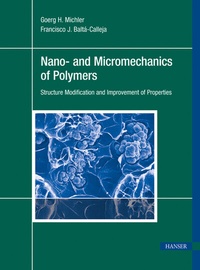
Nano- and Micromechanics of Polymers
Structure Modification and Improvement of Properties
1st Edition
Published on 1. March 2012
Book
Hardback
X, 550 pages
978-3-446-42767-9 (ISBN)
Description
The book brings together the detailed knowledge of structure and morphology of the main classes of polymers, including commodities as well as special polymers, with explanation of the mechanical properties, processes, and mechanisms on macroscopic, microscopic, and nanoscopic scales. Description, explanation, and theoretical interpretation of all of the micro- and nanoscopic processes and mechanisms in different polymers constitute the central part the book. Thus, it offers a key for a better understanding of structure-property correlations of nearly all polymers of interest in industrial applications. A central aim of the book is to show how, by changing the morphology, microprocesses and, finally, the mechanical properties can be improved. There is no other book available on the market which is focused on micromechanical processes of polymers and their role to improve the properties of polymeric materials.
More details
Language
English
Place of publication
München
Germany
Target group
Professional and scholarly
Product notice
Paper over boards
Illustrations
494
494 illustrations
Dimensions
Height: 27.5 cm
Width: 20.6 cm
Thickness: 3.1 cm
Weight
1728 gr
ISBN-13
978-3-446-42767-9 (9783446427679)
Schweitzer Classification
Other editions
Additional editions
Goerg H. Michler | Francisco J. Baltá-Calleja
Nano- and Micromechanics of Polymers
Structure Modification and Improvement of Properties
E-Book
03/2012
1st Edition
Hanser
€239.99
Available for download
Persons
Content
Part I: Polymeric Materials
1. The relevance of polymers
2. General properties
3. Trends in polymer science. Routes for the modification of polymers
Part II: Techniques to study polymers
4. Techniques to investigate structure and morphology
5. Techniques to investigate the mechanical properties
6. Techniques to investigate the nano- and micromechanical properties and processes
Part III: Overview: Structure and morphology of polymers
7. Chemical/molecular structures
8. Supermolecular structures (morphology)
Part IV: Overview: Nano- and Micromechanical processes and mechanisms
9. Types of deformation
10. Processes/mechanisms
11. Fracture processes
12. Mechanisms to enhance the mechanical properties (stiffness, strength, toughness)
Part V: Main types of polymer materials (detailed description)
13. Amorphous polymers
14. Semicrystalline polymers
15. Blockcopolymers
16. Polymer blends
17. Rubber-toughened polymers
18. Rubbers and elastomers
19. Polymer Composites
20. Fibre-reinforced polymers
21. Nanofibres
22. Multilayered, hot-compacted polymers
23. Foamed polymers
24. Biomedical polymers