

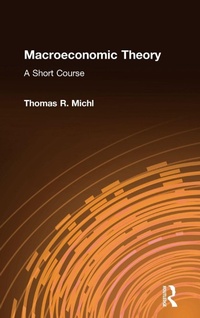
Macroeconomic Theory: A Short Course
A Short Course
1st Edition
Published on 31. October 2002
Book
Hardback
284 pages
978-0-7656-1141-3 (ISBN)
Description
A look at all the key topics in intermediate-level macroeconomic theory with carefully chosen linear versions of the standard models of both the closed and the open economy. It requires no mathematical proficiency beyond high school level algebra, and has been thoroughly tested in the classroom.
Reviews / Votes
"Because Professor Michl's book covers its territory so efficiently, adopters are free to complement the text with whatever additional material they think most important in an intermediate course." - Steve Cohn, Knox CollegeMore details
Language
English
Place of publication
London
United Kingdom
Publishing group
Taylor & Francis Ltd
Target group
College/higher education
Professional and scholarly
Illustrations
tables, figures, references, index
Dimensions
Height: 235 mm
Width: 157 mm
Thickness: 20 mm
Weight
566 gr
ISBN-13
978-0-7656-1141-3 (9780765611413)
Copyright in bibliographic data and cover images is held by Nielsen Book Services Limited or by the publishers or by their respective licensors: all rights reserved.
Schweitzer Classification
Other editions
Additional editions
E-Book
02/2015
1st Edition
Routledge
€77.99
Available for download
E-Book
02/2015
1st Edition
Routledge
€77.99
Available for download
Book
10/2002
1st Edition
Routledge
€83.80
Shipment within 15-20 days
Person
Thomas R. Michl
Content
Chapter 1 Macroeconomic Accounting; Chapter 2 Prices and Output; Chapter 3 Keynesian Theory; Chapter 4 The IS Curve; Chapter 5 The LM Curve; Chapter 6 The IS-LM Model; Chapter 7 The Aggregate Demand Curve; Chapter 8 The Aggregate Supply Curve; Chapter 9 The AS-AD Model; Chapter 10 Inflation and Unemployment; Chapter 11 A Model with Active Monetary Policy; Chapter 12 Open Economy Basics; Chapter 13 Fixed Exchange Rates; Chapter 14 Flexible Exchange Rates; Chapter 15 The Classical Growth Model; Chapter 16 The Neoclassical Growth Model;