

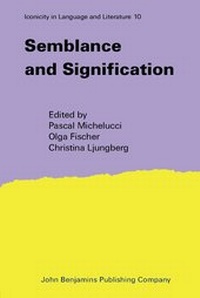
Semblance and Signification
Published on 23. November 2011
Book
Hardback
427 pages
978-90-272-4346-1 (ISBN)
Description
The articles assembled in Semblance and Signification explore linguistic and literary structures from a range of theoretical perspectives with a view to understanding the extent, prevalence, productivity, and limitations of iconically grounded forms of semiosis. With the complementary examination of large theoretical issues, extensive corpus analysis in several modern languages such as Italian, Japanese Sign Language, and English, and applied close studies across a range of artistic media, this volume brings a fresh understanding of the cognitive underpinnings of iconicity. If primary and secondary modelling systems are rarely studied in tandem, it is clear from this volume that their fruitful juxtaposition yields striking insight into the cognitive concerns that pervade current semiotic research.
More details
Series
Language
English
Place of publication
Amsterdam
Netherlands
Target group
Professional and scholarly
Illustrations
+ index
Dimensions
Height: 245 mm
Width: 164 mm
Weight
935 gr
ISBN-13
978-90-272-4346-1 (9789027243461)
Copyright in bibliographic data and cover images is held by Nielsen Book Services Limited or by the publishers or by their respective licensors: all rights reserved.
Schweitzer Classification
Other editions
Additional editions
Pascal Michelucci | Olga Fischer | Christina Ljungberg
Semblance and Signification
E-Book
11/2011
1st Edition
John Benjamins Publishing Company
€130.99
Available for download
Persons
Content
1. Preface and acknowledgements; 2. Introduction (by Michelucci, Pascal); 3. Toward a phonosemantic definition of iconic words (by Kimi, Akita); 4. Iconic thinking and the contact-induced transfer of linguistic material: The case of Japanese, signed Japanese, and Japan Sign Language (by Herlofsky, William J.); 5. Ezra Pound among the Mawu: Ideophones and iconicity in Siwu (by Dingemanse, Mark); 6. Cognitive iconic grounding of reduplication in language (by Fischer, Olga); 7. Imagic iconicity in the Chinese language (by Hu, Zhuanglin); 8. Words in the mirror: Analysing the sensorimotor interface between phonetics and semantics in Italian (by Nobile, Luca); 9. Un melange genevois: Tacit notions of iconicity in Ferdinand De Saussure's Writings in General Linguistics (by Chien, Jui-Pi); 10. How to put art and brain together (by Changizi, Mark); 11. Image, diagram, and metaphor: Unmined resource and unresolved questions (by Colapietro, Vincent); 12. The farmers sowed seeds and hopes: Element order in metaphorical phrases (by Shen, Yeshayahu); 13. Non-iconic chronology in English narrative texts (by Yevseyev, Vyacheslav); 14. A burning world of war: How iconicity works in constructing the fictional world view in A Farewell to Arms (by Xinxin, Zhao); 15. Aesthetic qualities as structural resemblance: Divergence and perceptual forces in poetry (by Tsur, Reuven); 16. Mental space mapping in classical Chinese poetry: A cognitive approach (by Chang, Han-liang); 17. Iconicity in conceptual blending: Material anchors in William Morris's News from Nowhere (by Glyn, Wilson David); 18. Thematized iconicity and iconic devices in the modern novel: Some modes of interaction (by White, John J.); 19. Iconicity and intermediality in Charles Simic's Dime-Store Alchemy (by Rippl, Gabriele); 20. Words, like shells, are signs as well as things (by Plooy, Heilna du); 21. Unveiling creative subplots through the non-traditional application of diagrammatic iconicity: An analysis of Kingsley Amis's The Green Man (by James, Andrew); 22. The iconic indexicality of photography (by Sadowski, Piotr); 23. Unbinding the text: Intermedial iconicity in Peter Greenaway's Prospero's Books (by Ljungberg, Christina); 24. Argumentative, iconic, and indexical structures in Schubert's Die schone Mullerin (by Maeder, Costantino); 25. John Irving's A Widow for One Year and Tod Williams' The Door in the Floor as '(mult-)i-conic' works of art (by Schwanecke, Christine)