

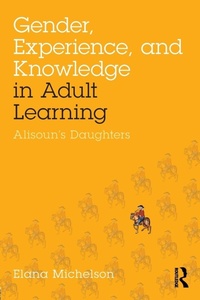
Gender, Experience, and Knowledge in Adult Learning
Alisoun's Daughters
1st Edition
Published on 18. May 2015
Book
Paperback/Softback
218 pages
978-1-138-89217-0 (ISBN)
Description
In this wide-ranging book, Elana Michelson invites us to revisit basic understandings of the `experiential learner'. How does experience come to be seen as the basis of knowledge? How do gender, class, and race enter into the ways in which knowledge is valued? What political and cultural belief systems underlie such practices as the assessment of prior learning and the writing of life narratives?
Drawing on a range of disciplines, from feminist theory and the politics of knowledge to literary criticism, Michelson argues that particular understandings of `experiential learning' have been central to modern Western cultures and the power relationships that underlie them. Presented in four parts, this challenging and lively book asks educators of adults to think in new ways about their assumptions, theories, and practices:
Part I provides readers with a short history of the notion of experiential learning.
Part II brings the insights and concerns of feminist theory to bear on mainstream theories of experiential learning.
Part III examines the assessment of prior experiential learning for academic credit and/or professional credentials.
Part IV addresses a second pedagogical practice that is ubiquitous in adult learning, namely, the assigning of life narratives.
Gender, Experience, and Knowledge in Adult Learning will be of value to scholars and graduate students exploring adult and experiential learning, as well as academics wishing to introduce students to a broad range of feminist, critical-race, materialist and postmodernist thinking in the field.
Drawing on a range of disciplines, from feminist theory and the politics of knowledge to literary criticism, Michelson argues that particular understandings of `experiential learning' have been central to modern Western cultures and the power relationships that underlie them. Presented in four parts, this challenging and lively book asks educators of adults to think in new ways about their assumptions, theories, and practices:
Part I provides readers with a short history of the notion of experiential learning.
Part II brings the insights and concerns of feminist theory to bear on mainstream theories of experiential learning.
Part III examines the assessment of prior experiential learning for academic credit and/or professional credentials.
Part IV addresses a second pedagogical practice that is ubiquitous in adult learning, namely, the assigning of life narratives.
Gender, Experience, and Knowledge in Adult Learning will be of value to scholars and graduate students exploring adult and experiential learning, as well as academics wishing to introduce students to a broad range of feminist, critical-race, materialist and postmodernist thinking in the field.
More details
Language
English
Place of publication
London
United Kingdom
Publishing group
Taylor & Francis Ltd
Target group
College/higher education
Illustrations
2 s/w Zeichnungen
2 Line drawings, black and white
Dimensions
Height: 234 mm
Width: 156 mm
Thickness: 13 mm
Weight
363 gr
ISBN-13
978-1-138-89217-0 (9781138892170)
Copyright in bibliographic data and cover images is held by Nielsen Book Services Limited or by the publishers or by their respective licensors: all rights reserved.
Schweitzer Classification
Other editions
Additional editions
Book
05/2015
1st Edition
Routledge
€241.80
Shipment within 10-20 days
E-Book
05/2015
Routledge
€76.49
Available for download
E-Book
05/2015
Routledge
€76.49
Available for download
Person
Elana Michelson is Professor of Liberal Studies and Adult Learning at Empire State College, University of New York.
Content
Introduction
Part I:
Chapter 1
Chapter 2
Chapter 3
Part II:
Chapter 4
Chapter 5
Chapter 6
Part III:
Chapter 7
Chapter 8
Chapter 9
Part IV
Chapter 10
Chapter 11
Chapter 12
Conclusion
Part I:
Chapter 1
Chapter 2
Chapter 3
Part II:
Chapter 4
Chapter 5
Chapter 6
Part III:
Chapter 7
Chapter 8
Chapter 9
Part IV
Chapter 10
Chapter 11
Chapter 12
Conclusion