

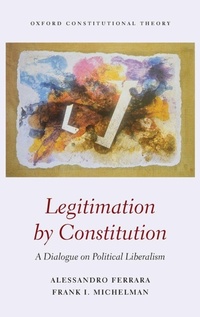
Legitimation by Constitution
A Dialogue on Political Liberalism
Published on 22. November 2021
Book
Hardback
208 pages
978-0-19-285512-1 (ISBN)
Description
"Legitimation by Constitution" is the phrase, coined by distinguished authors Frank Michelman and Alessandro Ferrara, for a key idea in Rawlsian political liberalism of a reliance on a dualist form of democracy-a subjection of ground-level lawmaking to the constraints of a higher-law constitution that most citizens could find acceptable as a framework for their politics-as a response to the problem of maintaining a liberally just, stable, and oppression-free democratic government in conditions of pluralist visionary conflict.
Legitimation by Constitution recalls, collects, and combines a series of exchanges over the years between Michelman and Ferrara, inspired by Rawls' encapsulation of this conception in his proposed liberal principle of legitimacy. From a shared standpoint of sympathetic identification with the political-liberal statement of the problem, for which legitimation by constitution is proposed as a solution, these exchanges consider the perceived difficulties arguably standing in the way of this proposal's fulfillment on terms consistent with political liberalism's defining ideas about political justification. The authors discuss the mysteries of a democratic constituent power; the tensions between government-by-the-people and government-by-consent; the challenges posed to concretization by judicial authorities of national constitutional law; and the magnification of these tensions and challenges under the lenses of ambition towards transnational legal ordering. These discussions engage with other leading contemporary theorists of liberal-democratic constitutionalism including Bruce Ackerman, Ronald Dworkin, and Juergen Habermas.
Legitimation by Constitution recalls, collects, and combines a series of exchanges over the years between Michelman and Ferrara, inspired by Rawls' encapsulation of this conception in his proposed liberal principle of legitimacy. From a shared standpoint of sympathetic identification with the political-liberal statement of the problem, for which legitimation by constitution is proposed as a solution, these exchanges consider the perceived difficulties arguably standing in the way of this proposal's fulfillment on terms consistent with political liberalism's defining ideas about political justification. The authors discuss the mysteries of a democratic constituent power; the tensions between government-by-the-people and government-by-consent; the challenges posed to concretization by judicial authorities of national constitutional law; and the magnification of these tensions and challenges under the lenses of ambition towards transnational legal ordering. These discussions engage with other leading contemporary theorists of liberal-democratic constitutionalism including Bruce Ackerman, Ronald Dworkin, and Juergen Habermas.
More details
Series
Language
English
Place of publication
Oxford
United Kingdom
Target group
Professional and scholarly
Dimensions
Height: 240 mm
Width: 161 mm
Thickness: 16 mm
Weight
473 gr
ISBN-13
978-0-19-285512-1 (9780192855121)
Copyright in bibliographic data and cover images is held by Nielsen Book Services Limited or by the publishers or by their respective licensors: all rights reserved.
Schweitzer Classification
Other editions
Additional editions
E-Book
11/2021
1st Edition
OUP eBook
€67.49
Available for download
E-Book
11/2021
1st Edition
OUP eBook
€67.49
Available for download
Persons
Alessandro Ferrara is Professor of Political Philosophy at the University of Rome Tor Vergata, Italy, and teaches Legal Theory at Luiss Guido Carli University in Rome. He served as President of the Italian Society for Political Philosophy (2005-2010). He has authored The Democratic Horizon (2014), several other monographs, many articles, and contributions to edited volumes in political and legal philosophy. Since 1992 Ferrara has been a Co-Director of the Yearly Conference on Philosophy and Social Science, held in Prague since 1933 under the auspices of the Czech Academy of Science.
Frank I. Michelman is the Robert Walmsley University Professor, Emeritus, Harvard University. He has been the President of the American Society for Political and Legal Philosophy, a fellow of the American Academy of Arts and Sciences, Co-Director of the annual Prague Conference on Philosophy and Social Science, and has served on the Board of Directors of the United States Association of Constitutional Law and the National Advisory Board of the American Constitution Society. In 2005, Professor Michelman was awarded the American Philosophical Society's Phillips Prize in Jurisprudence.
Frank I. Michelman is the Robert Walmsley University Professor, Emeritus, Harvard University. He has been the President of the American Society for Political and Legal Philosophy, a fellow of the American Academy of Arts and Sciences, Co-Director of the annual Prague Conference on Philosophy and Social Science, and has served on the Board of Directors of the United States Association of Constitutional Law and the National Advisory Board of the American Constitution Society. In 2005, Professor Michelman was awarded the American Philosophical Society's Phillips Prize in Jurisprudence.
Content
Part I: Popular Sovereignty Versus Higher (and Higher) Law
1: "Always Under Law"
2: On the Paradox of Deliberative Democracy
3: The Challenge of "Most Reasonable for Us"
4: The "Most Reasonable for Us" or "Irrescusability" as Preserving Authenticity
Part II: A Democratic Horizon
5: Constitutional Interpretation: A Dualist Democrat's Dilemma
6: On Reconciling the Two Understandings of Judicial Review
7: Judicial Constitutional Application: A Rejoinder
8: Backgrounding the Debate: Judicial Occlusion and Remedial Strategies
Part III: Global Orders and Limits of Liberalism
9: Hyperpluralized Constituencies: The Challenge for Political Liberalism
10: Can Legitimation by Constitution Apply Beyond the State?
11: A Political Conception of People (and its Consequences)
12: From Decency to Democracy: Leading by Example
Conclusion
A Glance Back and the Road Ahead
A Liberal Limit to Constitutional Thinness
1: "Always Under Law"
2: On the Paradox of Deliberative Democracy
3: The Challenge of "Most Reasonable for Us"
4: The "Most Reasonable for Us" or "Irrescusability" as Preserving Authenticity
Part II: A Democratic Horizon
5: Constitutional Interpretation: A Dualist Democrat's Dilemma
6: On Reconciling the Two Understandings of Judicial Review
7: Judicial Constitutional Application: A Rejoinder
8: Backgrounding the Debate: Judicial Occlusion and Remedial Strategies
Part III: Global Orders and Limits of Liberalism
9: Hyperpluralized Constituencies: The Challenge for Political Liberalism
10: Can Legitimation by Constitution Apply Beyond the State?
11: A Political Conception of People (and its Consequences)
12: From Decency to Democracy: Leading by Example
Conclusion
A Glance Back and the Road Ahead
A Liberal Limit to Constitutional Thinness