

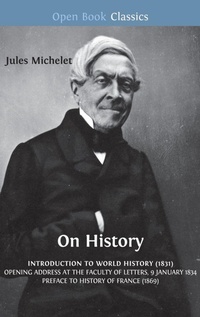
On History
Published on 9. October 2013
Book
Hardback
174 pages
978-1-909254-71-8 (ISBN)
Description
Edited by Lionel Gossman, this volume contains three programmatic essays by Michelet. The first two are available here for the first time in English translation. The third, the Preface to the 1869 edition of the Histoire de France, originally published in its first English translation by Edward K. Kaplan in his Michelet's Poetic Vision (1977), has been revised by the translator for this volume. One of the greatest Romantic historians and immensely popular during his lifetime, Jules Michelet (1798-1874) fell into disfavour among the positivist historians who came after him and who regarded his work with disdain as "literature." In the 1920s and 30s, however, he began to be rediscovered and rehabilitated by the members of the influential Annales school. The objects of Michelet's interest-living conditions, popular mentalities, laws and the arts, the historian's relation to the objects of his study, no less than political history-have since come to occupy a central place in modern historical research. A free online-only supplement contains an essay on Michelet by John Stuart Mill from the Edinburgh Review (January 1844) and several studies of Michelet by Lionel Gossman.
More details
Language
English
Place of publication
Cambridge
United Kingdom
Product notice
sewn/stitched
Cloth over boards
Dimensions
Height: 240 mm
Width: 161 mm
Thickness: 14 mm
Weight
432 gr
ISBN-13
978-1-909254-71-8 (9781909254718)
Copyright in bibliographic data and cover images is held by Nielsen Book Services Limited or by the publishers or by their respective licensors: all rights reserved.
Schweitzer Classification
Persons
Jules Michelet was a French historian. In his 1855 work, Histoire de France (History of France), he was the first historian to use and define the word Renaissance ('Re-birth' in French), as a period in Europe's cultural history that represented a drastic break from the Middle Ages (which he loathed), creating a modern understanding of humanity and its place in the world. His aphoristic style emphasized his anti-clerical republicanism.