

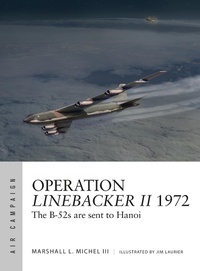
Operation Linebacker II 1972
The B-52s are sent to Hanoi
Published on 20. September 2018
Book
Paperback/Softback
96 pages
978-1-4728-2760-9 (ISBN)
Description
The Linebacker II campaign of 1972 saw America's fearsome but irreplaceable B-52s finally sent into action above the Vietnamese capital Hanoi in an attempt to bomb the Vietnamese to the negotiating table.
After the failed April 1972 invasion of South Vietnam and the heavy US tactical bombing raids in the Hanoi area, the North Vietnamese agreed to return to the Paris peace talks, yet very quickly these negotiations stalled.
In an attempt to end the war quickly and 'persuade' the North Vietnamese to return to the negotiating table, President Nixon ordered the Air Force to send the US' ultimate conventional weapon, the B-52 bomber, against their capital, Hanoi. Bristling with the latest Soviet air defence missiles, it was the most heavily defended target in Vietnam. Taking place in late December, this campaign was soon dubbed the 'Christmas Bombings'.
Using specially commissioned artwork and maps, ex-USAF fighter colonel Marshall Michel describes Linebacker II, the climax of the air war over Vietnam, and history's only example of how America's best Cold War bombers performed against contemporary Soviet air defences.
After the failed April 1972 invasion of South Vietnam and the heavy US tactical bombing raids in the Hanoi area, the North Vietnamese agreed to return to the Paris peace talks, yet very quickly these negotiations stalled.
In an attempt to end the war quickly and 'persuade' the North Vietnamese to return to the negotiating table, President Nixon ordered the Air Force to send the US' ultimate conventional weapon, the B-52 bomber, against their capital, Hanoi. Bristling with the latest Soviet air defence missiles, it was the most heavily defended target in Vietnam. Taking place in late December, this campaign was soon dubbed the 'Christmas Bombings'.
Using specially commissioned artwork and maps, ex-USAF fighter colonel Marshall Michel describes Linebacker II, the climax of the air war over Vietnam, and history's only example of how America's best Cold War bombers performed against contemporary Soviet air defences.
More details
Series
Language
English
Place of publication
United Kingdom
Publishing group
Bloomsbury Publishing PLC
Target group
Professional and scholarly
Illustrations
Illustrated throughout with around 60 photos and at least 14pp of colour illustrations
Dimensions
Height: 249 mm
Width: 182 mm
Thickness: 10 mm
Weight
309 gr
ISBN-13
978-1-4728-2760-9 (9781472827609)
Copyright in bibliographic data and cover images is held by Nielsen Book Services Limited or by the publishers or by their respective licensors: all rights reserved.
Schweitzer Classification
Other editions
Additional editions
Marshall Michel III | Adam Tooby | Bounford.com
Operation Linebacker II 1972
The B-52s are Sent to Hanoi
E-Book
09/2018
1st Edition
Osprey Publishing
€16.49
Available for download
Marshall Michel III | Adam Tooby | Bounford.com
Operation Linebacker II 1972
The B-52s are Sent to Hanoi
E-Book
09/2018
1st Edition
Osprey Publishing
€16.49
Available for download
Persons
Marshall L. Michel III is a native of New Orleans who attended Georgetown and Harvard universities. He joined the US Air Force in 1966 and from 1970 to 1973 flew 321 combat missions. He was the assistant air attache at the American embassy in Tel Aviv from 1977 to 1980, when he returned to the United States to fly F-15s at Langley Air Force Base, Virginia. He later served as the Israel desk officer for the Joint Chiefs of Staff in the Pentagon, as a fellow at the Jaffee Center for Strategic Studies at Tel Aviv University, and on the NATO staff in Brussels, Belgium. He retired from the Air Force in 1992 and now lives in Biloxi, Mississippi, USA.
Content
Introduction
Chronology
Attackers' Capabilities
Defenders' Capabilities
Campaign Objectives
The Campaign
Analysis and Conclusion
Further Reading
Index
Chronology
Attackers' Capabilities
Defenders' Capabilities
Campaign Objectives
The Campaign
Analysis and Conclusion
Further Reading
Index