

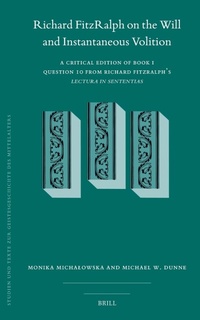
Richard FitzRalph on the Will and Instantaneous Volition
A Critical Edition of Book I, Question 10 from Richard FitzRalph's Lectura in Sententias
Published on 27. March 2025
Book
Hardback
276 pages
978-90-04-52803-1 (ISBN)
Description
The volume offers a critical edition of a text by Richard FitzRalph, one of the most original 14th-century Oxonian thinkers. FitzRalph's philosophical and theological ideas were enthusiastically adopted or fiercely challenged, consolidating his recognition at the universities of Oxford, Paris, and Italy.
For all this, his work remains relatively little-known today, an obscurity this book redresses by making a question on the will from FitzRalph's Lectura in Sententias available to a larger readership. Besides, FitzRalph's strongly voluntaristic position and analytical techniques derived from the natural sciences and logic are shown to place him close to the Oxford Calculators.
For all this, his work remains relatively little-known today, an obscurity this book redresses by making a question on the will from FitzRalph's Lectura in Sententias available to a larger readership. Besides, FitzRalph's strongly voluntaristic position and analytical techniques derived from the natural sciences and logic are shown to place him close to the Oxford Calculators.
More details
Series
Language
English
Place of publication
Leiden
Netherlands
Target group
College/higher education
Product notice
sewn/stitched
Cloth over boards
Dimensions
Height: 238 mm
Width: 156 mm
Thickness: 20 mm
Weight
476 gr
ISBN-13
978-90-04-52803-1 (9789004528031)
Copyright in bibliographic data and cover images is held by Nielsen Book Services Limited or by the publishers or by their respective licensors: all rights reserved.
Schweitzer Classification
Persons
Monika Michalowska, Ph.D. (2007), is Professor at the Medical University of Lodz. Her research focuses on late medieval ethics and theology. She has critically edited Richard Kilvington's Quaestiones super libros Ethicorum and Quaestiones super libros Sententiarum (Brill, 2016, 2021, 2023).
Michael W. Dunne, Ph.D. (1993), is Professor of Medieval Philosophy at Maynooth University. His research focuses on Irish thinkers of the Middle Ages and Oxford thought in the 13th and 14th centuries. He has co-edited A Companion to Richard FitzRalph (Brill, 2023).
Michael W. Dunne, Ph.D. (1993), is Professor of Medieval Philosophy at Maynooth University. His research focuses on Irish thinkers of the Middle Ages and Oxford thought in the 13th and 14th centuries. He has co-edited A Companion to Richard FitzRalph (Brill, 2023).
Content
Preface
Introduction
Life and Career
The Structure and Sources of Book I, Question 10
?The Structure of BookI, Question 10
?The Sources of BookI, Question 10
The Content of BookI, Question 10
?A Physics-Oriented Approach to the Will
?Willing Freely Not to Exist and Nilling the Ultimate Good
FitzRalph's Influence on the Late Medieval Debate on the Will
?Adam Wodeham as a Vigilant Witness of FitzRalph's Teaching on Loving and Cognizing
?Robert Holcot's Close Reading of FitzRalph's Arguments on Instantaneus Volition
?Gregory of Rimini as a Disseminator of FitzRalph's Thought among Continental Thinkers
?Peter Ceffons on FitzRalph's Arguments on Willing in an Instant
The Manuscripts of Book I, Question 10
?The Description of the Manuscripts
?The Manuscript Tradition
?Editorial Principles
?Abbreviations
?Sigla
?Bibliographical References
Bibliography
Ricardus FitzRalph, Lectura in Sententias, LiberI, Quaestio 10: Utrum omnis amor procedat ab aliqua notitia
Argumenta principalia quaestionis
Articulus 1: Utrum voluntas sit activa respectu suae actionis vel passiva
Articulus 2: Utrum actus voluntatis fiat subito vel in tempore
Articulus 3: Utrum ex actuali notitia delectabilis obiecti sequatur necessario amor sive volitio eiusdem
Ad quaestionem
Appendix
?Articulus 2: Utrum actus voluntatis fiat subito vel in tempore Responsiones ad argumenta quod actus voluntatis fiat in tempore
Index locorum
Index nominum
Introduction
Life and Career
The Structure and Sources of Book I, Question 10
?The Structure of BookI, Question 10
?The Sources of BookI, Question 10
The Content of BookI, Question 10
?A Physics-Oriented Approach to the Will
?Willing Freely Not to Exist and Nilling the Ultimate Good
FitzRalph's Influence on the Late Medieval Debate on the Will
?Adam Wodeham as a Vigilant Witness of FitzRalph's Teaching on Loving and Cognizing
?Robert Holcot's Close Reading of FitzRalph's Arguments on Instantaneus Volition
?Gregory of Rimini as a Disseminator of FitzRalph's Thought among Continental Thinkers
?Peter Ceffons on FitzRalph's Arguments on Willing in an Instant
The Manuscripts of Book I, Question 10
?The Description of the Manuscripts
?The Manuscript Tradition
?Editorial Principles
?Abbreviations
?Sigla
?Bibliographical References
Bibliography
Ricardus FitzRalph, Lectura in Sententias, LiberI, Quaestio 10: Utrum omnis amor procedat ab aliqua notitia
Argumenta principalia quaestionis
Articulus 1: Utrum voluntas sit activa respectu suae actionis vel passiva
Articulus 2: Utrum actus voluntatis fiat subito vel in tempore
Articulus 3: Utrum ex actuali notitia delectabilis obiecti sequatur necessario amor sive volitio eiusdem
Ad quaestionem
Appendix
?Articulus 2: Utrum actus voluntatis fiat subito vel in tempore Responsiones ad argumenta quod actus voluntatis fiat in tempore
Index locorum
Index nominum