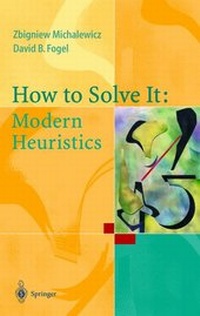
This book is the only source that provides a systematic, integrated introduction to problem solving using modern heuristics, presenting the state-of-the-art in both numerical and analytic methods. It covers classic methods of optimization, including dynamic programming, the simplex method, and gradient techniques, as well as recent innovations such as simulated annealing, tabu search, and evolutionary computation. Integrated into the discourse is a series of problems and puzzles to challenge the reader. Written in a lively, engaging style, readers will learn how to use some of the most powerful problem solving tools currently available.
Reviews / Votes
The March 2002 issue of ACMs Computing Reviews identifies a review of "How to Solve It" as the best review they published in 2001. The review is then reprinted in its entirety. Reviewer: H. van Dyke Parunak.
Excerpt: Like its predecessor, the new How to Solve It, combines deep mathematical insight with skilled pedagogy. Puzzle lovers will seek out the book for its insightful discussion of many intriguing brain twisters. Students of computational methods will find it an accessible but rigorous introduction to evolutionary algorithms. Teachers will learn from its expositions how to make their own subject matter clearer to their students. Polya would be honored to know that his spirit lives on in the computer age.
From the reviews of the second edition:
"This is an outstanding book. It takes the reader close to the current knowledge frontier . . The book's writing style is lively and educational, and this makes it extremely interesting . . is intended for students and practitioners. . is an excellent choice for a course on heuristics . . One of the most comprehensive views . is provided in this book. It is written to be read and understood . . is a must-read and must-have for anyone engaged in the art of problem solving." (Dimitrios Katsaros, Computing Reviews, April, 2005)
Edition
1st ed. 2000. Corr. 3rd printing
Language
Place of publication
Publishing group
Target group
College/higher education
Professional and scholarly
Illustrations
7
7 s/w Tabellen
174 figs., 7 tabs.
Dimensions
Height: 23.5 cm
Width: 15.5 cm
Thickness: 32 mm
Weight
ISBN-13
978-3-540-66061-3 (9783540660613)
DOI
10.1007/978-3-662-04131-4
Schweitzer Classification
I What Are the Ages of My Three Sons?.- 1 Why Are Some Problems Difficult to Solve?.- II How Important Is a Model?.- 2 Basic Concepts.- III What Are the Prices in 7-11?.- 3 Traditional Methods - Part 1.- IV What Are the Numbers?.- 4 Traditional Methods - Part 2.- V What's the Color of the Bear?.- 5 Escaping Local Optima.- VI How Good Is Your Intuition?.- 6 An Evolutionary Approach.- VII One of These Things Is Not Like the Others.- 7 Designing Evolutionary Algorithms.- VIII What Is the Shortest Way?.- 8 The Traveling Salesman Problem.- IX Who Owns the Zebra?.- 9 Constraint-Handling Techniques.- X Can You Tune to the Problem?.- 10 Tuning the Algorithm to the Problem.- XI Can You Mate in Two Moves?.- 11 Time-Varying Environments and Noise.- XII Day of the Week of January 1st.- 12 Neural Networks.- XIII What Was the Length of the Rope?.- 13 Fuzzy Systems.- XIV Do You Like Simple Solutions?.- 14 Hybrid Systems.- 15 Summary.- Appendix A: Probability and Statistics.- A.1 Basic concepts of probability.- A.2 Random variables.- A.2.1 Discrete random variables.- A.2.2 Continuous random variables.- A.3 Descriptive statistics of random variables.- A.4 Limit theorems and inequalities.- A.5 Adding random variables.- A.6 Generating random numbers on a computer.- A.7 Estimation.- A.8 Statistical hypothesis testing.- A.9 Linear regression.- A.10 Summary.- Appendix B: Problems and Projects.- B.1 Trying some practical problems.- B.2 Reporting computational experiments with heuristic methods.- References.