

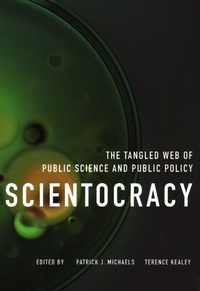
Scientocracy
The Tangled Web of Public Science and Public Policy
Published on 7. November 2019
Book
Paperback/Softback
365 pages
978-1-948647-49-6 (ISBN)
Description
Scientific research is the time-honored key to objective knowledge. In the past it was funded pluralistically, but today certain portions of the market for knowledge are dominated by a single buyer, namely the government. This is especially true in the research fields that impinge on the regulatory sphere, such as pollution and climate change. As discussed in Scientocracy: The Tangled Web of Public Science and Public Policy, science today is in systematic trouble.
The popular notion is that science is a force for good. Knowledge, derived from theory and experiment, gives rise to technological advancement, which results in improved lives for all. The editors and authors of this book believe that this is not always the case. Science can be a force for good, and it has enhanced our lives in countless ways, but even a cursory look at the last century shows that what passes for “science” can be detrimental. This book examines a number of recent abuses of science in research areas including nutrition, pollution, drugs and the opioid crisis, and global warming.
Please don't let this book make you into a science cynic. Science has done much for us under both public and private funding; we certainly live longer, healthier lives! Many fundamental questions have been answered, especially in physics. We look forward to a future of still more vigorous scientific discovery; we ask only that science be structured in a more polycentric manner, and less subject to authoritarian abuse. We believe that the chapters you are about to read will more than justify these desires.
The popular notion is that science is a force for good. Knowledge, derived from theory and experiment, gives rise to technological advancement, which results in improved lives for all. The editors and authors of this book believe that this is not always the case. Science can be a force for good, and it has enhanced our lives in countless ways, but even a cursory look at the last century shows that what passes for “science” can be detrimental. This book examines a number of recent abuses of science in research areas including nutrition, pollution, drugs and the opioid crisis, and global warming.
Please don't let this book make you into a science cynic. Science has done much for us under both public and private funding; we certainly live longer, healthier lives! Many fundamental questions have been answered, especially in physics. We look forward to a future of still more vigorous scientific discovery; we ask only that science be structured in a more polycentric manner, and less subject to authoritarian abuse. We believe that the chapters you are about to read will more than justify these desires.
More details
Language
English
Place of publication
Washington DC
United States
Product notice
Paperback (trade)
Unsewn / adhesive bound
Dimensions
Height: 230 mm
Width: 155 mm
Thickness: 25 mm
Weight
592 gr
ISBN-13
978-1-948647-49-6 (9781948647496)
Copyright in bibliographic data and cover images is held by Nielsen Book Services Limited or by the publishers or by their respective licensors: all rights reserved.
Schweitzer Classification
Persons
Patrick J. Michaels is the director of the Center for the Study of Science at the Cato Institute. Michaels is a past president of the American Association of State Climatologists and was program chair for the Committee on Applied Climatology of the American Meteorological Society. He is the author and editor of several titles including Lukewarming: The New Climate Science that Changes Everything and Climate of Extremes: Global Warming Science They Don't Want You to Know.
Terence Kealey is a professor of clinical biochemistry at the University of Buckingham in the United Kingdom and a senior fellow at the Cato Institute.
Terence Kealey is a professor of clinical biochemistry at the University of Buckingham in the United Kingdom and a senior fellow at the Cato Institute.
Content
Contents
1. Introduction Patrick J. Michaels and Terence Kealey
2. Science and Liberty: A Complicated Relationship Terence Kealey and Patrick J. Michaels
3. Larding the Science: The Dietary Fat Fiasco Terence Kealey
4. Heads in the Sand: How Politics Created the Salt-Hypertension Myth Michelle Minton
5. Death: The Unintended Consequence of the War on Opoids Jeffrey A. Singer
6. Drugs: The Systematic Prohibition of U. S. Science Trevor Burrus
7. Medical Innovation and the “Government-Academic-Biomedical Complex” Thomas R. Stossel
8. Regulation of Carcinogens and Chemicals: What Went Wrong Edward N. Calabrese
9. Radiation Poisoning Patrick J. Michaels
10. Can Politics Turn Gold into Dross? The Story of Alaska's Pebble Mine Ned Mamula
11. Endangered Science and the EPA's Finding of Endangerment from Carbon Dioxide Patrick J. Michaels
12. EPA's Conflicted Science on Fine Particulate Mortality Jason Scott Johnson
1. Introduction Patrick J. Michaels and Terence Kealey
2. Science and Liberty: A Complicated Relationship Terence Kealey and Patrick J. Michaels
3. Larding the Science: The Dietary Fat Fiasco Terence Kealey
4. Heads in the Sand: How Politics Created the Salt-Hypertension Myth Michelle Minton
5. Death: The Unintended Consequence of the War on Opoids Jeffrey A. Singer
6. Drugs: The Systematic Prohibition of U. S. Science Trevor Burrus
7. Medical Innovation and the “Government-Academic-Biomedical Complex” Thomas R. Stossel
8. Regulation of Carcinogens and Chemicals: What Went Wrong Edward N. Calabrese
9. Radiation Poisoning Patrick J. Michaels
10. Can Politics Turn Gold into Dross? The Story of Alaska's Pebble Mine Ned Mamula
11. Endangered Science and the EPA's Finding of Endangerment from Carbon Dioxide Patrick J. Michaels
12. EPA's Conflicted Science on Fine Particulate Mortality Jason Scott Johnson