

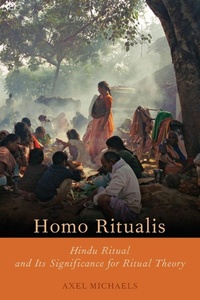
Homo Ritualis
Hindu Ritual and Its Significance to Ritual Theory
Published on 7. January 2016
Book
Paperback/Softback
400 pages
978-0-19-026263-1 (ISBN)
Description
Are the richness and diversity of rituals and celebrations in South Asia unique? Can we speak of a homo ritualis when it comes to India or Hinduism? Are Indians or Hindus more involved in rituals than other people? If so, what makes them special? Homo Ritualis is the first book to present a Hindu theory of rituals. Based on extensive textual studies and field-work in Nepal and India, Axel Michaels argues that ritual is a distinctive way of acting, which, as in the theater, can be distinguished from other forms of action. The book analyzes ritual in these cultural-specific and religious contexts, taking into account how indigenous terms and theories affect and contribute to current ritual theory. It describes and investigates various forms of Hindu rituals and festivals, such as life-cycle rituals, the Vedic sacrifice, vows processions, and the worship of deities (puja). It also examines conceptual components of (Hindu) rituals such as framing, formality, modality, and theories of meaning.
Reviews / Votes
Michaels's book is a positive contribution to ritual studies and to the study of Hindu ritual within the larger conversation of ritual theory. The ethno-Indological approach taken by Michaels is, furthermore, an innovative and rewarding method for the study of Hindu ritual, particularly as these two fieldsethnography and Indologyhave sometimes been seen as at odds with each other. * Adam Newman, Reading Religion * Michaels's key contributions are twofold: first, he offers a unifying theory of the complex structure and variety of South Asian ritual performances in their own hermeneutical terms, and second he demonstrates that a theoretically sophisticated understanding of such rituals can make significant contributions to the field of ritual studies. * Jarrod Whitaker, Journal of Religion *More details
Series
Language
English
Place of publication
New York
United States
Target group
College/higher education
Illustrations
3 illustrations
Dimensions
Height: 234 mm
Width: 156 mm
Thickness: 23 mm
Weight
672 gr
ISBN-13
978-0-19-026263-1 (9780190262631)
Copyright in bibliographic data and cover images is held by Nielsen Book Services Limited or by the publishers or by their respective licensors: all rights reserved.
Schweitzer Classification
Other editions
Additional editions
Book
01/2016
Oxford University Press Inc
€221.50
Shipment within 15-20 days

E-Book
12/2015
1st Edition
OUP eBook
€24.99
Available for download

E-Book
11/2015
1st Edition
OUP eBook
€34.99
Available for download
Person
Axel Michaels is Professor of Classical Indology in the South Asia Institute at the University of Heidelberg.
Content
Preface ; Acknowledgements ; Abbreviations ; Plates and Figures ; Pronunciation of Indian Words ; Introduction ; Part I: Framing ; 1. The Beginning of Rituals ; 1.1 The Solemn Intention (samkalpa) ; 1.2 Greeting and Ritualized Greeting (namaskara) ; Conclusion ; Part II: Formality ; 2. Repetitive Rules (vidhi) ; 2.1 The Grammar of Rituals ; 2.2 A Preliminary "Grammar" of Newar Life-cycle Rituals ; 2.3 Rituals in Handbooks (paddhati) ; 3. Agency in Ritual ; 3.1 Ritual Competency (adhikara) ; 3.2 Atonements for Ritual Mishaps (prayascitta) ; 3.3 The Comic Side of Ritual Formality ; 4. Performed and Played Rituals (lila) ; 4.1 Music and Ritual Music ; 4.2 Dance and Ritual Dance ; 4.3 Emotions and Ritual Emotions ; Conclusion ; Part III: Modality ; 5. Individualized and Domestic Rituals (samskara) ; 5.1 The Boy's Initiation ; 5.2 The Girl's Initiation ; 5.3 The Marriage ; 5.4 Death Rituals and Redemption ; 6. Collective and Public Rituals ; 6.1 Temple Festivals (utsava) ; 6.2 Vows (vrata) ; 6.3 Pilgrimages and Processions (yatra) ; 7. Transcendence in Rituals ; 7.1 The Vedic Sacrifice (yajna) ; 7.2 The Fire Sacrifice (homa) ; 7.3 Worship and Prayer (puja) ; 7.4 E-darshan and Cyber-puja ; Conclusion ; Part IV: Meaning ; 8. Meaning and Function ; 8.1 The Cultural Studies Approach ; 8.2 The Cognitive Sciences approach ; 9. The Purvamimamsa Theory of Ritual Efficacy ; Conclusion ; Part V: The Hindu Path of Ritual-Summary ; Appendix: Automatic Detection of Ritual Structures ; Glossary ; References