

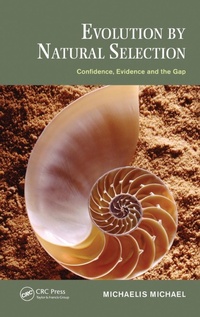
Evolution by Natural Selection
Confidence, Evidence and the Gap
1st Edition
Published on 9. December 2015
Book
Hardback
176 pages
978-1-4987-0087-0 (ISBN)
Description
A persistent argument among evolutionary biologists and philosophers revolves around the nature of natural selection. Evolution by Natural Selection: Confidence, Evidence and the Gap explores this argument by using a theory of persistence as an intentional foil to examine ways in which similar theories can be misunderstood. It discusses Charles Darwin's theory of natural selection, including what the theory says, what it aims to explain, and how it manages to explain natural selection.
Darwin's theory is so familiar today that it feels universally understood. However, the fact that there are so divergent views about the theory means that not everyone who thinks he or she understands it can be right. This book describes the history of evolutionary theory as a sequence of theoretical developments, not all of which can be considered improvements. In particular, it suggests that some attempts to use the theory of natural selection end up reshaping the concepts involved so that they can be applied more easily to the world. As a result, the theory is stripped of some of its explanatory power and becomes detached from the empiricism that good scientific examination requires.
With these issues in mind, Evolution by Natural Selection shows there are aspects of the theory of natural selection that are not totally understood. These misunderstandings create problems in uses of the theory. At a time when selectionist explanations are being brought forward to explain an ever-widening range of phenomena, this book analyzes the explanatory structure of Darwin's theory. It takes a much-needed thoughtful look into the working parts of the theory of natural selection to provide better understanding of the theory and its role in contemporary science and life.
Darwin's theory is so familiar today that it feels universally understood. However, the fact that there are so divergent views about the theory means that not everyone who thinks he or she understands it can be right. This book describes the history of evolutionary theory as a sequence of theoretical developments, not all of which can be considered improvements. In particular, it suggests that some attempts to use the theory of natural selection end up reshaping the concepts involved so that they can be applied more easily to the world. As a result, the theory is stripped of some of its explanatory power and becomes detached from the empiricism that good scientific examination requires.
With these issues in mind, Evolution by Natural Selection shows there are aspects of the theory of natural selection that are not totally understood. These misunderstandings create problems in uses of the theory. At a time when selectionist explanations are being brought forward to explain an ever-widening range of phenomena, this book analyzes the explanatory structure of Darwin's theory. It takes a much-needed thoughtful look into the working parts of the theory of natural selection to provide better understanding of the theory and its role in contemporary science and life.
More details
Series
Language
English
Place of publication
Bosa Roca
United States
Publishing group
Taylor & Francis Inc
Target group
College/higher education
Professional and scholarly
Illustrations
6 s/w Abbildungen
6 Illustrations, black and white
Dimensions
Height: 240 mm
Width: 161 mm
Thickness: 14 mm
Weight
438 gr
ISBN-13
978-1-4987-0087-0 (9781498700870)
Copyright in bibliographic data and cover images is held by Nielsen Book Services Limited or by the publishers or by their respective licensors: all rights reserved.
Schweitzer Classification
Other editions
Additional editions
Book
03/2021
1st Edition
CRC Press
€72.70
Shipment within 15-20 days
E-Book
11/2015
CRC Press
€67.49
Available for download
E-Book
11/2015
CRC Press
€67.49
Available for download
Person
Michaelis Michael studied zoology and philosophy at Monash University in Melbourne, Australia, before receiving his PhD in philosophy from Princeton University. He works across a number of areas in philosophy, from human rights to formal logic. He has recently published articles and contributed chapters on the role of noncognitive factors in religious conversion, on the metaphysics of the mind, and against the idea of adopting deviant logics to deal with inconsistent theories in science.
Content
Introduction. The Circularity Argument. Resolving the Problem of Circularity. Darwin's Key Argument for Evolution by Natural Selection. Explanation, Causation, and Counterfactuals. Philip Henry Gosse and the Geological Knot. Heritability of Characteristics: The Role of Genetics and Epigenetics. Concluding Remarks.