

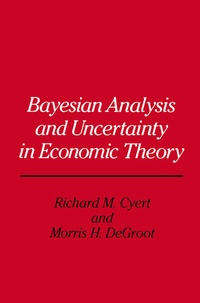
Bayesian Analysis and Uncertainty in Economic Theory
Published on 12. October 2011
Book
Paperback/Softback
XVI, 206 pages
978-94-010-7922-8 (ISBN)
Description
We began this research with the objective of applying Bayesian methods of analysis to various aspects of economic theory. We were attracted to the Bayesian approach because it seemed the best analytic framework available for dealing with decision making under uncertainty, and the research presented in this book has only served to strengthen our belief in the appropriateness and usefulness of this methodology. More specif ically, we believe that the concept of organizational learning is funda mental to decision making under uncertainty in economics and that the Bayesian framework is the most appropriate for developing that concept. The central and unifying theme of this book is decision making under uncertainty in microeconomic theory. Our fundamental aim is to explore the ways in which firms and households make decisions and to develop models that have a strong empirical connection. Thus, we have attempted to contribute to economic theory by formalizing models of the actual pro cess of decision making under uncertainty. Bayesian methodology pro vides the appropriate vehicle for this formalization.
More details
Edition
Softcover reprint of the original 1st ed. 1987
Language
English
Place of publication
Dordrecht
Netherlands
Target group
Professional and scholarly
Research
Illustrations
XVI, 206 p.
Dimensions
Height: 235 mm
Width: 155 mm
Thickness: 13 mm
Weight
347 gr
ISBN-13
978-94-010-7922-8 (9789401079228)
DOI
10.1007/978-94-009-3163-3
Schweitzer Classification
Other editions
Additional editions

Morris H. DeGroot | Richard Michael Cyert
Bayesian Analysis and Uncertainty in Economic Theory
Book
07/1987
Chapman and Hall
€89.13
Article exhausted; check different version
Content
1 Introduction.- 2 Bayesian Decision Theory.- 3 Behavioral and Control Theory of the Firm.- 4 Bayesian Analysis and Duopoly Theory.- 5 Multiperiod Decision Models with Alternating Choice as a Solution to the Duopoly Problem.- 6 Cooperation and Learning in a Duopoly Context.- 7 Interfirm Learning and the Kinked Demand Curve.- 8 Sequential Strategies in Dual Control Problems.- 9 Adaptive Utility.- 10 Some Examples of Adaptive Utility.- 11 Sequential Investment Decisions.- 12 Capital Allocation within Firms.- 13 Rational Expectations.- 14 Epilogue.- References.- Author Index.