

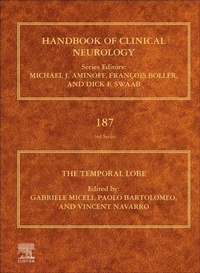
The Temporal Lobe: Volume 187
Volume 187
Published on 15. December 2022
Book
Hardback
580 pages
978-0-12-823493-8 (ISBN)
Description
The Temporal Lobe, Volume 187 covers the exponential growth of studies on the relationships between brain and language/cognition, many of which involved the temporal lobe. This volume summarizes research on the anatomy and function of the temporal lobe under both normal and pathological conditions. In addition, it discusses the interactions of the temporal lobe with other brain structures. The book highlights the role of the temporal lobe in language processing as well as vision, object, face recognition and processing. The book also discusses the temporal lobe's role in reading, speech and the processing of color, music, action and memory.
Temporal lobe disorders, assessments and treatments are also covered, including encephalitis, Alzheimer's, epilepsy, Korsakov's syndrome, and more.
Temporal lobe disorders, assessments and treatments are also covered, including encephalitis, Alzheimer's, epilepsy, Korsakov's syndrome, and more.
More details
Series
Language
English
Place of publication
United States
Target group
Professional and scholarly
Clinical neurologists
Product notice
sewn/stitched
Cloth over boards
Dimensions
Height: 267 mm
Width: 198 mm
Thickness: 36 mm
Weight
1474 gr
ISBN-13
978-0-12-823493-8 (9780128234938)
Copyright in bibliographic data and cover images is held by Nielsen Book Services Limited or by the publishers or by their respective licensors: all rights reserved.
Schweitzer Classification
Other editions
Additional editions
Persons
Gabriele Miceli MD is senior professor of neurology at the Center for Mind/Brain Sciences, University of Trento (also seconded to the Accademia dei Lincei, Rome, for the period 2018-2021). He leads the team "Cognitive Neuroscience of Language?. His clinical and research work focuses on the cognitive neuroscience of language. He is a member of the Editorial Board of Brain and Language and Cognitive Neuropsychology, and of the Advisory board of the Ecole Normale Superieure, Paris and of the Institut de Mondor de Recherche Biomedicale, Creteil. Paolo Bartolomeo, MD PhD is a neurologist and research director at the French biomedical research institute (Inserm). He leads the team "Physiological Investigations of Clinically Normal and Impaired Cognition? at the Brain and Spine Institute (ICM) in Paris, France. He has developed extensive work in the field of cognitive neuroscience, in particular on human attention and perception, and on their deficits after brain damage. He is action editor for the journal Cortex. Vincent Navarro, MD, PhD is full professor of neurology at Sorbonne Universite. He leads the epilepsy Unit and the EEG laboratory, in the Pitie-Salpetriere Hospital, in Paris, France. He leads the Center of Reference for Rare Epilepsies for adults in Paris.
He is co-director of the team "Dynamics of epileptic networks and neuronal excitability?, in the Paris Brain Institute. His clinical and research works focus on pathophysiology of focal epilepsies-based on in vivo and in vitro electrophysiological recordings-, on status epilepticus and autoimmune epilepsies.
He is co-director of the team "Dynamics of epileptic networks and neuronal excitability?, in the Paris Brain Institute. His clinical and research works focus on pathophysiology of focal epilepsies-based on in vivo and in vitro electrophysiological recordings-, on status epilepticus and autoimmune epilepsies.
Volume editor
Senior Professor of Neurology, Center for Mind/Brain Sciences, University of Trento, Rovereto, Italy; Centro Interdisciplinare Linceo 'Beniamino Segre', Accademia dei Lincei, Rome, Italy
Sorbonne Universite, Institut du Cerveau - Paris Brain Institute - ICM, Inserm, CNRS, AP-HP, Hopital de la Pitie-Salpetriere, Paris, France
Sorbonne Universite, Paris Brain Institute - ICM, INSERM, CNRS, Paris, France;
AP-HP, Pitie-Salpetriere Hospital, DMU Neurosciences, Epilepsy Unit and Clinical Neurophysiology Department, Paris, France;
Center of Reference for Rare Epilepsies, Pitie-Salpetriere Hospital, Paris, France
AP-HP, Pitie-Salpetriere Hospital, DMU Neurosciences, Epilepsy Unit and Clinical Neurophysiology Department, Paris, France;
Center of Reference for Rare Epilepsies, Pitie-Salpetriere Hospital, Paris, France
Content
Section I. Introduction
1. The connectional anatomy of the temporal lobe
2. Anatomy of the temporal lobe: From macro to micro
Section II. Structure/functions of the T Lobe, as they emerge from studies in healthy participants and brain-damaged populations
3. Music processing and amusia
4. Cortical disorders of speech processing: Pure word deafness and auditory agnosia
5. Neuroplasticity following cochlear implants
6. Components of language processing and their long-term and working memory storage in the brain
7. Cross-modal integration and plasticity in the superior temporal cortex
8. Visual mental imagery: Inside the mind's eyes
9. The functions of the temporal-parietal junction
10. Visual objects and their colors
11. Face processing in the temporal lobe
12. The neural underpinnings of word comprehension and production: The critical roles of the temporal lobes
13. Domain-specific connectivity drives the organization of object knowledge in the temporal lobe
14. The noun-verb distinction
15. The neural correlates of abstract and concrete words
16. Acquired dyslexias following temporal lesions
17. Proper names and personal identity
18. Neural correlates of recognition and naming of famous persons and landmarks: A special role for the left anterior temporal lobe
19. The temporal lobes and memory
20. Working memory and active sampling of the environment: Medial temporal contributions
21. Amygdala function in emotion, cognition, and behavior
22. Amygdala connectivity and implications for social cognition and disorders
Section III. Diseases of/in the temporal lobe
23. Neuropathology of the temporal lobe
24. Frontotemporal dementia: A unique window on the functional role of the temporal lobes
25. The temporal lobe in typical and atypical Alzheimer disease
26. Limbic encephalitis
27. Semiology, EEG, and neuroimaging findings in temporal lobe epilepsies
28. Neuropsychology of temporal lobe epilepsies
29. Surgery procedures in temporal lobe epilepsies
1. The connectional anatomy of the temporal lobe
2. Anatomy of the temporal lobe: From macro to micro
Section II. Structure/functions of the T Lobe, as they emerge from studies in healthy participants and brain-damaged populations
3. Music processing and amusia
4. Cortical disorders of speech processing: Pure word deafness and auditory agnosia
5. Neuroplasticity following cochlear implants
6. Components of language processing and their long-term and working memory storage in the brain
7. Cross-modal integration and plasticity in the superior temporal cortex
8. Visual mental imagery: Inside the mind's eyes
9. The functions of the temporal-parietal junction
10. Visual objects and their colors
11. Face processing in the temporal lobe
12. The neural underpinnings of word comprehension and production: The critical roles of the temporal lobes
13. Domain-specific connectivity drives the organization of object knowledge in the temporal lobe
14. The noun-verb distinction
15. The neural correlates of abstract and concrete words
16. Acquired dyslexias following temporal lesions
17. Proper names and personal identity
18. Neural correlates of recognition and naming of famous persons and landmarks: A special role for the left anterior temporal lobe
19. The temporal lobes and memory
20. Working memory and active sampling of the environment: Medial temporal contributions
21. Amygdala function in emotion, cognition, and behavior
22. Amygdala connectivity and implications for social cognition and disorders
Section III. Diseases of/in the temporal lobe
23. Neuropathology of the temporal lobe
24. Frontotemporal dementia: A unique window on the functional role of the temporal lobes
25. The temporal lobe in typical and atypical Alzheimer disease
26. Limbic encephalitis
27. Semiology, EEG, and neuroimaging findings in temporal lobe epilepsies
28. Neuropsychology of temporal lobe epilepsies
29. Surgery procedures in temporal lobe epilepsies