

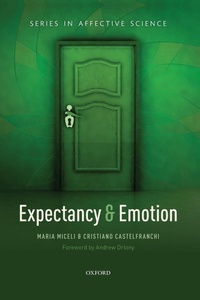
Expectancy and emotion
Published on 27. November 2014
Book
Hardback
278 pages
978-0-19-968586-8 (ISBN)
Description
The mind is a powerful anticipatory device. It frequently makes predictions about the future, telling us not only how the world might or will be, but also how it should be - or better - how we would like it to be. These expectancies shape our lives: they impact on our actual outcomes, often acting as self-fulfilling prophecies. They also constitute a reference point for establishing whether an outcome is a loss or a gain; that is, we evaluate our own outcomes not in absolute terms, but against our expectancies. And we feel ill-treated and betrayed when our expectancies are disappointed.
This book explores anticipation-based emotions, that is, the emotions associated with the dialectical interaction between 'what is' and 'what is not (yet)', be it a mere wished-for possibility or an expectation proper. It offers an analysis of both the emotions implying anticipations of future events - such as fear, anxiety, hope, and trust - and those elicited by the disconfirmation of a previous anticipation - surprise, disappointment, discouragement, sense of injustice, regret, and relief - in terms of their belief and goal components. In addition, it addresses anticipated emotions, that is, emotions we think we might experience in future circumstances, and explores how they influence our decisions. The reader will be taken on a journey of exploration and discovery into the multifarious facets and implications of an important family of emotions, aimed at understanding what they have in common, as well as the distinguishing features of each distinct emotion, and predicting their motivational and behavioral consequences.
For students and researchers interested in the affective sciences, including psychology, philosophy, and neuroscience, this is a highly original and thought provoking new work.
This book explores anticipation-based emotions, that is, the emotions associated with the dialectical interaction between 'what is' and 'what is not (yet)', be it a mere wished-for possibility or an expectation proper. It offers an analysis of both the emotions implying anticipations of future events - such as fear, anxiety, hope, and trust - and those elicited by the disconfirmation of a previous anticipation - surprise, disappointment, discouragement, sense of injustice, regret, and relief - in terms of their belief and goal components. In addition, it addresses anticipated emotions, that is, emotions we think we might experience in future circumstances, and explores how they influence our decisions. The reader will be taken on a journey of exploration and discovery into the multifarious facets and implications of an important family of emotions, aimed at understanding what they have in common, as well as the distinguishing features of each distinct emotion, and predicting their motivational and behavioral consequences.
For students and researchers interested in the affective sciences, including psychology, philosophy, and neuroscience, this is a highly original and thought provoking new work.
Reviews / Votes
In all my years of thinking about the various types of emotions and how best to characterize their differences, as well as my thinking about the nature of surprise, I have never been able to be as insightful, as profound, and as rigorous as these two authors are in this book. What they have done is not only unique, it is brilliant. As I read it, I stopped worrying about whether I agreed with them that this or that mental state is or isn't an emotion. Instead, I realized that sometimes it doesn't matter-that what matters is that there is a family of interesting and psychologically important, related states that we need to understand, regardless of how we categorize them. To make a die-hard purist like me ignore my prejudices is quite an achievement, and yet I feel all the better for it-indeed, almost liberated! Quite simply, this is wonderful, compelling book for which I heartily congratulate my friends, the authors. I loved reading it; I wish I had written it. * Andrew Ortony *More details
Series
Language
English
Place of publication
Oxford
United Kingdom
Target group
College/higher education
Dimensions
Height: 260 mm
Width: 183 mm
Thickness: 20 mm
Weight
723 gr
ISBN-13
978-0-19-968586-8 (9780199685868)
Copyright in bibliographic data and cover images is held by Nielsen Book Services Limited or by the publishers or by their respective licensors: all rights reserved.
Schweitzer Classification
Other editions
Additional editions
Maria Miceli | Cristiano Castelfranchi
Expectancy and emotion
E-Book
11/2014
1st Edition
OUP eBook
€42.99
Available for download
Maria Miceli | Cristiano Castelfranchi
Expectancy and emotion
E-Book
11/2014
1st Edition
OUP eBook
€50.49
Available for download
Persons
Maria Miceli, a social psychologist with a background in philosophy, is a senior researcher at the Institute of Cognitive Sciences and Technologies of the Italian National Research Council (ISTC-CNR) in Rome, where she is a member of the Goal-Oriented Agents Lab. Her research activity focuses on the cognitive aspects of social mechanisms and processes and their interplay with motivational and emotional components, and on modelling architectures of intelligent autonomous agents endowed with social capabilities. Topics of interest include: kinds and processes of evaluation; values; self-esteem and defense strategies; loneliness; dependence, help-giving and help-seeking; loss of motivation; helplessness and crying; guilt and guilt-inducement strategies; anticipation and related emotions; social comparison and related emotions; persuasion strategies, with special reference to emotional strategies; comfort as a special form of social support; forgiveness.
Cristiano Castelfranchi is professor of economical psychology at the LUISS University in Rome (2007-present), and full professor of social psychology at the Uninettuno international telematic university (2008-present). He has been full professor of general psychology at the University of Siena (2001-2011), and director of the ISTC-CNR in Rome (2002-2011), where he is presently coordinator of the Goal-Oriented Agents Lab. A cognitive scientist with a background in linguistics and psychology, he is also active in the multi-agent systems and social simulation communities. He introduced the study of goal-directed action and normative behavior in distributed artificial intelligence, and at the same time championed the use of the autonomous agents paradigm and social simulation in cognitive psychology and social science.
Cristiano Castelfranchi is professor of economical psychology at the LUISS University in Rome (2007-present), and full professor of social psychology at the Uninettuno international telematic university (2008-present). He has been full professor of general psychology at the University of Siena (2001-2011), and director of the ISTC-CNR in Rome (2002-2011), where he is presently coordinator of the Goal-Oriented Agents Lab. A cognitive scientist with a background in linguistics and psychology, he is also active in the multi-agent systems and social simulation communities. He introduced the study of goal-directed action and normative behavior in distributed artificial intelligence, and at the same time championed the use of the autonomous agents paradigm and social simulation in cognitive psychology and social science.
Content
1. Introduction ; 2. Anticipation and Emotion: Basic Premises ; 3. Anticipation and Emotion: a Two-Way Road ; 4. Kinds of Anticipatory Representations ; 5. Emotions Elicited by Invalidated Anticipatory Representations ; 6. Anticipatory Emotions ; 7. Anticipated Emotions ; 8. The Value of a Cognitive-Motivational Anatomy of Emotions: The Family of Anticipation-Based Emotions ; 9. References