

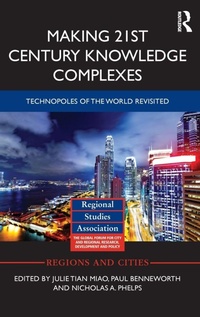
Making 21st Century Knowledge Complexes
Technopoles of the world revisited
1st Edition
Published on 19. May 2015
Book
Hardback
300 pages
978-0-415-72779-2 (ISBN)
Description
The world has changed profoundly since the publication of the influential book Technopoles of the World. As policy-makers and practitioners attempt to harness science, technology and innovation to create dynamic and vibrant cities many wonder how relevant Manuel Castells and Peter Hall's messages are today. Twenty years later, this book returns to their concepts and practices to update their message for the 21st century.
Making 21st Century Knowledge Complexes: Technopoles of the World Revisited argues that the contemporary technopole concept encompasses three new dimensions. Firstly, building synergy between partners is vital for the success of complexes. Secondly, the correct governance arrangements are critical to balance competing interests inevitable in any science city project. Thirdly, new evaluation mechanisms are indispensable in allowing policy-makers to steer their long-term benefits.
Through twelve case study chapters and a detailed comparative analysis, this book provides academics, policy-makers and practitioners with critical insights in understanding, managing and promoting today's high-technology urban complexes.
Making 21st Century Knowledge Complexes: Technopoles of the World Revisited argues that the contemporary technopole concept encompasses three new dimensions. Firstly, building synergy between partners is vital for the success of complexes. Secondly, the correct governance arrangements are critical to balance competing interests inevitable in any science city project. Thirdly, new evaluation mechanisms are indispensable in allowing policy-makers to steer their long-term benefits.
Through twelve case study chapters and a detailed comparative analysis, this book provides academics, policy-makers and practitioners with critical insights in understanding, managing and promoting today's high-technology urban complexes.
More details
Series
Language
English
Place of publication
London
United Kingdom
Publishing group
Taylor & Francis Ltd
Target group
College/higher education
Illustrations
22 s/w Abbildungen, 3 s/w Photographien bzw. Rasterbilder, 19 s/w Zeichnungen, 22 s/w Tabellen
22 Tables, black and white; 19 Line drawings, black and white; 3 Halftones, black and white; 22 Illustrations, black and white
Dimensions
Height: 240 mm
Width: 161 mm
Thickness: 22 mm
Weight
652 gr
ISBN-13
978-0-415-72779-2 (9780415727792)
Copyright in bibliographic data and cover images is held by Nielsen Book Services Limited or by the publishers or by their respective licensors: all rights reserved.
Schweitzer Classification
Other editions
Additional editions
Julie Miao | Paul Benneworth | Nicholas A. Phelps
Making 21st Century Knowledge Complexes
Technopoles of the world revisited
Book
07/2018
1st Edition
Routledge
€71.90
Shipment within 10-20 days
Julie Miao | Paul Benneworth | Nicholas A. Phelps
Making 21st Century Knowledge Complexes
Technopoles of the world revisited
E-Book
05/2015
Routledge
€64.49
Available for download
Julie Miao | Paul Benneworth | Nicholas A. Phelps
Making 21st Century Knowledge Complexes
Technopoles of the world revisited
E-Book
05/2015
Routledge
€64.49
Available for download
Persons
Julie Tian Miao is Lecturer in Urban Planning and Development, University of Glasgow, UK.
Paul Benneworth is a Senior Researcher at the Center for Higher Education Policy Studies (CHEPS) at the University of Twente, the Netherlands.
Nicholas A. Phelps is Professor of Urban and Regional Development, The Bartlett School of Planning, University College London, UK.
Paul Benneworth is a Senior Researcher at the Center for Higher Education Policy Studies (CHEPS) at the University of Twente, the Netherlands.
Nicholas A. Phelps is Professor of Urban and Regional Development, The Bartlett School of Planning, University College London, UK.
Content
1. Technopoles of the World, the changes, the dynamics, and the challenges 2. The Entrepreneurial University as a Technopole Platform: A Global Phenomenon 3. Back to the future of high technology fantasies? Reframing the role of knowledge parks and science cities in innovation based economic development 4. Synergy management at knowledge locations 5. From technopoles to science cities: characteristics of a new phase of science cities 6. Context matters: the English Science Cities and visions for knowledge-based urbanism 7. Spatial planning and technopole development: the case of Hsinchu high-tech city region, Taiwan 8. Suburbs in the cognitive-cultural capitalist economy: limits to the suburban knowledge and creative strategies in Madrid and Lisbon 9. Urban innovation as urban redevelopment in Spain? the Janus-face of Barcelona's science and technology parks 10. The influence of Science and Technology Parks' characteristics on firms' innovation results 11. Stories behind science parks: resources and networking in Optical Valley of China, Wuhan 12. The Effect of Localisation and Urbanisation Economies on Malaysian Science and Technology Parks: the case of Kulim Hi-tech Park and Technology Park Corporation, Malaysia 13. Science parks and their contribution to regional development: The example of the Campus Tulln Technopole 14. Old and new lessons for Technopoles