

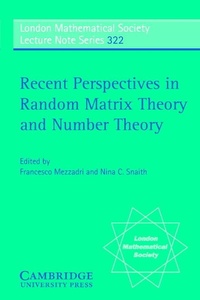
Recent Perspectives in Random Matrix Theory and Number Theory
Published on 21. June 2005
Book
Paperback/Softback
532 pages
978-0-521-62058-1 (ISBN)
Description
In recent years the application of random matrix techniques to analytic number theory has been responsible for major advances in this area of mathematics. As a consequence it has created a new and rapidly developing area of research. The aim of this book is to provide the necessary grounding both in relevant aspects of number theory and techniques of random matrix theory, as well as to inform the reader of what progress has been made when these two apparently disparate subjects meet. This volume of proceedings is addressed to graduate students and other researchers in both pure mathematics and theoretical physics. The contributing authors, who are among the world leading experts in this area, have taken care to write self-contained lectures on subjects chosen to produce a coherent volume.
More details
Series
Language
English
Place of publication
Cambridge
United Kingdom
Target group
Professional and scholarly
Product notice
Paperback (trade)
Illustrations
Worked examples or Exercises
Dimensions
Height: 229 mm
Width: 152 mm
Thickness: 31 mm
Weight
854 gr
ISBN-13
978-0-521-62058-1 (9780521620581)
Copyright in bibliographic data and cover images is held by Nielsen Book Services Limited or by the publishers or by their respective licensors: all rights reserved.
Schweitzer Classification
Other editions
Additional editions
F. Mezzadri | N. C. Snaith
Recent Perspectives in Random Matrix Theory and Number Theory
E-Book
01/2011
1st Edition
Cambridge University Press
€82.99
Available for download
Persons
Francesco Mezzadri is a Lecturer in Applied Mathematics at the University of Bristol. Nina Snaith is a Lecturer in Applied Mathematics at the University of Bristol.
Content
1. Introduction; 2. Prime number theory and the Riemann zeta-function; 3. Notes on pair correlation of zeros and prime numbers; 4. Notes on eigenvalue distributions for the classical compact groups; 5. Compound nucleus resonances, random matrices and quantum chaos; 6. Families of L-functions and 1-level densities; 7. Basic analytic number theory; 8. Applications of mean value theorems to the theory of the Riemann zeta function; 9. L-functions and the characteristic polynomials of random matrices; 10. Mock gaussian behaviour; 11. Some specimens of L-functions; 12. Computational methods and experiments in analytic number theory.