

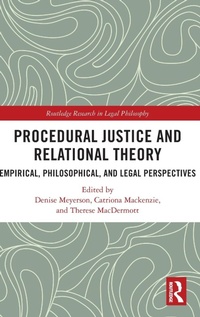
Procedural Justice and Relational Theory
Empirical, Philosophical, and Legal Perspectives
1st Edition
Published on 30. October 2020
Book
Hardback
274 pages
978-0-367-32172-7 (ISBN)
Description
This book bridges a scholarly divide between empirical and normative theorizing about procedural justice in the context of relations of power between citizens and the state.
Empirical research establishes that people's understanding of procedural justice is shaped by relational factors. A central premise of this volume is that this research is significant but needs to be complemented by normative theorizing that draws on relational theories of ethics and justice to explain the moral significance of procedures and make normative sense of people's concerns about relational factors. The chapters in Part 1 provide comprehensive reviews of empirical studies of procedural justice in policing, courts and prisons. Part 2 explores empirical and normative perspectives on procedural justice and legitimacy. Part 3 examines philosophical approaches to procedural justice. Part 4 considers the implications of a relational perspective for the design of procedures in a range of legal contexts.
This collection will be of interest to a wide academic readership in philosophy, law, psychology and criminology.
Empirical research establishes that people's understanding of procedural justice is shaped by relational factors. A central premise of this volume is that this research is significant but needs to be complemented by normative theorizing that draws on relational theories of ethics and justice to explain the moral significance of procedures and make normative sense of people's concerns about relational factors. The chapters in Part 1 provide comprehensive reviews of empirical studies of procedural justice in policing, courts and prisons. Part 2 explores empirical and normative perspectives on procedural justice and legitimacy. Part 3 examines philosophical approaches to procedural justice. Part 4 considers the implications of a relational perspective for the design of procedures in a range of legal contexts.
This collection will be of interest to a wide academic readership in philosophy, law, psychology and criminology.
More details
Series
Language
English
Place of publication
London
United Kingdom
Publishing group
Taylor & Francis Ltd
Target group
College/higher education
Postgraduate
Illustrations
3 s/w Zeichnungen, 1 s/w Tabelle
1 Tables, black and white; 3 Line drawings, black and white
Dimensions
Height: 240 mm
Width: 161 mm
Thickness: 20 mm
Weight
596 gr
ISBN-13
978-0-367-32172-7 (9780367321727)
Copyright in bibliographic data and cover images is held by Nielsen Book Services Limited or by the publishers or by their respective licensors: all rights reserved.
Schweitzer Classification
Other editions
Additional editions
Denise Meyerson | Catriona Mackenzie | Therese MacDermott
Procedural Justice and Relational Theory
Empirical, Philosophical, and Legal Perspectives
Book
04/2022
1st Edition
Routledge
€65.60
Shipment within 15-20 days
Denise Meyerson | Catriona Mackenzie | Therese MacDermott
Procedural Justice and Relational Theory
Empirical, Philosophical, and Legal Perspectives
E-Book
10/2020
1st Edition
Routledge
€0.00
Available for download
Denise Meyerson | Catriona Mackenzie | Therese MacDermott
Procedural Justice and Relational Theory
Empirical, Philosophical, and Legal Perspectives
E-Book
10/2020
1st Edition
Routledge
€0.00
Available for download
Persons
Denise Meyerson, Macquarie Law School, Macquarie University, Sydney.
Catriona Mackenzie, Department of Philosophy, Macquarie University, Sydney.
Therese MacDermott, Macquarie Law School, Macquarie University, Sydney.
Catriona Mackenzie, Department of Philosophy, Macquarie University, Sydney.
Therese MacDermott, Macquarie Law School, Macquarie University, Sydney.
Content
Introduction: procedural justice in law, psychology, and philosophy
Part I Procedural justice in policing, courts and prisons: empirical reviews
1. The empirical study of procedural justice policing in Australia: highlights and challenges
2. Procedural fairness and jury satisfaction: an analysis of relational dimensions
3. Procedural justice in corrections
Part II Procedural justice and legitimacy: empirical and normative perspectives
4. Procedural justice, legitimacy and social contexts
5. Procedure-content interaction in attitudes to law and in the value of the rule of law: an empirical and philosophical collaboration
6. Legal legitimacy and the relevance of participatory procedures
Part III The concept of procedural justice: philosophical perspectives
7. The inadequacy of instrumentalist theories of procedural justice
8. The many facets of procedural justice in legal proceedings
9. Procedural justice, relational equality and self-respect
Part IV Implications and applications: legal institutions and the exercise of legal authority.
10. Racial profiling as pejorative discrimination
11. Administrative discretion and governing relationships: situating procedural fairness
12. The framing of tribunal procedures: a question of balance or a participation-centred approach?
Part I Procedural justice in policing, courts and prisons: empirical reviews
1. The empirical study of procedural justice policing in Australia: highlights and challenges
2. Procedural fairness and jury satisfaction: an analysis of relational dimensions
3. Procedural justice in corrections
Part II Procedural justice and legitimacy: empirical and normative perspectives
4. Procedural justice, legitimacy and social contexts
5. Procedure-content interaction in attitudes to law and in the value of the rule of law: an empirical and philosophical collaboration
6. Legal legitimacy and the relevance of participatory procedures
Part III The concept of procedural justice: philosophical perspectives
7. The inadequacy of instrumentalist theories of procedural justice
8. The many facets of procedural justice in legal proceedings
9. Procedural justice, relational equality and self-respect
Part IV Implications and applications: legal institutions and the exercise of legal authority.
10. Racial profiling as pejorative discrimination
11. Administrative discretion and governing relationships: situating procedural fairness
12. The framing of tribunal procedures: a question of balance or a participation-centred approach?