

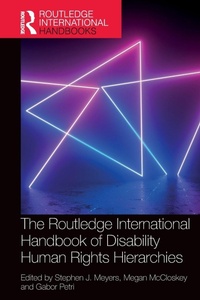
The Routledge International Handbook of Disability Human Rights Hierarchies
1st Edition
Published on 29. September 2025
Book
Paperback/Softback
648 pages
978-1-032-53084-0 (ISBN)
Description
Disability is defined by hierarchy. Regardless of culture or context, persons with disabilities are almost always pushed to the bottom of the social hierarchy.
With the advent of the Convention on the Rights of Persons with Disabilities (2006), disability human rights seemingly provided a path forward for tearing down ableist social hierarchies and ensuring that all persons with disabilities everywhere were treated equally. Despite important progress, the disability human rights project not only remains incomplete, but has often created new hierarchies among persons with disabilities themselves or across the human rights it promotes. Certain groups of persons with disabilities have gained new voices while others remain silenced and certain rights are prioritized over others depending on what states, international organizations, or advocates want rather than what those on the ground need most.
This volume was inspired both by the continued need to expose human rights violations against persons with disabilities, but to also explore the nuanced role that hierarchies play in the spread, implementation, and protection of disability human rights. The enjoyment of human rights is not equal nor is the recognition of specific individuals and groups' rights. In order to change this situation, inequalities across the disability human rights movement must be explored.
Divided into five parts:
Who counts as disabled?
Political, social, and cultural context
Which rights on top, whose rights on bottom?
Pushed to the periphery in the disability rights movement
Representations of disability
and comprised of 34 newly-written chapters including case-studies from the Anglophone Caribbean, Bangladesh, Bosnia-Herzegovina, China, Ghana, Haiti, Hungary, India, Israel, Kenya, Latin America, Poland, Russia, Scotland, Serbia and South Africa, and other countries, this book will be of interest to all scholars and students of disability studies, sociology, human rights law and social policy.
With the advent of the Convention on the Rights of Persons with Disabilities (2006), disability human rights seemingly provided a path forward for tearing down ableist social hierarchies and ensuring that all persons with disabilities everywhere were treated equally. Despite important progress, the disability human rights project not only remains incomplete, but has often created new hierarchies among persons with disabilities themselves or across the human rights it promotes. Certain groups of persons with disabilities have gained new voices while others remain silenced and certain rights are prioritized over others depending on what states, international organizations, or advocates want rather than what those on the ground need most.
This volume was inspired both by the continued need to expose human rights violations against persons with disabilities, but to also explore the nuanced role that hierarchies play in the spread, implementation, and protection of disability human rights. The enjoyment of human rights is not equal nor is the recognition of specific individuals and groups' rights. In order to change this situation, inequalities across the disability human rights movement must be explored.
Divided into five parts:
Who counts as disabled?
Political, social, and cultural context
Which rights on top, whose rights on bottom?
Pushed to the periphery in the disability rights movement
Representations of disability
and comprised of 34 newly-written chapters including case-studies from the Anglophone Caribbean, Bangladesh, Bosnia-Herzegovina, China, Ghana, Haiti, Hungary, India, Israel, Kenya, Latin America, Poland, Russia, Scotland, Serbia and South Africa, and other countries, this book will be of interest to all scholars and students of disability studies, sociology, human rights law and social policy.
More details
Series
Language
English
Place of publication
London
United Kingdom
Publishing group
Taylor & Francis Ltd
Target group
College/higher education
Postgraduate
Illustrations
21 s/w Photographien bzw. Rasterbilder, 3 s/w Zeichnungen, 8 s/w Tabellen, 24 s/w Abbildungen
8 Tables, black and white; 3 Line drawings, black and white; 21 Halftones, black and white; 24 Illustrations, black and white
Dimensions
Height: 234 mm
Width: 156 mm
Thickness: 36 mm
Weight
1007 gr
ISBN-13
978-1-032-53084-0 (9781032530840)
Copyright in bibliographic data and cover images is held by Nielsen Book Services Limited or by the publishers or by their respective licensors: all rights reserved.
Schweitzer Classification
Other editions
Additional editions
Stephen Meyers | Megan McCloskey | Gabor Petri
The Routledge International Handbook of Disability Human Rights Hierarchies
Book
11/2023
1st Edition
Routledge
€302.30
Shipment within 10-20 days
Stephen Meyers | Megan McCloskey | Gabor Petri
The Routledge International Handbook of Disability Human Rights Hierarchies
E-Book
10/2023
1st Edition
Routledge
€67.49
Available for download
Stephen Meyers | Megan McCloskey | Gabor Petri
The Routledge International Handbook of Disability Human Rights Hierarchies
E-Book
10/2023
1st Edition
Routledge
€67.49
Available for download
Persons
Stephen J. Meyers is Director of the Center for Global Studies, at the University of Washington, Seattle, USA. He is the author of Civilizing Disability Society: The UN Disability Convention socializing grassroots disabled persons organizations in Nicaragua. Cambridge University Press, 2019.
Megan McCloskey is Senior Fellow, Disability Inclusive Development Initiative, International Policy Institute, Henry M. Jackson School of International Studies at the University of Washington, Seattle, USA.
Gabor Petri is postdoctoral researcher at the Democracy Institute, Central European University, Budapest and Honorary Lecturer at the Tizard Centre at the University of Kent, Canterbury, UK.
Megan McCloskey is Senior Fellow, Disability Inclusive Development Initiative, International Policy Institute, Henry M. Jackson School of International Studies at the University of Washington, Seattle, USA.
Gabor Petri is postdoctoral researcher at the Democracy Institute, Central European University, Budapest and Honorary Lecturer at the Tizard Centre at the University of Kent, Canterbury, UK.
Content
0.Introduction. Part One - Who counts as disabled? 1.Knowing about Human Rights Situation of Burn Survivors Women of Bangladesh. 2.Creating a STORM: Working together to fight stigma and stand up for the rights of people with learning disabilities. 3.Rethinking the capacities of disabled children from the perspective of new materialism. 4.A Journey to Realize Autistic's Right. 5."To tremble, else break": Dismanlting Normative Hierarchies of Chronic Lyme. 6.The Balancing Act: Disability at the intersection of minority ethnicity. 7.Mental health service users claiming their right to self-advocacy: The journey of "Autoekprosopsi". 8.Developing cultural capacity with people who have profound intellectual disabilities. 9.Fighting for the rights of the non-speaking: Typing words to be heard. Part Two - Political, social, and cultural context. 10.Exploring the now and the prospects of the Disability rights movement in Latin America. 11.On the margins while in the midst of conflict - Adults with intellectual disabilities in Northern Ireland and Bosnia Herzegovina. 12.Personal assistance services in Poland during the period of higher education: Paving the way for independent living. 13.Theories of social dominance in group-based hierarchies: Reflections from the United Nations Partnership on the Rights of Persons with Disabilities (UNPRPD) project in Uruguay. 14.Intellectual Disability and Sexuality in Ultra-Orthodox Jewish Communities. 15.On the Hierarchy of Human Rights of Persons with Disabilities and Higher Education: Capturing the fulfilment of the right to accessibility in Indonesia. 16.Violence against women and girls with disabilities in residential institutions in Serbia. 17.Disability and Displacement: Disability Hierarchy Among Refugees and Other Displaced People. 18.Hierarchy, education and persons with disabilities in Anglophone Caribbean. Part Three - Which rights on top, whose rights on bottom? 19.Hierarchies of impairment and digital disability rights. 20.Communication rights moderated through hierarchies of disability and childhood. 21.Including the voices of persons with intellectual disabilities in academia: Participatory research, education and development in the academic world. 22.Exploring intersectional and ethical feminist perspectives as a possible framework for understanding violence against women with disabilities in Africa with specific reference to forced sterilisation. 23.Inclusive Education through a Neoliberal lens: The hierarchal differences between rural and urban China. Part Four - Pushed to the periphery in the disability rights movement. 24.Excluded from disability rights debate: the missed voices of people with speech impairments. 25.Hierarchies of Leadership Within Disability Justice Movements: The Voices of individuals with intellectual disabilities are often left unheard. 26.Zhenshchiny. Invalidnost'. Feminizm/Women. Disability . Feminism: Claiming Ourselves Against Ableism. 27.Two sides of the same coin: Domination of the views of the educated in organisations of the blind in Ghana. 28.Between the Disability Movement and the Feminist Movement - Intersectional Mobilizations of Women with Disabilities in Haiti. Part Five - Representations of Disability. 29.Reflections of Misperceptions. 30.Pirate Island. 31.Disability or Vulnerability: How Courts Distinguish between Physical and Psychosocial Disabilities in an Employment Context. 32.Rooted in Rights - "Women with Disabilities in India and Kenya". 33.Conversation Across Continents on Hierarchies, Human Security and Covid-19. 34.An Invitation to Contemplate: Dialogues about disability hierarchies between South Africa and Scotland. 35.Countering Disability Hierarchy with Cross Disability Solidarity. 36.Intersecting identities.