

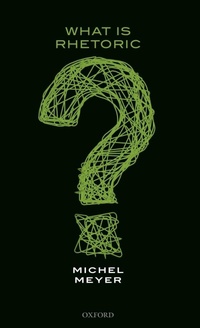
What is Rhetoric?
Published on 10. August 2017
Book
Hardback
268 pages
978-0-19-969182-1 (ISBN)
Description
This book offers a new approach to the principles and functioning of rhetoric. In everyday life, we often debate issues or simply discuss questions. Rhetoric is the way in which we answer questions in an interpersonal context, when we want to have an effect on those with whom we are communicating. They can be convinced or charmed, persuaded or influenced, and the language used can range from reasoning to the sharing of narratives, literary or otherwise. What is Rhetoric? provides a breakthrough in the field, offering a systematic and unified view of the topic. The book combines the social aspects of rhetoric, such as the negotiation of distance between speakers, with the theory of emotions. All the principal authors from Plato and Aristotle to contemporary theorists are integrated into Michel Meyer's 'problematological' conception of rhetoric, based on the primacy of questioning and answering in language and thought.
More details
Language
English
Place of publication
Oxford
United Kingdom
Target group
College/higher education
Professional and scholarly
Dimensions
Height: 222 mm
Width: 145 mm
Thickness: 18 mm
Weight
472 gr
ISBN-13
978-0-19-969182-1 (9780199691821)
Copyright in bibliographic data and cover images is held by Nielsen Book Services Limited or by the publishers or by their respective licensors: all rights reserved.
Schweitzer Classification
Other editions
Additional editions
Person
Michel Meyer is Perelman Professor of Rhetoric and Argumentation at the Universite Libre de Bruxelles, having previously taught at Berkeley, McGill University, the Sorbonne, and the College de France. He is the chief editor of the Revue Internationale de Philosophie and editor of the book series L'Interrogation Philosophique at the Presses Universitaires de France. His publications in English include Of Problematology (University of Chicago Press, 1995), and Philosophy and the Passions (Penn State University Press, 1999). He is the co-editor, with Jas Elsner, of Art and Rhetoric in Roman Culture (CUP, 2014). He is the founder of a philosophy called problematology, based on the priority of questioning in thought. The main works of this radical new foundation of thought have been translated into a dozen languages.
Content
Introduction
1: The basic features of the history of rhetoric
2: The question-view of logos
3: Rhetoric and argumentation: the unity of the field
4: The common operators in figures and arguments
5: The argumentative structures
6: The elements of rhetoric istricto sensu: the figures of speech
7: The foundations of literary rhetoric
8: The rhetoric of the arts
9: The role of ethos: the voice of values
10: The role of pathos: from argumentative responses to feelings and emotions
11: The negotiation of distance or the embodiment of the interpersonal
Conclusion
Glossary
1: The basic features of the history of rhetoric
2: The question-view of logos
3: Rhetoric and argumentation: the unity of the field
4: The common operators in figures and arguments
5: The argumentative structures
6: The elements of rhetoric istricto sensu: the figures of speech
7: The foundations of literary rhetoric
8: The rhetoric of the arts
9: The role of ethos: the voice of values
10: The role of pathos: from argumentative responses to feelings and emotions
11: The negotiation of distance or the embodiment of the interpersonal
Conclusion
Glossary